WASHINGTON, DC, December 26, 2008 (ENS) - The national trade association of
America's wind industry says in 2008 the industry had another record growth
year - the third record year in a row and generated more than $18 billion in
revenues.
This year, the United States passed Germany to become the world leader in
wind generation, said the American Wind Energy Association in its year-end
report.
AWEA says that this summer, the U.S. wind industry reached the
20,000-megawatt installed capacity milestone, doubling installed wind power
generating capacity since 2006.
By the end of September, the U.S. had over 21,000 megawatts of wind capacity
up and running. Germany had 22,300 megawatts, but U.S. windpower developers
sprinted to the end of the year while German wind development slowed.
"With additional projects coming on line every week since, the wind industry
is on its way to charting another record-shattering year of growth," AWEA
said in its report.
That 21,000 megawatts of capacity are expected to generate over 60 billion
kilowatt hours of electricity in 2009, enough to serve over 5.5 million
American homes.
This means that in 2009 wind power is estimated to displace the burning of
30.4 million short tons of coal - enough to fill a coal train that would
stretch 2,000 miles, from Washington, DC to the middle of Utah.
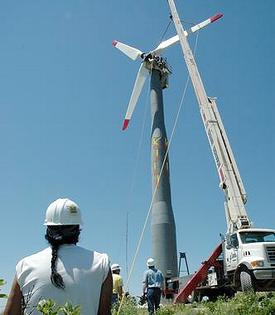 Workers attach the blades of a refurbished wind turbine that will be used to power the KILI radio station at the Pine Ridge Reservation in South Dakota. (Photo by Bob Gough courtesy Native American Wind Interest Group) |
AWEA calculates the 60 billion kilowatt hours of electricity generated by
wind power next year will displace 91 million barrels of oil, or 560 billion
cubic feet of natural gas - about nine percent of the natural gas used for
electricity generation in the United States.
In October, as part of the $700 billion financial bailout law, the
production and investment tax credits that benefit the wind industry and
other renewable energy industries were approved by Congress and signed into
law. The tax credit package will extend the renewable energy production tax
credit for one year and the investment tax credit for eight years.
In May, the U.S. Department of Energy reported that wind power could provide
20 percent of U.S. electricity by 2030, supporting 500,000 jobs and reducing
greenhouse gas emissions as much as taking 140 million vehicles off the
road, and saving four trillion gallons of water.
"Wind energy installations are well ahead of the curve for contributing 20
percent of the U.S. electric power supply by 2030 as envisioned by the U.S.
Department of Energy," said outgoing AWEA Executive Director Randall
Swisher, who has held the post for the past 19 years.
On January 2, 2009, he will be replaced by Denise Bode, who is currently CEO
of the American Clean Skies Foundation, an advocate for energy produced from
natural gas based in Washington, DC.
Bode served for nine years on the Oklahoma Corporation Commission and for
seven years as president of the Independent Petroleum Association of
America.
"Denise Bode is an extremely dynamic and well-respected leader on energy
issues in Washington, D.C.," said Swisher, "and brings a wealth of knowledge
and experience to AWEA. We are very fortunate to have such a talented and
able individual available to lead the association at a time when renewable
energy stands on the threshold of dramatically expanding its contribution to
America's energy supply."
"I am thrilled by my new opportunity of working with the AWEA team to grow
wind power in the U.S.," Bode said. "I am particularly proud of the role I
played as Oklahoma Corporation Commissioner to bring commercial wind power
to Oklahoma."
In 2008, the wind industry and environmental groups forged a new
partnership. In November, 20 conservation and environmental groups and wind
energy companies announced the creation of the American Wind Wildlife
Institute to facilitate timely and responsible development of wind energy
while protecting wildlife and wildlife habitat.
AWWI intends to serve as an example for other energy sectors by proactively
addressing potential biodiversity impacts as wind energy is more widely
deployed.
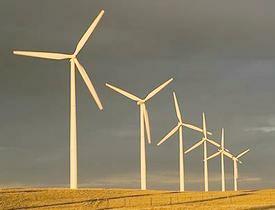 Rows of turbines at sunrise on the prairies at Ponnequin Wind Facility, Weld County, Colorado (Photo by Jenny Hager Photography courtesy NREL) |
"Climate and energy are the issues of our time," said Julia Levin, global
warming director at the National Audubon Society and the first chair of
AWWI's board of directors. "AWWI will play a crucial role in developing the
science, mapping and other tools needed to accelerate properly sited wind
power development and begin reducing U.S. greenhouse gas emissions."
"Addressing global climate change demands a higher level of collaboration
between different sectors and interests," said Jan Blittersdorf, CEO of NRG
Systems and AWWI vice chair. "Development of clean, renewable wind energy
and wildlife protection need not be mutually exclusive goals. It's my
pleasure to work with industry and nonprofit leaders to make this vision a
reality."
The seven nonprofit founding organizations of AWWI represent more than 4.3
million members nationwide. These groups include: Association of Fish &
Wildlife Agencies, Environmental Defense Fund, National Audubon Society,
Natural Resources Defense Council, The Nature Conservancy, Sierra Club and
Union of Concerned Scientists.
The remaining 13 founding AWWI members are wind industry businesses. They
include: AES Wind Generation, BP Wind Energy, Babcock & Brown, enXco,
Clipper Windpower, E.ON, GE Energy, Horizon Wind Energy, Iberdrola Renewable
Energies USA, Nordic Windpower, NRG Systems, Renewable Energy Systems
Americas and Vestas Americas.
"The expansion of wind power in the United States is essential to reduce
heat-trapping emissions and limit the impacts of global warming on our
nation's wildlife," said Dr. Peter Frumhoff, AWWI board member and director
of science and policy at the Union of Concerned Scientists. "Our new
institute will work to ensure that wind power and wildlife can both thrive."
Copyright Environment News Service (ENS) 2008. All rights
reserved.