Child Mortality Rates Continue Dramatic Fall
 Child Mortalityby Hannah Doherty | September 3, 2008
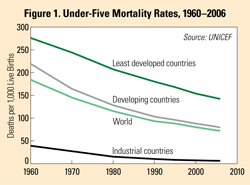
In 2006, the latest year with data available, the world's child
mortality rate-the number of children who die before the age of
five per 1,000 live births-dropped to 72, a 20-percent decline
since 1990, when 93 children died for every 1,000 live births.1
(See Figure 1.) For the first time since recordkeeping began in
1960, child mortality fell below 10 million, to 9.7 million, which
was less than half the number who died before reaching five in
1960.2
This welcome achievement, however, still leaves most developing
countries well short of the pace needed to meet the United Nations
Millennium Development Goal (MDG) of reducing under-five child
mortality by two thirds between 1990 and 2015. And despite the
steady decline in global under-five deaths, disparities between
and within regions continue to grow.
Under-five mortality decreases as per capita income increases.3 In the poorest households in developing countries, 107 children under the age of five die for every 1,000 live births.4 This is nearly 40 percent higher than in the richest households in those nations, where the rate is 67 deaths for every 1,000 live births.5 The disparity is even greater when compared with the rate in industrial nations-6 deaths per 1,000 live births.6 For the average child living in rural areas and isolated from basic health services and adequate sanitation, the under-five mortality rate is 105-far greater than in urban areas, where the rate is 69 deaths per 1,000 live births.7 East Asia and the Pacific, Central and Eastern Europe, and Latin America and the Caribbean have reduced child mortality rates by half since 1990.8 (See Figure 2.) They are the only regions on track to meet the child mortality MDG.9 In 2006, the mortality rate for each of these regions was below 30 per 1,000 live births.10 A number of countries in Latin America, such as Cuba and Chile, have lowered their child mortality rates by more than 50 percent since 1990 and are more than halfway to cutting them by two thirds.11 Despite these positive trends, the averages mask wide disparities between and within Latin America.12 The mortality rates of Haiti and Bolivia are more than twice the regional average, and indigenous children living in both urban and rural areas in Latin America face a greater risk of dying before their first birthday than non-indigenous children.13 South Asia has shown improvement, reducing its under-five mortality rate from 123 child deaths per 1,000 live births in 1990 to 83 in 2006.14 Even with the improvements, however, in 2006 this region had the second highest number of deaths among children under the age of five-roughly 3.1 million-accounting for 32 percent of the global total.15 Afghanistan, Pakistan, and India account for half the world's undernourished children, despite having just 29 percent of the developing world's under-five population.16 Afghanistan's child mortality rate was 252 for the 2002-05 period, three times South Asia's average rate and the third highest in the world.17 Compared with the regional average of 1 child death for every 12 children, in Afghanistan 1 child dies for every 5 children.18 Sub-Saharan Africa has made the least progress in reducing child mortality rates, with 1 in every 6 children dying before the age of five.19 On average, its under-five mortality rate was 160 deaths for every 1,000 live births in 2006, an improvement from its 1990 rate of 187.20 Some countries in West and Central Africa, however, have made no progress, and some nations actually reported increases in under-five mortality rates, such as Côte d'Ivoire.21 Only 22 percent of the world's children are born in sub-Saharan Africa, yet this region accounts for 49 percent of the world's under-five deaths.22 Lack of safe water and sanitation along with inadequate hygiene are largely responsible for breeding the leading killers of children under five: diarrheal diseases, pneumonia, neonatal disorders, and undernutrition.23 Some 88 percent of diarrheal diseases, the second most common direct cause of under-five deaths, are attributed to poor water management.24 These illnesses take nearly 2 million children a year and account for 17 percent of children deaths.25 Access to adequate health care is also a leading contributor. Pneumonia, the single leading cause of child mortality, kills 2 million children and 1 million infants worldwide each year, accounting for 19 percent of children's deaths and nearly a quarter of neonatal deaths.26 Sadly, only 56 percent of the world's children with pneumonia are taken to appropriate health care providers.27 Life is most vulnerable in the first 28 days of life, when most of the world's child deaths occur, taking 4 million infants each year.28 Collectively, neonatal causes contribute to 37 percent of under-five deaths. The disparity between neonatal deaths in rich and poor nations has been growing.29 Newborns in developing countries are eight times more likely than newborns in industrial countries to die, largely because mothers there receive inadequate or no care during pregnancy, childbirth, and the postpartum period.30 The World Health Organization reports that nearly three quarters of all neonatal deaths could be prevented if women were adequately nourished and received appropriate care.31 Skilled help at birth can prevent the leading causes of newborn deaths-severe infections and asphyxia, which together account for 49 percent of neonatal deaths.32 Undernutrition, the result of insufficient food intake and repeated infectious diseases, decreases a child's resistance to infection and is the underlying cause in up to half of all under-five deaths.33 With 42 percent of South Asia's under-five population underweight, the region has the highest rate of undernutrition worldwide.34 Maternal undernutrition is also a significant contributing factor to child mortality, leading to children who are severely underweight with stunted physical and intellectual growth.35 The low status of women presents serious challenges in reducing child mortality, especially in South Asia and sub-Saharan Africa. In India, for example, girls are up to 50 percent more likely than boys to die between their first and fifth birthdays.36 Exclusion of girls from health care is often most severe in rural areas and in urban slums, where women are largely illiterate and suffer from sociocultural barriers to services, compromising the health of all family members.37 Poverty, race, language, and culture are other factors excluding women and their children from public health services.38 Armed conflicts and AIDS also affect a young child's prospects for survival. More than half of the 11 countries where 20 percent or more of children die before age five suffered a major armed conflict since 1989.39 In the war-torn Democratic Republic of Congo, for example, the child mortality rate was 211 per 1,000 live births in 2000-05.40 AIDS has also destabilized sub-Saharan Africa, leaving 12 million children without parents.41 A motherless child is more likely than an infant with a surviving mother to die before reaching age two.42 And the children themselves are dying of AIDS: sub-Saharan Africa accounts for almost 90 percent of pediatric HIV infections.43 The MDG campaign has encouraged basic health interventions, such as early and exclusive breastfeeding, measles immunization, and Vitamin A supplementation, which have decreased child mortality rates.44 In Latin America, timely measles immunization since 2000 has reached 93 percent of the region's population, nearly eliminating this disease that still kills at least 1 million people a year, 80 percent of whom are children under the age of five.45 If the MDG is to be reached, annual child mortality must be reduced to fewer than 5 million by 2015.46 Achieving this will rely heavily on accomplishing the other important Millennium Development Goals: reducing poverty and hunger, improving maternal health, increasing the use of cleaner water and sanitation, and providing affordable essential drugs on a sustainable basis.
Purchase this trend
Includes the following charts
and graphs
Notes Worldwatch Institute - 1776 Massachusetts
Avenue, NW, Washington, DC 20036 |