Senate Forges a Compromise Energy Bill
The measure is winning adherents from both sides of the aisle—and upsetting ideologues of both parties
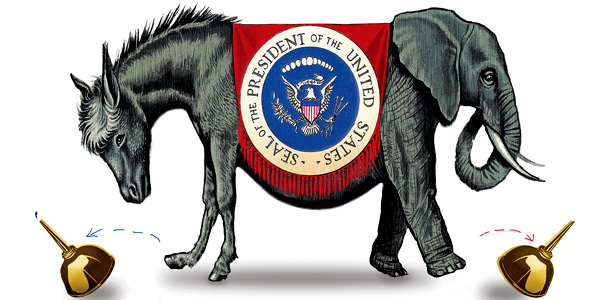
Acme Illustrators
High energy prices have become a bitterly
contested political issue. Republicans are bashing Democrats for standing in
the way of drilling for more oil and gas at home, while Democrats retort
that their rivals are misleading the American public by saying that such
drilling would significantly lower prices. Yet amid the partisan
bomb-throwing over America's future energy policy, Washington is actually
making a rare effort to forge a compromise.
Over the summer a group of five GOP and five Democratic senators, dubbed the
Gang of 10, hammered out a comprehensive energy proposal. And now, after
taking withering heat from both left and right, the idea is gaining support.
Three more senators from each party have officially signed on, and the
proposal is expected to come up for a vote in the Senate when Congress
returns from the current recess. "We've seen the tide gradually turn," says
Senator Saxby Chambliss (R-Ga.), who began the effort with a visit in June
to Senate colleague Kent Conrad (D-N.D.). "Thank goodness there are some
people willing to work across the aisle."
The proposal contains some items on the Republican wish list, such as
opening areas of the Outer Continental Shelf to drilling and boosting
nuclear power. The Democrats get incentives for wind, solar, and other
renewables along with energy efficiency measures—and pay for much of the
projected $84 billion cost by eliminating tax breaks on the oil and gas
industry. "Some environmentalists have serious problems with it, but it's
actually a pretty good deal," says Joseph J. Romm, senior fellow at the
Center for American Progress, a Democratic think tank, and a top Energy
Dept. official in the Clinton Administration.
As the compromise gains momentum, it is creating dilemmas for both parties.
There are plenty of reasons to be against it. For one, John McCain's choice
for running mate, Alaska Governor Sarah Palin, is a strong advocate of
opening up new areas like the Arctic National Wildlife Refuge to the oil and
gas industry. Polls also show that Republicans are getting a major boost by
blaming Democrats for blocking increases in oil and gas supplies, so why
would they give up their best campaign issue? "One man knows we must now
drill more in America and rescue our family budgets:…McCain," says one ad
for the GOP Presidential candidate, which accuses Democratic rival Barack
Obama of standing in the way.
A compromise with the Democrats would "cut the knees off of Senator McCain,"
Rush Limbaugh recently charged on his radio show. In addition, oil and gas
companies are leaning heavily on their GOP friends to oppose the plan.
"Opening up a very, very minor area [to drilling] and punishing the industry
while doing it makes absolutely no sense," says Charles T. Drevna, president
of the National Petrochemical & Refiners Assn. For their part, Democrats
fear losing support among core constituents if they vote to drill.
On the other hand, members of Congress got an
earful during the August recess from voters who want action now. "People are
increasingly weary of this endless toxic partisanship. They are hungry for
results," says North Dakota's Conrad. And it's not just voters who are
frustrated. "The business community has finally come to the point where we
think there is blame all around," says Jack N. Gerard, president of the
American Chemistry Council, which represents the chemical industry. "There's
way too much politics and not enough policy."
Chemical companies are upset that Congress hasn't done anything to increase
supplies of natural gas, the industry's feedstock. Wind and solar companies
warn that failure to renew their tax credits will devastate their
industries. Meanwhile, the narrow escape from Hurricane Gustav, which
slammed into the Gulf Coast on Sept. 1, is yet another reminder of the
nation's energy vulnerability. With 20% of the country's oil production
capacity in the Gulf of Mexico, a catastrophic storm would ratchet up the
already sharp pain in Americans' pocketbooks.
This delicate political calculus is forcing some in Washington toward
compromise. House Speaker Nancy Pelosi (D-Calif.) has agreed to hold a vote
on drilling. In early August, Senator John E. Sununu (R-N.H.) won praise
from conservatives for not joining the Gang of 10's plan. But he's in a
tight race, and New Hampshire has been hit hard by high energy prices. On
Aug. 26, Sununu signed on.
Uphill Battle
If the plan does come up for a vote in the Senate, it will be a key test for
both Presidential contenders, forcing them to go on record on a major issue.
McCain has yet to get behind the compromise. Lead economics adviser Douglas
J. Holtz-Eakin explains that while McCain supports the notion of a
bipartisan approach, he doesn't like the repeal of tax breaks for the oil
and gas industry. "Senator McCain believes we don't need to be raising
taxes," he says.
In contrast, Obama supports the basic framework, along with the general idea
of bipartisan compromise. "If I had to reduce the McCain energy platform to
a single word, it would be 'drill,' while ours would be 'diversity,'"
explains Jason Grumet, Obama's senior adviser on energy. "It's the
difference between serious energy policy and slogans."
The proposal still faces an uphill battle. "Both the Left and the Right are
quite unhappy with what we came up with," says Conrad. "It's kind of sad
that offering solutions to a serious challenge facing the country is seen as
being disloyal to one's own party." Even if the political stars do begin to
align, Congress doesn't have much time to broker the deal before the
Presidential election, and the Bush Administration vows to veto anything
that it believes is a tax increase. Meanwhile, falling oil prices could
lessen the urgency of the issue for lawmakers. But Washington insiders say
real progress has been made toward a compromise that breaks the gridlock on
energy. "Whether it happens in this Congress or the next one, it is clear we
are close to getting something done," says Gerard.
With Jane Sasseen.
Carey is a senior correspondent for BusinessWeek in Washington.
