Date: 07-Apr-09
Country: GERMANY
Author: Gerard Wynn
Carbon Cap Deal
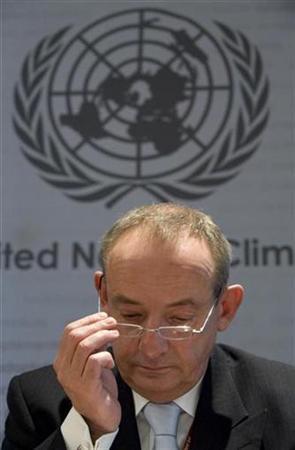
Yvo de
Boer, Executive Secretary of the United Nations Framework Convention on
Climate Change (UNFCCC) adjusts his glasses during a news conference in Bonn
November 17, 2008.
Photo: Wolfgang Rattay
BONN - It will be hard work getting rich nations to agree cuts in greenhouse
gases that are deep enough to satisfy the demands of developing countries at
climate talks, UN's climate chief told Reuters on Monday.
Some 175 nations are meeting this week in Bonn in one of a series of UN-led
meetings meant to forge a deal in Copenhagen in December to replace or
extend the Kyoto Protocol.
The talks are split on the level of action which industrialised countries
take to curb their greenhouse gas emissions by 2020. More ambitious goals
would unlock action from developing nations.
Asked whether he ruled out agreement on the most commonly referenced range
of emissions cuts, Yvo de Boer said:
"I'm not ruling it out but I'm saying it would be very difficult. If you
look at the offers that are on the table at the moment they're a long way
from that range."
The Intergovernmental Panel on Climate Change (IPCC) in 2007 matched global
temperature increases with different cuts in greenhouse gas emissions.
They said that a cut by rich countries of 25-40 percent below 1990 levels by
2020, and substantial action by developing nations, could limit temperature
rises to about 3.6 Fahrenheit (2 degrees Celsius), viewed by some
governments as a threshold for dangerous change.
Only European Union proposals have come close to that, to cut greenhouse gas
emissions by 30 percent in the event of tough action by others. US President
Barack Obama pledged in his election campaign to return US emissions to 1990
levels.
"That's quite a long way from minus 25 let alone minus 40," de Boer said of
the Obama target.
GAP
The gap has even grown in Bonn, after some developing nations last week
urged cuts at the top end of the range.
China and India said rich countries should cut greenhouse gases by at least
40 percent by 2020. An alliance of 43 island states, backed by more than a
dozen nations in Africa and Latin America, urged developed countries to cut
by at least 45 percent.
That is far deeper than proposals averaged across the group of developed
countries of 4-14 percent below 1990 levels, according to calculations by
Greenpeace published on Monday.
Environment and development groups are urging the Bonn talks to swifter
action, saying unabated climate change will cause human suffering far worse
than the present financial crisis.
One way to bridge the gap between proposed and recommended action may be for
rich countries to pay for emissions cuts in developing countries -- a
cheaper option than cuts at home.
Democrats last week proposed a US climate bill with a stiffer carbon cut
than Obama's campaign pledge.
The bill would also raise money to curb tropical deforestation and so make
additional cuts equal to one tenth of US greenhouse gases, according to a
spokesman for the Union of Concerned Scientists.
"It's a work in progress, the Obama campaign pledge is not necessarily the
final answer," said Alden Meyer.
(Reporting by Gerard Wynn, Editing by Jon Boyle)
© Thomson Reuters 2009 All rights reserved