Gulf oil spill: Greed didn't trump safety, says Deepwater Horizon panel
The presidential commission investigating the April 20 explosion of the Deepwater Horizon oil rig in the Gulf of Mexico cited a misread test as one likely cause of the disaster.
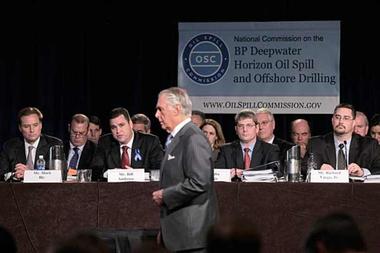
Chief counsel Fred Bartlit, of the National Commission on the BP Deepwater Horizon Oil Spill and Offshore Drilling, speaks with a panel of representatives from BP, Transocean, and Halliburton during the panel's public hearing in Washington on Nov. 8.
J. Scott Applewhite/AP
Crewmen and company officials overseeing the Deepwater Horizon oil drilling operation in April misinterpreted a critical "negative pressure" test on the well. They thought it was a success – it was actually a failure. If recognized, it would have revealed the imminent danger of a blowout, reported the chief investigator of the presidential commission looking into the disaster.
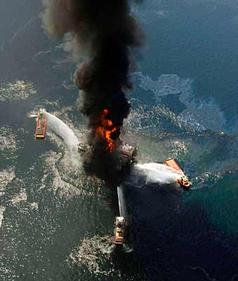
The blowout of the Macondo well that killed 11 men and wreaked environmental havoc on the Gulf also hinged on the failure of the cementing of the well. That critical process was to have prevented gases from flowing up and around the drill well casing, said Fred Bartlit, chief counsel for the commission.
But there is no evidence so far to suggest that there was a conscious decision to sacrifice safety to save money, he said. Instead, the preliminary conclusion on the cause of the disaster cites a litany of problems, including:
- The volatile gas that reached the surface and exploded flowed exclusively through a device at the bottom of the well called a "shoe track" and from there on "up through the casing."
- The cement injected into the well to block the passage of gas was potentially contaminated or displaced by other materials in the shoe track and failed to isolate the high-pressure oil and gas from coming up the well.
- Pre-job laboratory tests of the cement mixture should have prompted a redesign of the cement slurry, as was previously reported. Haliburton last week said investigators' methods used to reproduce the results of the company’s earlier cement tests produce inaccurate results.
- Later, cement evaluation tools might have been used to identify cementing failures, but most operators (including BP) would not have run tools at that time. Instead, they would have relied on a "negative pressure test" – the results of which were completely misinterpreted.
A negative pressure test is considered the last critical step before a drill rig places a final cement plug, pulls up its blowout preventer, and moves on. For that test, the drill crew first had to remove the downward pressure of heavy mud being exerted by the rig on the well. This had to be done to determine whether cement at the bottom of the well was holding back oil and gas – or whether it was being bypassed by those hydrocarbons. If gas was bypassing the cement, it could cause the well to "kick" – allowing a blast of explosive gas to rocket to the surface.
The crew repeatedly tested and consistently found that the well had 1,400 pounds per square inch pushing back up the well – when there should have been none. This showed oil and gas were bypassing the cement and pushing surfaceward. In the end, however, pressure readings from alternate lines and a debate over the results led the crew to consider the pressure reading from the well to be unreliable and the result of an inexplicable phenomenon dubbed the "bladder effect."
That effect was, however, something that nobody in the industry has come forward to confirm, the investigators said.
In the end, the negative pressure test results were deemed a success. Yet experts on all sides who reviewed data sent back to onshore facilities now say they clearly were not.
"Why would these men not have realized that this was a bad negative pressure test?" asked Sam Sankar, deputy chief counsel of the National Commission on the BP Deepwater Horizon Oil Spill and Offshore Drilling. "Nobody in industry or in government had set forth any procedures governing what the negative pressure test is, how to conduct it, or how to interpret it."
After the negative pressure test “success,” BP took the next steps toward "temporary abandonment" – a process that investigators said introduced "additional risk." That was because the oil company chose to set the final concrete "temporary abandonment plug" of cement at 3,000 feet below the ocean floor – instead of 300 feet, as originally planned. That unusual step required removing a far larger amount of drilling mud from the well – the weight of which was holding down the well’s oil and gas. That reduced the pressure holding back the gas, a risk not anticipated because the negative pressure test had earlier been deemed a success.
Added to those factors was the high number of activities going on about the rig at the time of the critical test and afterward. For crewmen watching flow monitoring equipment, such distractions would have made subtle instrument readings and detection of a well "kick" – the unexpected emergence of volatile gas – more difficult, investigators said.
Even so, logs show that pressure in the well was rising, a sure sign that a kick was happening. If it had been observed, it would have allowed the rig crew to respond, investigators said.
Once the rig crew recognized the influx of gas, several options were open to them that might have prevented or delayed the explosion. They could have "shut in" the well by triggering the 400-ton blowout preventer (BOP) device sitting on the ocean floor. Or, they could have diverted the gas and drilling mud overboard, thereby preventing, delaying, or limiting the impact of the explosion, investigators found.
Charges that a failed BOP was at fault must await results of a forensic examination, said Mr. Bartlit.
He cast doubt on the idea that premeditated efforts to cut costs were a primary cause of the disaster.
"As we stand here today, and we've asked everybody, we don't see a man or two men or a group of men who are making one of these decisions and they had it in their minds if we do it this way, it will be safer, if do it this way it will be cheaper, we'll do it the cheap way instead of the safe way," Bartlit said. "We haven't seen that."
While acknowledging that the Deepwater Horizon's $1.5 million-a day-operating cost was "overhanging" the heads of those on the rig, Bartlit said the research showed "a complex matrix" for decisionmaking by crew that included efficiency. But at the same time, "they don't want their buddies to be killed or themselves," he said.
"I don't believe people sit there and say, 'This is dangerous, but the guys in London will make more money,' " Bartlit said. "We don't' see a concrete situation where human beings made a tradeoff of safety for dollars."
© The Christian Science Monitor. All Rights Reserved. To subscribe or visit go to: http://www.csmonitor.com