An Electromagnetic Pulse Attack would Shut Down the Power Grid, Stall Your Car, and Knock Out our Nation's DefensesEMP attacks don't kill people and animals directly, but indirectly they could kill up to 90% of humanity. If you think you don't need this protection, get the book: ONE SECOND AFTER |
| – by James
Roberts - SecretsofSurvival.com –
Imagine that you're sitting in your house like you are now (surfing on the computer). Then, suddenly, you hear an explosion overhead. You look outside. A strange cloud has formed in the sky. And then your computer starts acting up like it never has before. Perhaps you try your cell phone with the same result. What your electronic devices are experiencing is the after effects of something called Electromagnetic pulse (EMP). In sum, EMP refers to the electromagnetic radiation that can be caused from an explosion (in the aforementioned example, a nuclear explosion) or a widely fluctuating magnetic field. In the case of a nuclear attack, the scenario typically involves the detonation of a nuclear device miles above the area designed to be damaged. The possible result? Electronic systems may couple with these dangerous electric and magnetic fields resulting in damaging current and voltage surges. Further, depending on the power and trajectory of the explosion, the spread of the damage could actually reach the entire country (would take near perfect trajectory and a highly powerful weapon). In other words, much of our electronics would be devastated. Thus, so would we. EMP attacks: The history Concerns regarding EMP attacks did not sprout up recently with the advent of our war on terrorism. Rather, these concerns initially came about during the Cold War. However, once the Cold War was won, well, defense strategists relaxed. Until a few years ago, that is. According to Patrick Chisholm (in an October 2005 article at Military Information Technology), "a 2004 report by a panel of experts warned terrorists or other adversaries could launch an EMP attack without having a high level of sophistication, such as through short-range SCUD missile(s). Also of concern are non-nuclear, small-scale E-bombs that target localized areas." The good thing is that there are ways to defend electronics and/ or the shelters that hold them from EMP attacks (at least to an extent). Further, the fact that our nation was once concerned about such an assault long ago would lead many to believe that our government may have some defense systems to fall back on. Hopefully, that is. The devastation that an EMP attack could deliver In an April 16, 2005 Washington Post article written by Jon Kyle, he noted that at a Senate Judiciary Subcommittee Meeting he chaired the threat of an EMP attack was delved into. In sum, the devastation that such an attack could bring on its target area was looked at very closely during this meeting. How about car damage (actual cars would likely be okay because they are encased in metal, but in order for cars to run they need gas and pumps need electricity), refrigerators on the fritz (immeasurable supplies of food would go bad), water sanitation devices unable to work (dehydration and bacteria infested water), and communication devices going down for starters? And of course the social disorder that would follow would bring even more pain and death. In the end, those that survived, Kyle said, "would find themselves transported back to the United States of the 1880's." Ouch! Educated guesses on how ready the United States is to handle an EMP attack First, it should be noted that this is a difficult question to answer, primarily because too little is known. After all, an EMP attack has never really occurred; thus, we're in somewhat of a theoretical situation here (we know there would be significant damage, but how much is unclear). Further, the United States keeps what military systems are ready for an EMP attack classified. That said, we certainly do have some information. First, the EMP that would likely be generated from nuclear or E-bombs would probably pass through the protection normal consumers have against other electromagnetic interference and power surges (EMI). Thus, such contraptions wouldn't offer much help. That said, the good news is that the military is probably far more ready to take on EMP than normal consumers. As Daryl Gerke and William Kimmel, principals at Kimmel Gerke Associates, an EMC consulting and training firm said in Interference Technology Magazine: "Military equipment may be subjected to very high levels of RF energy (radar and radio transmitters), lightning and nuclear EMP effects. MIL-STD-461E, the key military EMC specification, addresses these multiple environments through a matrix of recommended requirements. For example, an electronic device used in a submarine will have different requirements than a device used in a helicopter." So that's good to hear. But what about us and society at large? What can your everyday civilian do to protect themselves against the possibility of an EMT attack? 1. Have a lot of battery operated devices on hand and the batteries to use them. Further, these appliances should have cords and antennas 30 inches or less in length. The reason for this is simple: Metal pulls in EMP and makes it more dangerous. Thus, less metal is good. Further, keep these appliances away from metal. 2. Stay 8 feet from large scale metal fixtures yourself. In fact, when EMP is concentrated by metal it can actually be dangerous to man in and of itself. 3. Harden your equipment (another way of saying, protect it from EMP). Some considerations include the use of tree formation circuits (not standard loop formations), induction shielding around components, self-contained battery packs, loop antennas, and Zener diodes. In addition, grounding wires for each separate instrument into a system could help as well. 4. A new device called the Ovonic Threshold Device (Energy Conversion Devices of Troy, MI) is a solid state switch that opens a path to ground when a massive surge of EMP is encountered by a circuit. This would help in a big way. 5. Use a Faraday Box to store equipment in. Makeshift Faraday boxes can be made from metal filing cabinets, ammunition containers, and cake boxes. That said, the device you are protecting must not touch the metal container (use insulation: paper, cardboard, whatever). Further, there can be no holes. Last, if the box seems less than adequate, you may wrap it in aluminum foil for more protection. 6. Wrap your rooms in aluminum foil. Well, it's certainly extreme, but thought it worth mentioning. After you do so, cover it with some type of fake wood, etc. 7. Cars are already a metal box. Thus, most of them would survive. That said, gas would be a problem. So have a lot of that and food on hand (remember that refrigerators and water sanitizing devices would go out). In the end, we don't know when or how disaster may strike. What we do know is that we need to be ready. And since an EMP attack is a stated possibility that could wreak tremendous havoc. . . We need to be ready for that as well. See you next time at SecretsofSurvival.com. REFERENCES: Iran military journal eyes nuclear EMP attack on U.S |
| Protect our electronics
against EMP attack
The saturation of society with modern electronics, while certainly a good thing overall, gives us an Achilles' heel. The more dependent we become on such electronics, the more vulnerable we are to societal chaos if a substantial portion of them fail simultaneously. It is said that an electromagnetic pulse, or EMP, could cause such a failure. An EMP is generated by a nuclear explosion, or by a smaller-scale "e-bomb." If a terrorist or rogue nation detonated a nuclear bomb a few hundred miles above the United States, the resulting shock wave could damage or disrupt electronic components throughout the country. The consequences could be catastrophic. Our life-sustaining critical infrastructure such as communications networks, energy networks, and food and water distribution networks could all break down. An EMP was a prominent concern during the cold war with the Soviet Union. That concern is rearing its head again, now that it appears we are headed toward cold wars with Iran, North Korea, and other third-world regimes bent on acquiring nuclear weapons. The possibility of terrorist groups getting a hold of nuclear missiles adds to the danger. Some of the literature on EMPs gives the impression that such an event would fry every computer in the country, that planes would fall out of the sky, and that society would be thrust back into 19th-century technological backwardness. Such claims may be far-fetched, but EMPs are nevertheless a deadly serious issue. Fortunately, protecting electronics and critical infrastructure against an EMP is doable. It involves enclosing every electronic component with a metallic cage that blocks out electromagnetic waves. Sound impossible? Actually, electronic components already enjoy some form of shielding against electromagnetic interference. Federal Communications Commission standards require it. Such shielding is designed to prevent everyday electromagnetic radiation from entering and/or exiting the device. Your computer contains this shielding, from metal housings down to the little metal coverings soldered to your motherboard. There even are housings the size of rooms or buildings that protect sensitive equipment inside. Without electromagnetic shielding, many electronic devices would not work properly. However, most existing shielding may not be enough to protect against an EMP. While U.S. military standards often require electronic components to be protected against an EMP, commercial standards do not. And while our power grid is shielded against things such as lightning strikes, it is not tested for protection against an EMP. Upgrading to shield against an EMP would entail using more robust shielding materials, especially for the cords, cables, and/or wires that connect devices to external entities such as power supplies or networks. Cables and wires act as antennas through which an EMP travels directly into a device. To what extent would an EMP destroy electronics in their current configurations? Certainly not 100%. Not all electronics are connected to cables or wires. And many of those that are connected may only temporarily be disrupted or not be disrupted at all, thanks to the existing shielding against electromagnetic interference. But an EMP that is powerful enough or close enough could ruin many electronic devices such as computers. Unlike what was depicted in the 1983 movie The Day After, automobiles may keep functioning after an EMP attack. The electronics within automobiles enjoy robust shielding because of the harsh electromagnetic environment on existing roadways. Aircraft have even stronger electromagnetic shielding, so they are unlikely to fall out of the sky. "Some of the [aircraft's] equipment may not work, but the propulsion and control system usually is pretty robust," said Dr. William A. Radasky, president of Metatech Corp, a consulting firm specializing in electromagnetic environment analysis. Radasky, one of the world's few experts on protecting electronics against an EMP, thinks that most electronics would undergo only a temporary disruption in the event of an EMP. "You may just have to restart the computer and everything would be fine," said Radasky. But a temporary shutdown of a control system for a critical infrastructure system, he said, would be "troublesome." And if just 1% of all electronics failed, havoc could ensue. "Just think about the power outage in August of '03 when a couple of wires hit a tree," observed Radasky. "That was a single failure, propagated over a huge area. Now imagine, at the speed of light every place in the United States, some portion of electronics failing. Now you have a very widespread problem." The only way to know the extent to which an EMP would knock out electronics is to conduct testing with EMP simulators. Unfortunately, since the end of the cold war, most EMP simulators in the United States have been closed, according to Radasky. And the few that remain open are for military use, not civilian use. The Department of Homeland Security should set up civilian EMP simulators, and encourage — or require — those in charge of our critical infrastructure to upgrade their facilities and conduct tests to assess EMP vulnerability. It would be wise to follow Switzerland's lead. According to Radasky, that country during the cold war hardened some of its critical infrastructure against EMPs, such as water works. "They felt that if there was high-altitude burst over Europe, they were going to be affected whether they were a combatant or not." It is a thorny question as to whether the FCC should revise its standards to require electronics manufacturers to build in EMP protection. This could be prohibitively expensive for the manufacture of individual components. But businesses and government agencies should install EMP protection at the system level. (This also would provide protection against other electromagnetic disturbances such as lightning.) One positive development is the increasing use of fiber optic cables. Most of them do not contain metal, so they are invulnerable to EMP, according to Radasky. The more common they become, the less exposed systems are to an EMP. But the Achilles' heel remains. Our dependence on electronics intensifies as a new era of nuclear cold war draws closer. It behooves us to protect our electronics against an EMP. Copyright 2005 Christian Science Monitor
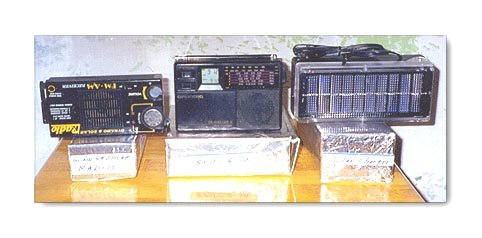
Photograph courtesy of Miles Stair, http://www.endtimesreport.com ) MAKING FARADAY CAGES by Miles Stair http://www.endtimesreport.com/faraday_cages.html The reality of protecting all electronic equipment against EMP from a nuclear explosion over our shores is becoming imminent. We now live in perilous times. The information to follow on building "Faraday cages" is timely indeed. A single atmospheric nuclear detonation releases enough electromagnetic pulse (EMP) to equal 100,000 volts per square centimeter on the ground. A single detonation 200 to 400 miles over the center of the continental United States would fry every unprotected computer chip from coast to coast, and from the middle of Canada to the middle of Mexico. And we are now into Solar Cycle 24, with solar flares common and expected to continue and grow. CME's are capable of extreme damage to modern computerized equipment! Sure, we have our windup BayGen radio's and spare lap top computers, but unless electronic equipment is protected from an electromagnetic pulse, they will be fried! When Einstein and the others first refined and purified uranium, they took time off and studied its properties. That is when they discovered the "rays" that were harmful, as well as the phase transformations. In the course of their work, one of the scientists discovered that simply covering an object with a grounded copper mesh would stop virtually all electromagnetic radiation, whether proton or neutron. Obviously, they had to protect their monitoring equipment! Thus was born the "Faraday cage." The copper mesh, like 1 inch chicken wire, worked well in large uses, like covering buildings, and it is still in use today: FEMA headquarters buildings are dome-shaped earth-bermed structures, and under the earth is a copper mesh that extends out from the base and is secured by grounding rods. As an Electro Magnetic Pulse (EMP) travels to earth, whether from a Coronal Mass Ejection (CME) or a nuclear detonation in the atmosphere, it hits and runs along electrical power lines as well, building up voltage and amperage, which is what happened during the last solar storm a dozen years ago, blowing out transformers and leaving 6 million people in eastern Canada without power for weeks. To prevent that problem, if you have a hard-wired generator, the wiring from the generator to the house should run in conduit that is grounded. The generator itself can have the frame grounded for added insurance, but that ground wire MUST be insulated and run to a different ground rod well away from the ground rod for building and conduit! With radio's and smaller appliances, a Faraday cage can be built by using two cardboard boxes: one should fit tightly inside the other, and the item to be covered should itself fit reasonably well inside the smaller box. That is about the most work involved--finding the right size boxes! The outer box is then covered with aluminum foil or Mylar, as from a cheap "space blanket." A grounding wire is then taped to the foil. I then cover the foil with black 6 mil plastic, taped securely in place, to protect the foil from ripping. At the end of the ground wire I attach a cheap small alligator clip from Radio Shack. The item to be protected is placed inside the inner box, which acts as insulation from the outer box, and any EMP hitting the foil and is bled away by the ground wire. Some medium sized electrical equipment can also easily fit into boxes covered with foil for EMP protection. My laptop computer, for example, fits easily into a Faraday box made from a box that held reams of paper: the entire lid is removable, allowing easy access to the laptop in its case, but is safely stored when not in use. For larger items which cannot be boxed, such as living room TV sets, etc, I tape a Mylar space blanket to a piece of 6 mil black plastic sheet, using double-sticky tape every foot or so to make sure the Mylar stays in place (it is slippery). I leave a 2 inch edge of black plastic showing all around the space blanket, and while taping down the edges I put on a short lead of ground wire. When it appears that EMP or CME's are on the way, the blanket can be draped over the appliance, the alligator clip attached to a small, unobtrusive ground wire behind the cabinet, and any electromagnetic radiation will be diverted to the ground wire. Very cheap, simple, and once done, items can be "draped" for protection very quickly indeed. And the plastic blankets fold up neatly for storage, ready for use when needed. The time to build Faraday cages or blankets is NOW, as when they are actually needed it will be far too late. Each box should be labeled on the ends and the top for the exact appliance they were built for, to eliminate any confusion when they must be protected in a hurry. Any electrical appliances not in use should be stored in the Faraday cage, where they will be kept clean, neat, in a known location, and protected against any sudden EMP surge. ================================================== FROM: http://www.unitedstatesaction.com/emp_and_faraday_cages.htm
Getting Prepared for
an
Electromagnetic Pulse Attack
by Jerry Emanuelson
Futurescience, LLC
The science fiction writer Arthur C. Clarke once said:
Any sufficiently advanced
technology is indistinguishable from magic.
This statement is commonly known as Clarke's Third Law. Many people have heard this quotation, but few people really think about its implications. We now live in a world that is so completely immersed in advanced technology that we depend upon it for our very survival. Most of the actions that we depend upon for our everyday activities -- from flipping a switch to make the lights come on to obtaining all of our food supplies at a nearby supermarket -- are things that any individual from a century ago would consider magic. Very few people in industrialized countries do work that is not directly assisted by electronic computers, although that computerized assistance is often quite invisible to the average person. Few people think about things such as the fact that whenever we buy some food item at a supermarket (and many others are buying the same item), the next time we go to that same supermarket, they still have about the same supplies that they had before. There are invisible infrastructures all around us that are made up of advanced technology. Most of us just take the magic for granted. Few people stop to consider what would happen if, in an instant, the magic went away. If our advanced technology were suddenly and completely destroyed, how would we manage to survive? A nuclear EMP could make the magic go away. I hope it never happens, and I don't think that it is at all inevitable. It makes no sense, however, to be blind to the danger. It is both much less likely to happen -- and also less likely to have a catastrophic impact -- if, both as a civilization and as individuals, we are prepared for an attack on our advanced technology. A nuclear EMP would be a seemingly magical attack upon our advanced technology, the technological infrastructure upon which our lives depend. Among all of the kinds of electromagnetic disturbances that can occur, though, it is important to keep things in perspective. It is possible that a nuclear EMP may never happen where you live. On the other hand, a severe solar storm that will destroy most of the world's power grids appears nearly inevitable at this point. Protection against the damage of a severe solar storm could be done easily and rather inexpensively by the electrical utilities; however it is not being done, and there is no sign that it will be done. A severe solar storm poses little threat to electronics, but would take down the most important power grids in the world for a period of years. This is a special problem in the United States, and is a severe threat in the eastern United States. So, more important than preparing for a nuclear EMP attack is preparing for all of the ramifications of a severe solar storm which would cause an electrical power outage that would, in most areas, last for a period of years. Most standby power systems would continue to function after a severe solar storm, but supplying the standby power systems with adequate fuel, when the main power grids are offline for years, could become a very critical problem. This is a page about some of the things that individuals can do to prepare for an electromagnetic pulse attack. I'm an electronics engineer who has been thinking about the EMP problem for about 3 decades. I even have an ancient Radio Shack TRS-80 Model 4 that has been retrofitted with a complete electromagnetic shield. It's just a personal antique, useless for anything but a personal reminder of how long I've been thinking about this problem. That early-model personal computer didn't even have a hard drive. I've spent much of my career working with radio and television transmitters on high mountaintops where there is a lot of lightning and other kinds of severe electromagnetic transients. Many engineers who spend their careers working in fairly benign electromagnetic environments don't realize the fragility of our technological infrastructure. On this page, I'm going to concentrate on a nuclear EMP attack, but much of this also applies to natural events such as unusual geomagnetic storms due to extremely large solar storms. The threat of a sudden EMP attack that causes a widespread catastrophe is certainly nothing new. Consider this Cold War era quotation from a widely-read and highly-respected publication: "The United States is frequently crossed by picture-taking Cosmos series satellites that orbit at a height of 200 to 450 kilometers above the earth. Just one of these satellites, carrying a few pounds of enriched plutonium instead of a camera, might touch off instant coast-to-coast pandemonium: the U.S. power grid going out, all electrical appliances without a separate power supply (televisions, radios, computers, traffic lights) shutting down, commercial telephone lines going dead, special military channels barely working or quickly going silent." -- from "Nuclear Pulse (III): Playing a Wild Card" by William J. Broad in Science magazine, pages 1248-1251, June 12, 1981. First: Another brief note about severe solar storms (and similar natural events), and then I'll get back to nuclear EMP. Solar storms would primarily affect the power grid, and are not likely to harm things like computers. Also, solar storms would only disrupt communications temporarily, and would not be likely to cause direct harm to communications equipment (except for satellites). An extremely large solar storm, though, could induce geomagnetic currents that would destroy a substantial fraction of the large transformers on the power grid (possibly over much of the world). If this happened, electric power loss due to a large solar storm would be out for a period of years and possibly decades. Unlike nuclear EMP, such a solar storm is an eventual inevitability. The last solar storm that could have caused this level of damage happened in 1859, before the power grid was in place (although in 1921 a large solar storm, of briefer duration than the 1859 event, occurred which affected only a small area of the planet). The power grid has only been in place for a tiny fraction of one percent of human history, and a really large solar storm (of the size and duration of the 1859 event) has not happened in that time. There is a general assumption that any solar event that is similar to, or larger than, the 1859 solar superstorm will simply never happen again, although there is no justification for such an assumption -- in fact, we know that this assumption is false. There is a good possibility that such a solar storm will happen in this century. If it happens in the current situation without spares for our large transformers, a large part of the power grid (including 70 to 100 percent of the United States power grid) will be down for years. A 2008 study by Metatech found that the time required to obtain a replacement for any one of the 370 or so largest transformers in the United States was 3 years. In a solar superstorm that affects vulnerable areas of the entire world, delivery times could easily be much longer. The United States, which has no capability to manufacture those transformers, will be at the end of a very long waiting line. Because of the inevitability of a large solar superstorm, we have to accept the fact that the current electric power grid upon which our lives depend is only a temporary infrastructure. This temporary infrastructure has served us very well, and we now have entrusted our very lives to it. We do not know how long it will last; but if it not replaced by a robust permanent infrastructure in time, hundreds of millions of people will die when the electric power grid collapses simultaneously in many countries. How such a collapse occurs is well known, and the methods to either prevent it, or to have spare transformers in place to fairly quickly repair it, are also well known. Although these preventive measures would not be terribly expensive, they would take some time to put into place, and those things have never been done. Provisions for insuring islands of power production within the country that would prevent millions of deaths could be put in place fairly quickly, and much less inexpensively, but this also has never been done -- or even seriously considered, except by the scientists and engineers who have studied the fragility of the electric power grid. What just happened??? The most important piece of information you can have after any sort of unusual electrical event is information about what happened. If there is a bright flash in the sky at the same time that the power goes off, and you've been thinking about nuclear EMP, your first reaction may be to assume the worst -- but it may be just a cloud-to-cloud lightning that happened at the same time that a distant cloud-to-ground lightning strike knocked out the power. Even if you thought the sky was clear outside, there may have been a distant thunderstorm, and lightning bolts sometimes travel remarkably long distances. If it is a nuclear EMP, though, you will want to know about it right away, and the local radio and television stations are going to all be off the air. The internet will also be down. There might be some telephone service if you are very lucky, but anyone that you would call probably won't know any more than you. The only way that you will get any timely information will be by listening to broadcasts originating on other continents using a battery-operated shortwave radio. If you have a shortwave radio, it is likely to be knocked out by the EMP unless it is adequately shielded. To be adequately shielded, it needs to be kept inside of a complete metallic shielded enclosure, commonly known as a faraday cage, and preferably inside nested faraday cages. A faraday cage is an total enclosure made out of a good electrical conductor such as copper or aluminum. Large faraday cages can get extremely complicated. For small portable electronics, though, completely covering the electronic equipment in aluminum foil makes an adequate faraday cage around the equipment. The foil covering needs to be complete, without any significant gaps. Wrap the device in plastic or put it in an insulated box before wrapping the covered device in foil. (Otherwise, the foil may simply conduct the EMP energy into the device more effectively.) A single layer of foil may not be adequate. In order to enclose the equipment in a nested faraday cage, place the foil-covered device in a plastic bag, such as a freezer bag, and wrap that bag completely in aluminum foil. If you really want to protect the equipment against a large EMP, add another layer of plastic and foil. Just adding layers of foil directly on top of foil won't do much good, due to what is called "skin effect." I won't bother to explain skin effect here, but you can look it up if you're curious. Of course, any antennas or power cords need to be either disconnected or contained completely within the faraday cage. You'll need to keep plenty of batteries on hand for the radio. There are some models of shortwave radios that have hand-crank or solar power, but those "emergency radios" that I've tried don't have very good shortwave reception. The idea behind having a shortwave radio is to be able to directly receive radio stations on another continent that has been unaffected by the EMP. The radio that I like best of the portable, and not too expensive, receivers is the SONY ICF-SW7600GR. This model is not cheap, but you can usually find it for at least 25 percent below its "list price." Many people have bought or kept old vacuum tube radios for use after an EMP attack. Although vacuum tubes are thousands of times more resistant to EMP than transistors (and discrete transistors are much more resistant than integrated circuits), other components of vacuum tubes radios can be damaged by EMP. In fact, vacuum tube radios actually were damaged in 1962 high-altitude nuclear tests. Vacuum tube radios also have the disadvantage of requiring much more power than solid-state radios, and electric power will be a rare commodity after a nuclear EMP. Although a vacuum tube radio would have a high likelihood of coming through an EMP event undamaged as long as it was turned off and not connected to an antenna, a modern solid-state shortwave radio kept inside of a nested faraday cage is the best form of insurance for obtaining information after an EMP event. (Many people don't realize that most vacuum tube radios still in existence have an early solid-state device called a selenium rectifier that is quite vulnerable to EMP damage. Although replacement selenium rectifiers are still sold for old radios, they are difficult to find, and you would probably find them to be impossible to get after an EMP attack.) A nuclear EMP will severely disrupt the upper atmosphere, so it could be several hours after an EMP before you get decent shortwave reception with any radio, but that will be long before you could get information from any other source. If you're in the United States, you may be able to get emergency information from a local NOAA Weather Radio station. I believe that a few NOAA emergency transmitters are EMP-protected, but most are not. Repairs to many of these transmitters may be able to be made by military personnel, who can also supply emergency power to them for a while, but that emergency power may not last very long. If you're in the United States, though, it is important to have a NOAA Weather Radio. These radios really are inexpensive, and whenever the NOAA transmitters are working, they can provide local information that is critically important. Like your shortwave radio, an emergency NOAA Weather radio needs to be kept in a nested faraday cage until you need it. NOAA Weather Radios could be especially important in the case of a large solar superstorm, where the radios would probably continue to work and give information, even though much of the power grid could be out for years. If you learn that you have been in an EMP attack, don't make any premature assumptions about how bad it may have been. It may have just hit a part of the country, or it may have been with a relatively small weapon so that the power grid may be back up and running in a few weeks. It also could be from a large weapon, or multiple weapons, that totally destroyed the infrastructure of the country. There is an enormous spectrum of possibilities for an EMP attack. If you have a spare laptop computer, it can also be stored in nested faraday cages, just like your radio. Much of what has been written elsewhere about faraday cages is based upon the assumption that the faraday cage is going to be a room or building sized structure. Large professionally-built faraday cages need to be well-grounded, but for smaller faraday cages, such as you would use to shield a radio or a laptop computer, any wire running to a ground is likely to just function as an antenna, and possibly as a very efficient antenna for gathering EMP. As the Soviets learned in 1962, even large underground conductors (such as underground power lines) can absorb huge induced currents from nuclear EMP. The same thing can happen to underground conductors like cold water pipes, which are commonly used for grounding. In a nuclear EMP, a cold water pipe ground may become a large underground antenna if it is connected to a long underground pipe. Although these underground pipes won't pick up the fast E1 pulse, they can pick up rather large DC-like currents, and you don't need unexpected electrical currents coming from what you thought was a ground connection. For shielding small items like radios and other electronics equipment, use the nested faraday cage system of alternating foil (or screen) and plastic, and don't bother with the ground connection (unless you plan to physically bury your equipment). EMP grounding gets very tricky, and the ordinary rules for grounding do not apply. (Most high-power transmitter antennas are actually at a DC ground.) A few days after an EMP attack, a lot of people will become really terrified as their food and water supplies run out, and they discover that there is no way to obtain fresh supplies. Within two or three weeks, the military services will likely come to the rescue for many people. If the size of the attack has been very large, though, that period of relief will probably not last very long. An even larger problem for food distribution is that any kind of centrally-directed distribution, no matter how well-intentioned, is highly inefficient. If you drive into any very large city with enough food for everyone, no centralized organization has ever figured out how to devise a mechanism that is anything close to being as efficient as the marketplace to get the food to everyone. In any case, most people will soon simply begin to starve to death. For many people, their first concern regarding an EMP attack or a a solar superstorm is the protection of their personal electronics, or even their automobiles. For nearly everyone, though, the first real problem they will face will come from the loss of power to the pumps that supply their water and with the computers that maintain the only local food supplies. Although individuals cannot do anything to protect critical computers or to protect the power to critical water pumps, some advanced planning can increase the chances that you will have an adequate supply of food and water. Whatever the scope of the EMP attack, the longer that you can remain at home and be fairly self-sufficient, the better things will be for you. This is likely to be especially true during the first few weeks after the EMP event. In most industrialized countries, it is not customary for individuals to keep very much in the way of emergency supplies in their homes. In fact, many people who do keep many emergency supplies are regarded with some suspicion, thought to be "survivalists" or some other strange breed of humans. Disasters are frequent enough, though, that any prudent individual should maintain some basic level of self-sufficiency. Most people in industrialized countries see large-scale emergencies happening frequently on television, while maintaining the irrational and completely unwarranted assumption that it will never happen to them. It is the people who do not plan for personal emergencies who ought to be regarded with suspicion as a strange and irrational breed of human. There are several mainstream companies that specialize in these emergency supplies. The MREs (meals ready to eat) used by military services, especially during emergencies, have to be made on an industrial scale, and they are available for sale to individuals during non-emergency times. The MREs are not the best choice for emergency supplies, though, because of the limited lifetime compared to canned dehydrated and canned freeze-dried food. Many of these same companies that make MREs also make freeze-dried food in cans, which have a far longer shelf life and a much lower daily relative cost. After any sort of large-scale disaster, these supplies are only going to be available from government agencies, and government agencies will only have a finite supply. Many basic emergency supplies can be purchased from reputable companies that have been making these emergency food supplies for years. The food that these companies sell normally has a shelf life of 5 to 25 years or more, depending upon exactly how it is prepared and packaged. Although I do not want to get into the process of naming companies, one that I believe to be one of the best, especially for those who have not thought about the subject before, is Emergency Essentials. For any emergency food supplies that you do get, it is important to get food that you personally like and are actually likely to use, even if a personal emergency never happens. Then, if an emergency does happen, it will be you, not distant relief workers, who will determine what the content of your food supply is. Some people keep only grains as an emergency food supply. Although some raw grains have a very long shelf life and a high calorie density, they do not have an adequate spectrum of nutrients for long-term use. In any emergency situation where scarcity of food is a long-term problem, we are likely to see the return of long-forgotten nutritional diseases such as scurvy and various kinds of other vitamin deficiencies, especially of the B vitamins and vitamin D. Don't forget about water. Few people keep an emergency supply of water, in spite of the fact that it is inexpensive and easy to do. Almost every country of the world has a period of days every year where many people in some large area are without drinkable water. In most countries, much of the water is pumped by electric motors. After a major EMP attack or a solar superstorm, electricity for most of those pumps is going to be unavailable for a very long period of time. It would be easy for most cities to have a protected emergency electrical supply in place for critical pumps; but, like most EMP protection activity, although it is easy and could possibly save millions of lives, it is not being done. It is also a good idea to have plenty of fire extinguishers. The immediate aftermath of either a nuclear EMP attack or a large solar superstorm is likely result in a number of fires, along with the elimination of the water necessary to extinguish the fires. Both the E3 component of a nuclear electromagnetic pulse, as well as the DC-like currents induced by a large solar superstorm, are likely to overheat thousands of transformers that are connected to long wires. Although it is the destruction of the very large transformers in the power grid that could keep the power grid from being restored for many years, many smaller transformers, such as those on utility poles, and spread throughout suburban neighborhoods, are at risk of overheating to the point that they cause fires. If you want to really be part of the solution, instead of part of the problem, and increase the probability that the country can return to normal within a few years after an EMP attack, then you can be prepared to become part of the new infrastructure. The more electronics equipment that you can store under nested faraday shielding, the better. If you want to be able to use that electronics equipment after the batteries run down, you will need a personal power source. A simple small electric generator, one that does not depend upon electronics to run, is always a good idea. After an EMP attack, though, fuel for the generator will be a scarce commodity. Solar panels can be used to supply a small amount of electricity indefinitely, especially if you also have some good rechargeable batteries that match the voltage of your solar panel. I don't know how resistant solar cells are to EMP (the solar panel technology is ever-changing), but if you have something like a 50 watt solar panel, you can store it in a nested faraday cage. Only very rare individuals are going to be able to have full electric power after an EMP attack, no matter what advance preparations they might like to make. In a post-pulse world, though, any amount of reasonably reliable electricity is going to be a real personal luxury. Laptop computers are generally much easier to protect from EMP than desktop computers. This is true both because of the smaller size of laptop computers and the fact that desktop computers have numerous cables which act as antennas for EMP -- and which conduct the pulse directly to the very sensitive electronics inside the computer. Even laptop computers must be well-shielded without any connections to unprotected wires. The U.S. military contractors have developed shielding devices so that laptop computers can continue to be used during EMP attacks, as described in this news release. Devices such as these, however, are not available on the commercial market. If you plan to use solar cells or battery power, you will probably want to keep a small inverter under shielding. Inverters that can step up ordinary 12 volt DC power to a few hundred watts of household AC are not terribly expensive. For people who own protected photovoltaic solar cells, a number of DC-powered appliances have recently become available. If you do have access to post-EMP electricity sufficient to run a microwave oven occasionally, that can be a very efficient way of cooking food in many situations. The problem is that most microwave ovens couldn't be turned on after an EMP event due to the sensitivity of the solid-state control circuitry. The magnetron that generates the heat in a microwave oven would probably survive an EMP just fine. Microwave ovens are heavily shielded, but the sensitive control circuits are outside of the shielding. A few microwave ovens are controlled by a mechanical timer, and these would probably be fully functional after an EMP (assuming that you can occasionally get enough electricity to operate them). You can still find mechanical-timer-controlled microwave ovens occasionally, although they are getting harder to find every year. I bought one about two years ago at K-Mart for $40 for post-EMP use. I have recently seen small microwave ovens with electro-mechanical controls come back onto the market. The chamber of a microwave oven is an efficient faraday cage which can be used for shielding small electronic items. It is important that any microwave oven used for this purpose should have its power cord cut off close the the body of the microwave oven. This should be done both to prevent accidentally turning on the microwave oven with electronics inside and to prevent the power cord from acting as an antenna to conduct EMP into the interior of the oven. If you want to store larger items in a faraday cage, you can use copper screen or aluminum screen. Most commercial faraday cages use copper screen, but copper screen is expensive and is difficult for most individuals to obtain. Bright aluminum screen works almost as well, and aluminum screen can be obtained in rolls at many building supply stores such as Home Depot. Don't worry about the fact that this screen is not a solid material. The size of the tiny ventilation holes in the mesh of ordinary window screen is irrelevant to EMP protection. Aluminum screen can make a very effective electromagnetic shield. Ordinary ferrous (iron-containing) window screen is not a good material for a faraday cage. Do keep in mind, though, that anything even approaching a room-sized faraday cage is likely to only be a partial shield unless it is carefully and professionally designed and maintained, something that is completely impractical for most individuals. A partial shield, though, can often reduce electromagnetic signals from the outside by a critical amount. When I was working at a broadcast transmitter site that had an unacceptable level of electromagnetic radiation from the FM broadcast antenna into the area at ground level where the vehicle was commonly parked, I had a carport built with copper screen imbedded into the roof of the carport. The reduction in electromagnetic radiation beneath the carport was quite dramatic -- as actually measured using professional equipment. Since nuclear EMP comes in from a fairly high angle, it is likely that a similar arrangement, but using aluminum screen, would reduce the EMP substantially, possibly enough to protect vehicles and other large items stored below the shielded structure. In the case of the carport that I had built, I grounded the imbedded screen because I knew that the wire leading to ground would not act as more of an antenna than a ground for the shield. Although most small faraday cages should not be grounded because of the "accidental antenna" problem, if a carport shield can be well-grounded at all four corners, then a direct wire going to a ground rod at each corner would probably be a good idea. It is important to have all of the computer data that is important to you backed up onto optical media, like CD or DVD. Paper printouts are fine, but after an EMP attack, most of the data on paper printouts will simply never get typed back into computers, so those paper printouts will just become your personal mementos. CD and DVD data (in other words, optical media) is not affected by EMP. Even if your computers are destroyed, if the country's economy can get re-built after an EMP attack, then new computers can be purchased from other continents. If all the computer data is gone, then recovery is going to be many years later than it would be if the data could just be reloaded from optical media. Computer data runs our modern world. It is a major part of the invisible magic that I mentioned at the top of this page. If you own a small business, that computer data can be especially important. (It is probably not a good idea to use double-sided DVDs, though, since there is the possibility of arcing between layers during electronic attacks. It is best to just use single-sided single-layer media.) For long-term storage of data, archival grade CD-R and DVD-R media are available at a reasonable price from manufacturers such as Verbatim and Memorex. The archival grade media are much more likely to last for many years or decades, and they don't cost that much more than standard media. Most stores don't carry archival grade media, but they aren't that difficult to find. Protecting most of the electronic appliances in your house against EMP, if they are plugged in and in use, is probably hopeless. There is always the possibility, though, that you will be near the edge of an area that is affected by an EMP attack. For this possibility, the combination of ordinary surge suppressors and ferrite suppression cores could be very valuable. There is at least one company that makes surge suppressors that look much like ordinary retail store surge suppressors, that are designed to be fast enough for nuclear EMP. Ferrite suppression cores are those imbedded cylindrical things that make the cylindrical protrusion in the power cords on sensitive electronics equipment. They can be very effective to protect your equipment against ordinary transients -- such as the type that occur constantly on the power lines and slowly damage your electronics equipment. The ferrite suppressors on power cords (and inside of many surge protectors) are usually the common type 43 ferrite material, which offers a considerable amount of protection against ordinary transients, but would do only a little to protect against the very fast E1 component of a nuclear EMP. You can buy separate snap-on ferrite suppressors, including snap-on ferrite suppression cores with type 61 ferrite, which will absorb much faster pulses. The ferrite cores with material 61 don't cost all that much more than the older ferrite, and they should attenuate the spike from a nuclear EMP much better than type 43 material. If you're in an area where there is a strong EMP, it won't attenuate it enough to do any good at all, but if you're at the edge of the affected area, or just get a nearby lightning strike, or have a lot of ordinary voltage spikes on your power line, these snap-on ferrite cores with material 61 could be extremely valuable. They are sold by companies such as Mouser Electronics. Look for items such as Fair-Rite part number 0461167281 or 0461164281. Items like surge suppressors and ferrite suppression cores are only going to be effective against relatively small pulses that come in through the power line. A large EMP will totally and completely fry your large screen television by directly inducing currents in the equipment itself that are far too large for it to handle. The same is true for much of the other electronics in your home. There is no reason to assume, though, that any EMP attack will be maximally effective -- or that you will never be right at the edge of the affected area. Also, even if an EMP attack never happens, an endless barrage of small voltage spikes is eating away at your electronics equipment every day unless you are doing something to protect against it. There are all kinds of EMP attack scenarios. There are many situations one can imagine where the area around the edges of the EMP zone is extremely large. There could be entire large cities where even the unshielded equipment with minimal protection mostly survives, but everything unprotected is fried. There is actually quite a lot that can be done to protect your electronics from a small EMP attack or if you happen to be at the edge of the EMP-affected area. If you live in a lightning-prone area, many of these things will give your electronics equipment a much longer lifetime. Repeated hits from small electrical transients is a major cause of electronic failures, ranking second only to heat as a cause of most types of electronic failure. It is important to read the EMP Commission Report on Critical National Infrastructures, so you'll have some idea of the scope of the EMP problem. Note: This is a 200-page report (7 megabytes), and could take a half-hour or more to download if you are on a slow dial-up connection. This EMP Commission report is the best information, but definitely not the last word, on likely EMP effects on today's infrastructure and equipment. The EMP Commission relied heavily on data from simulators, and this data does not explain all of the effects that were actually seen in the 1962 nuclear tests, especially in the Soviet EMP tests over Kazakhstan. One thing that you'll discover in that Critical National Infrastructures Report is that automobiles and trucks seem to be much more resilient against EMP attacks that what is portrayed in most fiction. Although many vehicles would be rendered inoperative, and it will be a regular "demolition derby" on streets and highways, most (but not all) vehicles that are not running at the time of an EMP will be likely to run after they are started (although there is a very high probability that your car will experience electronic damage outside of the electronic ignition system, and your car may have to be started in an unconventional way). It may be necessary to have a maintenance manual for your car so that you, or someone you know, can figure out how to bypass the damaged modules in your car. Vehicles, especially gasoline vehicles, have to have a robust amount of electromagnetic shielding around the entire electronic ignition system. Otherwise, the ignition noise from all the automobiles would render radio and television sets unusable (especially car radios). Today's automobiles have published standards for electromagnetic shielding, but there is not much consistency in shielding requirements. You can check this list from Clemson University for a partial list of the many and varied standards for electromagnetic shielding of automobiles. Another interesting article about EMP testing of automobiles is in this page from a White Sands Missile Range Newsletter. The most difficult part of operating a car after an EMP event (or even a solar superstorm) is likely to be obtaining gasoline. It is very foolish to ever let the level of gasoline in your tank get below half full. In a wide range of emergencies, one of the most valuable things to have is a full tank of gasoline. A solar superstorm will NOT damage your automobile, but by knocking out the power grid, it can make fuel almost impossible to find. It is important to remember that the last time an automobile was actually tested against nuclear EMP was in 1962. Everything since then has been in simulators that we hope are close to the real thing. One common question people ask is about grounding the frames of cars. If you have a car parked in a location where there is a very short and direct connection straight down into a high-quality ground, then grounding the frame of a car might help. In most situations, though, attempts to ground the frame of a car are more likely to just make matters worse by providing an accidental antenna for EMP. The safest way to provide a modest amount of EMP protection for a car is to keep it parked inside a metal shed. In the 1962 Soviet high-altitude nuclear tests over Kazakhstan, even military diesel generators were damaged. This process was apparently started by a large voltage spike from the fast E1 component of the pulse punching through the insulation on the wiring at a single point. According to Vladimir M. Loborev, one of the chief scientists who studied this phenomenon, "The matter of this phenomenon is that the electrical puncture occurs at the weak point of a system. Next, the heat puncture is developed at that point, under the action of the power voltage; as a result, the electrical power source is put out of action very often." (From his report at the 1994 EUROEM Conference in Bordeaux, France.) This should be a warning to anyone who is planning to use any very old vehicle for possible use after an EMP event. If you have a pre-electronic-ignition era vehicle, it is important that you also have an electrical wiring diagram for the vehicle, and plenty of fuses (and I do mean plenty of fuses) and some critical electrical spare parts. My own personal experience in maintaining a 1959 model RCA high-power television transmitter until the year 2000 tells me that it is very easy for high voltages to punch through old insulation. Although post-EMP repair of these older vehicles may be easier than repair of a modern vehicle, it can be very frustrating, since very old insulation on electrical wiring can become extremely brittle. To protect small generators from the kind of insulation puncture in the windings that was experienced in the 1962 Soviet tests, it is likely that simple MOV transient protectors (wired across one of the 120-volt outlets) on most generators would provide sufficient protection. The MOVs are not fast enough to capture the leading edge of the EMP spike, but it takes a lot more energy to punch through enamel insulation than to damage microelectronics, so it is likely that these MOVs would provide adequate protection for the insulation. Small MOVs are readily available from companies such as Radio Shack (part number 276-568). (It is unlikely that these MOVs would be fast enough to protect any microelectronics that may be in the generator, though.) If you are constructing any kind of EMP protection that does need a ground connection, make sure that it is a good-quality ground. If the soil is dry, rocky, or otherwise likely to be of poor conductivity, proprietary commercial grounding compounds are available to enhance the conductivity of your ground rod to the earth. Bentonite is a material that is widely used in drilling industries that can also greatly enhance conductivity between the grounding system and the earth. I have found bentonite to be very effective as a grounding material. For most people, bentonite is easier to obtain and much more practical than the proprietary commercial grounding compounds. If it is not feasible to bury a ground rod vertically, a fairly good ground can be made by digging a trench as long and deep as is feasible, then placing flexible copper tubing (such as is used in plumbing) in the trench, covering the copper tubing with bentonite or other grounding compound, covering with topsoil, then using the above-ground part of the copper tubing for the ground connection. I have the first draft on-line now of a separate page on this web site about grounding for EMP, and how to easily construct a ground that is likely to avoid the "accidental antenna" problem that is so common when non-engineers try to construct an electrical ground for EMP. Steel enclosures of various kinds are often suggested for use as an EMP shield for storing electronics equipment. Although steel can be a good electromagnetic shield, I have found it to be considerably inferior to better electrical conductors such as copper and aluminum in actual measurements in intense electromagnetic environments. Steel has different characteristics from better electric conductors such as copper and aluminum, so the best situation if you are using an steel enclosure is to add a layer of copper or aluminum screen or foil as an additional layer of shielding. Actually, there is evidence that the very best EMP shields would be alternating layers of steel and aluminum or copper, with an insulating material separating the layers of metal. (This is how many electromagnetically shielded buildings are actually constructed.) One very effective means for isolating disturbances on the power line from electronics equipment is the use of a "double-conversion" type of "true online" UPS (uninterruptable power supply). Any very large E1 pulse coming in on the power line would destroy the UPS, but the UPS would have isolated the equipment from the power line transient before failing. It is important to note that most uninterruptable power supplies on the market are NOT the "true online" type, and are of very limited usefulness for isolating the equipment from the power line (even for ordinary voltage spikes). Most inexpensive uninterruptable power supplies let much of the voltage spike hit the equipment before switching to internal battery power after the AC line power has failed. The best of the true online UPS units are those made by SOLA, but they are also rather expensive. Tripp-Lite makes a series of true-online double-conversion UPS units that are less expensive and are easier to for most people to find. (Many major UPS manufacturers have been rather deceptive about whether their UPS units are actually the true-online double-conversion type, although most companies are becoming more honest about the architecture of their UPS units since the difference in actual equipment protection is quite considerable.) The true online UPS units can also isolate equipment from the effects of the solar-storm-like E3 pulse or the effects of an actual solar superstorm. Although the principal effects of E3-type events for the individual is total loss of power from the power grid, these events could cause extreme distortions in the AC power waveform for a short amount of time until the grid collapses. This extremely-distorted AC could burn out motors and damage electrical and electronics equipment in a very short amount of time unless measures are taken to isolate the equipment from the power line by using a true online UPS or a ferro-resonant transformer. Certain types of ferro-resonant transformers, such as the SOLA CVS series, can isolate equipment from power line distortions by insuring that the equipment gets either a pure sine wave or nothing at all. The SOLA CVS transformers are also extremely effective at blocking most voltage transients from getting into equipment, although they won't completely block extremely large and fast transients such as those from the fast E1 component of a nuclear EMP. One very important consideration for anyone using a UPS or a ferro-resonant transformer for protection any equipment containing a motor of any size (even a refrigerator) is that motors have very high start-up currents, and neither UPS units nor ferro-resonant transformers are designed for motor operation. If you are trying to use either a UPS or a ferro-resonant transformer to protect any appliance where a motor is a significant part of the load, you have to select a UPS or ferro-resonant transformer that has several times the rated load of the appliance. Because electronics equipment is becoming more vulnerable to voltage transients all the time, the surge suppressors that are sold for protecting expensive consumer electronics are getting better all the time. Today's AC plug-in transient suppressors are much faster than those sold just a year or two ago, and many of the newer units will absorb much larger voltage spikes. Although none of the consumer-type surge protection devices are likely to be completely effective against EMP, they may be helpful in protecting some types of household appliances. For anyone with two-way radio equipment or radio receivers that are already extremely well-shielded and also well isolated from the power line, but left with the vulnerability of a connection to an external antenna, EMP protection devices can be obtained that are made by Polyphaser. The Polyphaser EMP protection devices for antenna connections generally use only type N connectors (so you may need an adapter), and the cost is generally about $125. Polyphaser does not sell these devices directly to the customer in small quantities, but they can be purchased through companies such as Richardson Electronics if you know exactly what model number of Polyphaser device that you want. For conveniently protecting small electronics, such as laptop computers, when they are not in use, an aluminum briefcase should be very useful. It needs to be a solid metal aluminum briefcase (not the less expensive "aluminum briefcase" that is actually made largely of aluminum-colored plastic). If you are unsure of the electromagnetic integrity of your aluminum briefcase, a layer of electromagnetically shielding metallic spray paint can be added to the exterior of the briefcase. The cans of electromagnetically shielding spray paint tend to be rather expensive, but they can be purchased from companies such as Mouser Electronics. Your personal EMP and solar storm protection plan is likely to be very different depending upon where you live, and how many other people live with you. The only way to make an effective plan is to try to imagine an unpleasant future where you are suddenly thrust back into the middle ages. One thing that an EMP or a severe solar storm won't destroy is the knowledge of how to re-build effectively. Hopefully, even if we don't get an robust and permanent infrastructure built in time to prevent a catastrophe, the rebuilt post-pulse electrical and electronic infrastructure will be something that is permanent, and that all of us can finally trust, unlike the very fragile infrastructure that we have today.
Originally published: http://www.greatdreams.com/EMP-protection.html
|