Food is cheap
Here in the United States, we’re spoiled. Food is cheap. I know it’s
hard to believe, given what you’ve probably been paying for groceries
lately. But it’s true. Even with rising food prices, we still pay a
smaller percentage of our income for food than residents of just about
any other country in the world. But the farming system that helps keep
our food costs down also puts us at great risk. It’s the same farming
system that caused the Irish Potato Famine. And we all know what the
result of that was - 12% of the Irish starved to death. If an event of
the same magnitude happened in the United States today, we’d be talking
about over 37 million lives lost.
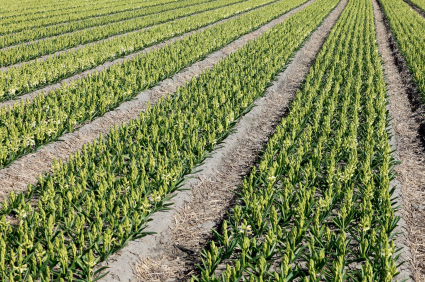 Today's monoculture farming put us at risk for major crop failure just as it did in the days of the Irish Potato Famine. |
What is this farming system - and why did it cause the Irish Potato Famine? One word: monoculture. In case you’re not familiar with the term, it simply means growing a single crop over a wide area. That’s the very picture of how we grow food here in America today. Just take a drive through Nebraska, and you’ll see what I mean. You can drive past cornfields for hours on end until you want to scream from the monotony.
But that’s the way we farm today - industrial agriculture. Giant growers typically choose one type of plant - corn, wheat, and soy are the biggies here in the U.S. - that performs well, and plant acres and acres of just that one type. In fact, almost all of the fruits and vegetable varieties you find in the store today are grown that way. It’s Henry Ford’s assembly line method applied to agriculture. Growers just want lots and lots of food per acre, and it doesn’t matter much to them how it tastes or how nutritious it is.
Ever wonder why the tomatoes you eat in the grocery store seem to be a pale imitation of the ones your grandmother grew? Store-bought tomatoes aren’t grown for flavor or nutrition. They’re chosen, instead, to do well on large industrial-scale growing operations, and to withstand being transported thousands of miles to their destination in grocery stores across the country. And the same goes for broccoli, lettuce, potatoes, carrots, strawberries, apples, and just about everything else in the produce department. There are literally hundreds of different varieties of tomatoes, but you’ll only find three or four at your grocery store. Same goes for other items, too, like apples and potatoes. Next time you’re at the grocery store, count how many varieties of potatoes you find. In mine, there are only three. Russets, Red, and Yukon Gold. Why so few? Because those are the three varieties that grow well in today’s industrial agricultural operations. It’s an economic decision. By planting just one variety over wide swaths of land, growers can streamline their operations and make more profits.
And that’s exactly what happened in Ireland in the 1840s. Back then two thirds of the Irish population depended upon agriculture for their very survival. They lived on the land but didn’t own it. Instead, they worked for their landlords in exchange for a plot of land to grow their families’ food. Working the land demanded long, hard hours, and they needed a crop that was easy to grow in quantity. That crop was potatoes. In 1845, the Irish planted over 2 million acres of potatoes.
Potatoes were actually a New World crop brought back to Europe in the late 1500s. They caught on very quickly. It’s no wonder. Potatoes are, for the most part, pretty easy to grow. You dig a hole, drop in a potato, throw some dirt on it, and walk away. Occasionally, as the potato grows, you throw a little more dirt on it. Three months later, you’ve got a potato harvest. Potatoes originally started out as a delicacy grown in the gardens of the gentry. But by the early 1700’s, they were a staple food of farm laborers and the poor.
For over a hundred years, potatoes were a staple crop and formed a major part of the diet for a huge portion of the population. By 1840, potatoes were the only significant source of food for 3 million Irish. Until 1845, that is. That was the year potato blight struck. Potato blight was actually Phytophthora infestans, a fungus-like infection that attacked the plants and actually caused them to ferment. First, the leaves turned black and curled up, and then began to rot. The tubers often looked perfectly normal on the outside, but were rotten on the inside. The disease spread quickly through windborne spores. One infected plant could infect thousands more in a matter of days. The blight spread at the rate of 50 miles a week or more. The whole countryside reeked of rot.
In 1845, up to half of the entire country’s potato harvest was lost. In 1846, three quarters of it was lost. The Irish population fell by almost 25%, as a million people died from starvation and over a million left the country.
Today, with all our technology and scientific advancements, we’re making the same mistake the Irish did almost 200 years ago. We practice monoculture. Wheat, corn and soy are the 21st century equivalent of yesteryear’s Irish potato. We plant over 60 million acres of wheat each year, and over 70 million each of corn and soy. Even potato production encompasses over a million acres. It would take just one disease with the same kill rate as Phytophthora infestans to cause a major collapse of U.S. agriculture.
At Heirloom Solutions, we are the very antithesis of monoculture. The Bible tells us “Divide your portion to seven, or even to eight, for you do not know what misfortune may occur on the earth.” (Ecclesiastes 11:2) If the Irish had heeded this wisdom and planted several varieties of potatoes, history would tell a very different story.
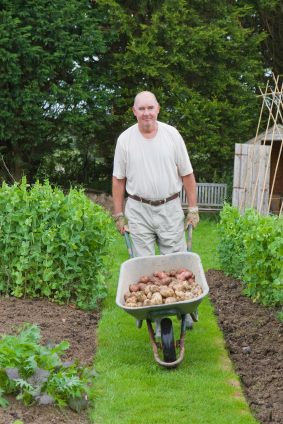 We
encourage all gardeners to plant a variety. If you plant two kinds of
tomatoes and a disease attacks one variety, you still have half your
tomatoes. Plant four varieties, and you have an even better hedge
against crop failure. Same goes, of course, for potatoes, and potato
blight is exactly the reason we stock five different varieties. As you
plan your spring garden, why not include a few different varieties of
potatoes in your plans?
We
encourage all gardeners to plant a variety. If you plant two kinds of
tomatoes and a disease attacks one variety, you still have half your
tomatoes. Plant four varieties, and you have an even better hedge
against crop failure. Same goes, of course, for potatoes, and potato
blight is exactly the reason we stock five different varieties. As you
plan your spring garden, why not include a few different varieties of
potatoes in your plans?
All Blue is the best blue potato available anywhere. It’s a great keeper and has great flavor and an unmatched moist texture. If you want to try something new, you can’t go wrong with this interesting potato.
Desiree is a Dutch introduction from the 1960s with light red skin and golden-yellow flesh. This standard type potato is good for just about anything and boasts a smooth and creamy texture.
Bintje - the original french fry potato with the funny name. This variety out-performed all other varieties in our 2011 trials. With its buttery-yellow flesh and exceptional storage qualities, this might be the perfect potato.
German Butterball, with its buttery yellow flesh, is an excellent all-purpose variety good for roasting, frying, and especially for mashed potatoes. This award-winning potato does well in long-term storage, too.
La Ratte is a top quality French variety highly sought after by chefs. If you’re a “foodie” this potato is a must-have. Great for boiling, roasting, and frying, it has a smooth buttery texture and a delicious nutty flavor. Like potato salad? This is the potato you want, since it holds it shape well when cooked.
Purple Viking makes a great all around, general purpose potato. Love mashed potatoes? Then you’ll love the snowy white flesh and slightly sweet flavor of this potato. Delicious when harvested early, too.
Rose Finn Apple fingerlings hold their shape exceptionally well when cooked. They’re perfect for potato salad, as well as steaming, frying, boiling, or roasting.
Yukon Gold is the most widely grown specialty potato. It’s a great all-around potato for baking, roasting, frying, mashing, or in salads. Plus, it matures early so you won’t have to wait as long.
Can’t decide? That’s precisely why we offer a sampler that includes seed potatoes of five different varieties. You’ll get four standard types and one fingerling type, and along with it you get a significant savings over buying them individually.
Never planted potatoes before?
 Don’t be
intimidated. As I mentioned earlier, potatoes are pretty easy to grow,
even if you’ve never gardened before. But unlike most vegetables, you
don’t plant seeds to grow potatoes. Actually, you could, but
the result would be unpredictable. The potato that grew from the seeds
might look and taste totally different from the potato plant it came
from. Potatoes are best propagated by somatic reproduction. Those are
fancy words, but they simply mean that you take a piece of the “mother”
plant - in this case, the actual potato - and start a new plant with it.
(Yes, it’s like cloning.) If you’ve ever kept potatoes around for a
little too long, you know they sprout eyes. Each eye represents a new
potential potato plant. If you throw it in the ground, cover it with
dirt, and wait awhile, you’ll grow more potatoes. It’s that simple.
Don’t be
intimidated. As I mentioned earlier, potatoes are pretty easy to grow,
even if you’ve never gardened before. But unlike most vegetables, you
don’t plant seeds to grow potatoes. Actually, you could, but
the result would be unpredictable. The potato that grew from the seeds
might look and taste totally different from the potato plant it came
from. Potatoes are best propagated by somatic reproduction. Those are
fancy words, but they simply mean that you take a piece of the “mother”
plant - in this case, the actual potato - and start a new plant with it.
(Yes, it’s like cloning.) If you’ve ever kept potatoes around for a
little too long, you know they sprout eyes. Each eye represents a new
potential potato plant. If you throw it in the ground, cover it with
dirt, and wait awhile, you’ll grow more potatoes. It’s that simple.
Of course, you want to start with potatoes that are proven to grow well. In theory, you could start with potatoes from the grocery store, but remember how the big growers do it. They choose a variety that does well in their particular climate and soil, and grow acres and acres of it. It won’t necessarily grow well in your soil. And because a grocery store potato is genetically identical to the majority of potatoes grown, you run the same disease risk as monocultured plants. Plus, most grocery store potatoes are treated with chemicals to prevent them from sprouting well.
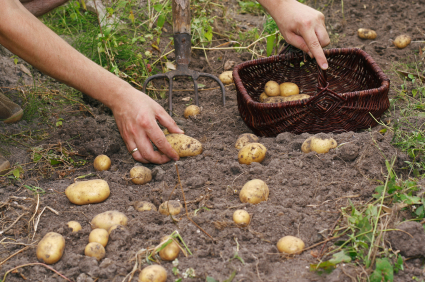 At
Heirloom Solutions, our
seed potatoes are carefully selected for their adaptability to a
wide variety of soil conditions and climates. They’re also genetically
different from the ones you’d buy in a grocery store. Genetic diversity
is one of the best strategies for long-term gardening success.
At
Heirloom Solutions, our
seed potatoes are carefully selected for their adaptability to a
wide variety of soil conditions and climates. They’re also genetically
different from the ones you’d buy in a grocery store. Genetic diversity
is one of the best strategies for long-term gardening success.
Compared to seeds, seed potatoes take up a lot of space. We don’t have unlimited warehouse space, so we only carry a limited amount of seed potatoes. For the best selection, we recommend you order early. Your potatoes will come with complete planting and growing instructions. And remember, the best crop insurance is to plant a variety, so be sure to check out our Potato Sampler with five delicious varieties! To order your potatoes - or any of our heirloom seeds - visit www.heirloomsolutions.com.
Solutions From Science
815 W. Main St.
P.O. Box 518
Thomson, IL 61285
Email us at info@solutionsfromscience.com