Is 'Prescription for Disaster' Our 'Most Optimistic' Climate Future?
New data indicates warming of 2C now planet's "most optimistic" scenario
New climate information from French scientists indicate that global warming of 2 C is the "most optimistic" scenario. Yet this is the amount of warming James Hansen has referred to as a "prescription for disaster."
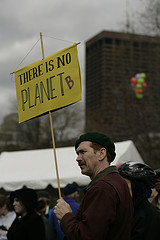
Agence France-Presse reports on the new climate scenarios:
French scientists unveiling new estimates for global warming said on Thursday the 2 C (3.6 F) goal enshrined by the United Nations was "the most optimistic" scenario left for greenhouse-gas emissions.
The estimates, compiled by five scientific institutes, will be handed to the UN's Intergovernmental Panel on Climate Change (IPCC) for consideration in its next big overview on global warming and its impacts. [...]
The French team said that by 2100, warming over pre-industrial times would range from two degrees Celsius (3.6 degrees Fahrenheit) to 5.0 C (9.0 F).
The most pessimistic scenarios foresee warming of 3.5-5.0 C (6.3-9.0 F), the scientists said in a press release.
Achieving 2C, "the most optimistic scenario," is possible but "only by applying climate policies to reduce greenhouse gases," they said.
The climate summit in Copenhagen in 2009 had agreed to a limit of 2 C in global warming, a deal many saw as a failure to stop runaway global warming. John Sauven, executive director of Greenpeace UK, said at the time:
"The city of Copenhagen is a crime scene tonight, with the guilty men and women fleeing to the airport. [...] It is now evident that beating global warming will require a radically different model of politics than the one on display here in Copenhagen."
James Hansen: "Limiting human-caused warming to 2 degrees is not sufficient. It would be a prescription for disaster."
In December of 2011, director of NASA's Goddard Institute for Space Studies James Hansen stated at a meeting of the American Geophysical Union:
"The paleoclimate record reveals a more sensitive climate than thought, even as of a few years ago. Limiting human-caused warming to 2 degrees is not sufficient," Hansen said. "It would be a prescription for disaster."
"We don’t have a substantial cushion between today's climate and dangerous warming," Hansen said. "Earth is poised to experience strong amplifying feedbacks in response to moderate additional global warming."
"Humans have overwhelmed the natural, slow changes that occur on geologic timescales," Hansen said.