Sidestep These Veggies - Even if They're Organic
Posted By Dr. Mercola | February 08 2012
Story at-a-glance
- Most people are well aware that fresh conventionally-grown produce is more or less contaminated with pesticides. Less known is the now-common practice of coating fresh fruits and vegetables—including organic varieties—with edible plastic coatings to increase shelf life
- So-called modified atmosphere packaging (MAP) involves controlling or modifying the atmosphere surrounding the product to slow spoilage. This can be accomplished by coating the food with an edible film
- Four basic materials used for edible films are lipids, resins, polysaccharides and proteins, to which a variety of antimicrobials, plasticizers and texturizers are added
- These types of coatings present several potential health hazards, the most severe of which is the potential to promote the growth of foodborne pathogens if misapplied
By Dr. Mercola
Videos like the two featured above have started making the rounds online, raising questions about what exactly that plastic-looking "peel" found on some fresh produce might be.
Let me preface this article by saying that I do not have the answer, but I will present a couple of theories here.
Fruits and vegetables—apparently even organically-grown varieties—may have cow-, pig-, and chicken collagen coatings on them rather than wax, as well as a number of other unsavory ingredients.
Wax was first applied to the skins of fruits and vegetables for longer shelf life hundreds of years ago.
Today, that tradition is being carried on with a new generation of chemicals and compounds I'd rather NOT have on my fresh produce...
Modified Atmospheric Packaging
While I normally do not feature blog posts, this instance is a rare exception, as I thought this Reality Blog report contained quite a bit of worth-while details. In response to one of the videos above, this blogger dug up information about so-called 'modified atmosphere packaging' that could offer one potential explanation for the bizarre plastic-like coating found on lettuce:
"... [M]odified atmosphere packaging (MAP) ... involves either actively or passively controlling or modifying the atmosphere surrounding the product within a package made of various types and/or combinations of films ... Edible films may consist of four basic materials: lipids, resins, polysaccharides and proteins ... The most common plasticizer used to cast edible films is food-grade polyethylene glycol, which is used to reduce film brittleness ... Gelatin is ... extracted from the boiled crushed bones, connective tissues, organs and some intestines of animals such as domesticated cattle, chicken, and pigs."
So, could that rubbery peel be a form of sprayed-on MAP, designed to prolong shelf life of fresh produce? As detailed by Reality Blog, this certainly seems like one reasonable conclusion.
Edible "Invisible Packaging" is More Common than You Might Think
According to the FDA, modified atmosphere packaging (MAP), which includes so-called "smart" and "edible" types of packaging, has made great strides over the past decade or so, and has "greatly improved the quality and shelf-stability" of otherwise highly perishable produce. This type of packaging can be either "active" or "passive."
"Active modification occurs by the displacement of gases in the package, which are then replaced by a desired mixture of gases, while passive modification occurs when the product is packaged using a selected film type, and a desired atmosphere develops naturally as a consequence of the products' respiration and the diffusion of gases through the film. ... Reducing the rate of respiration by limiting O2 (dioxygen) prolongs the shelf life of fruits and vegetables by delaying the oxidative breakdown of the complex substrates which make up the product. Also, O2 concentrations below 8% reduce the production of ethylene, a key component of the ripening and maturation process." [Emphasis mine]
Essentially, by spraying a substance on the fresh produce, which forms a thin film, oxygen levels can be limited, which slows down the ripening process. So what might this "edible" film substance be comprised of? The list of potential ingredients is a long one, and will vary from product to product, but can be generally divided into four basic materials:
- Lipids (waxes, oils, stearic acid)
- Resins (such as shellac and wood rosin)
- Polysaccharides (such as cellulose, pectin, starch, carrageenan, and chitosan)
- Proteins (such as casein, soy, and corn-zein)
Common additives to these base materials include:
- Plasticizers (such as polyethylene glycol, glycerol, and "other cross-linking agents")
- Antimicrobials
- Antioxidants
- Texturizers (to customize the film for the particular product)
The FDA's web page on MAP's offers one fairly detailed example of a concoction used on tomatoes to successfully extend their shelf life: Most of us are used to thinking about pesticide residues when purchasing fresh fruits and vegetables, but few probably consider that ON TOP of that, there's an additional layer of miscellaneous resins and plasticizers...
"Park and others (1994) reported the successful application of a corn-zein film to extend the shelf life of tomatoes. Color change, loss of firmness, and weight loss during storage were delayed, and shelf life was extended by 6 days in comparison to untreated tomatoes. The corn-zein product used in the above study was a commercial product that was brushed onto the tomatoes, and consisted of 54 grams of corn-zein, 14 grams of glycerine, and 1 gram of citric acid dissolved in 260 grams of ethanol."
Is it Safe to Eat?
Edible coatings probably won't kill you, but if you have a choice, why would you opt to eat fruits and vegetables that have been coated in a rubbery film? And, these types of coatings DO present a very real potential health hazard. The FDA openly admits that edible coatings have been associated with a number of problems:
"For example, modification of the internal gas composition of the product due to high CO2 and low O2 can cause problems such as anaerobic fermentation of apples and bananas, rapid weight loss of tomatoes, elevated levels of core flush for apples, rapid decay in cucumbers, and so on," the FDA states.
Furthermore:
"... [A]t extremely low O2 levels (that is, <1%), anaerobic respiration can occur, resulting in tissue destruction and the production of substances that contribute to off-flavors and off-odors, as well as the potential for growth of foodborne pathogens such as Clostridium botulinum."
This may help explain why fresh produce has managed to be the source of several outbreaks of food poisoning in the past several years. To combat the growth of foodborne pathogens, antimicrobial agents are added, such as:
"...metal ions supported in zeolite, isothiocyanate in cyclodextrin with cobalt ion, chitosan, allyl isothiocyanate, silver-based fungicide, quaternary ammonium salt, organic monoglycerides, copper and zinc, benzoic acid, sodium benzoate, sorbic acid and potassium sorbate and propionic acid. Researchers are also currently looking at the use of nisin, a bacteriocin, in coatings to suppress L. monocytogenes, as well as other bacteriocins for the control of C. botulinum. Successful applications of this technology have been demonstrated using sodium caseinate/stearic acid to coat peeled carrots and caseinate/acetylated monoglyceride to coat celery sticks."
The "Epidermal Peel" Theory
Another theory floating about is that this coating isn't really a coating at all, but rather an entirely natural occurrence, referred to as "epidermal peel," caused by cold weather. Lettuces in particular appear to be affected in this way when exposed to frost conditions. Epidermal peel can be likened to "chapped lips," in that the outer layer of a leaf will get damaged by freezing temperatures, causing a layer to peel away from the leaf. This peeling is typically considered unsightly, and harvesters will typically remove as many of the affected leaves as possible.
But while it sounds like what we're seeing in the featured videos could be epidermal peeling, is it really?
Unfortunately, I've not been able to find any kind of visual example of this naturally-occurring epidermal peeling to compare it with what we're seeing in the videos. In one 2011 Produce Report, the damage is described as follows, which leads me to think that what these consumers found is NOT epidermal peeling, but rather some form of MAP coating:
"Freezing causes blisters to form on the frost affected areas of Iceberg and Romaine lettuce. These blisters pop and then peel as the plant continues to grow. The epidermal peel discolors and eventually leads to decay. Harvest crews work at a reduced pace to remove all affected leaves before packing. The result is smaller heads, lighter weights and pale color."
How Can You Avoid Produce Coated in "Edible Plastic"?
Whatever the truth is with regards to the featured videos, one thing is for sure: MAP films are definitely being used on fresh produce, both conventional and organically-grown. Once you understand the reason WHY fresh foods are coated, the answer to how to avoid them becomes rather self-evident... Fresh fruits and vegetables of all kinds are "preserved" in this way in order to remain sellable even after lengthy transportation.
If you buy your produce from a local farm, they naturally will not need to process any of their foods in such a manner. This is yet another great reason to buy locally-farmed foods, even if it's not certified organic—although that would certainly be ideal. Still, fresh, non-coated/non-treated vegetables that have been grown conventionally will likely be healthier for you than wilted organic veggies from across the world, coated with plasticizers to keep them looking fresh...
Eight Guidelines for REAL Healthful Food
In your search for healthy food to feed your family, here is what to look for, whether you're at the grocery store or farmers' market. Foods that meet these standards will almost always be a wise choice:
- Grown without pesticides and chemical fertilizers (organic foods fit this description, but so do some non-organic foods)
- Not genetically modified
- Contains no added growth hormones, antibiotics, or other drugs
- Does not contain artificial anything, nor any preservatives (for fresh produce, you can now add the presence of MAP coatings or 'edible packaging')
- Fresh (if you have to choose between wilted organic produce or fresh conventional produce, the latter may be the better option)
- Did not come from a confined animal feeding operation (CAFO, a.k.a. factory farm)
- Grown with the laws of nature in mind (meaning animals are fed their native diets, not a mix of grains and animal byproducts, and have free-range access to the outdoors)
- Grown in a sustainable way (using minimal amounts of water, protecting the soil from burnout, and turning animal wastes into natural fertilizers instead of environmental pollutants)
Grow Your Own
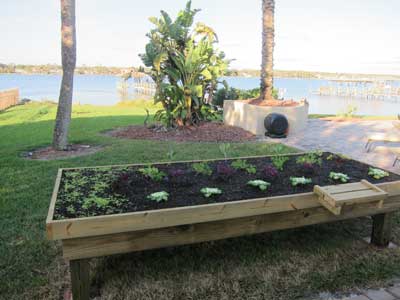
Here is my raised vegetable bed where I have planted two types of kale, collards greens, parsley and a variety of lettuces. Just planted it two weeks ago but should be able to start harvesting very soon. You can see my black composter directly below the second palm on the left. This is where I recycle the pulp from my veggies and other compostable food wastes that would normally go to the landfill.
Starting your own garden is another option. It may sound intimidating, but really all you need is a small plot of land (or several containers), some healthy soil, and the will to do it. Naturally, I encourage you to use only organic gardening methods. Once you get used to it, organic gardening is just as easy as conventional. For instance, you can make a homemade garden spray that will discourage most pests by combining mashed garlic paste with a little cayenne pepper or horseradish. Add a small amount to a gallon jug of water and let it sit for a day or two, shaking it occasionally. Just spray a small amount onto a few leaves first to make sure it's not so strong that it will burn them.
If you're not sure where to begin, Better Homes & Gardens has a free All-American Vegetable Garden Plan that can be put into a 6x6 area. It's a great starting point for beginners. For more tips, the following Web sites offer helpful advice and guidelines for the organic gardener:
Where to Find Locally-Grown Foods
If eating locally is new to you, rest assured that you can find a source near you, regardless of whether you're in a remote or rural area or a big city. Here's a list of helpful resources:
- For a listing of national farmer's markets, see this link.
- Another great web site is www.localharvest.org. There you can find farmers' markets, family farms, and other sources of sustainably grown food in your area where you can buy produce, grass-fed meats, and many other goodies.
- Subscribe to a community supported agriculture program (CSA). Some are seasonal while others are year round programs. Once you subscribe, many will drop affordable, high quality locally-grown produce right at your door step. To find a CSA near you, go to the USDA's website where you can search by city, state, or zip code.
- Eat Well Guide: Wholesome Food from Healthy Animals is a free online directory of sustainably raised meat, poultry, dairy, and eggs from farms, stores, restaurants, inns, and hotels, and online outlets in the United States and Canada.
- Community Involved in Sustaining Agriculture (CISA) is dedicated to sustaining agriculture and promoting the products of small farms.
- FoodRoutes. Their "Find Good Food" map can help you connect with local farmers to find the freshest, tastiest food possible. On their interactive map, you can find a listing for local farmers, CSA's, and markets near you.
- For an even more comprehensive list of CSA's and a host of other sustainable agriculture programs, check out this link to my Sustainable Agriculture page.
© Copyright 1997-2012 Dr. Joseph Mercola. All Rights Reserved http://articles.mercola.com