Oil Platform Effect on Fish
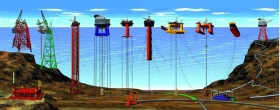
Fishes residing near oil platforms in southern California have similar contaminant levels as fishes in nearby natural sites, according to two recent reports by the U.S. Geological Survey, which were conducted to assist the Bureau of Ocean Energy Management (BOEM) in understanding potential consequences of offshore energy development. Since the underwater portion of many offshore oil and gas platforms often provides a habitat to a large number of fishes and invertebrates, some stakeholders have called for ocean managers to consider a "rigs-to-reefs" option during the decommissioning phase of a platform. This option would maintain some of the submerged structure to function as an artificial reef after oil and gas production has ended. The findings of this study address questions regarding how the industrial legacy of this kind of artificial reef may affect local fish populations.
In the United States, Marine Biologist Milton Love has proposed that
oil platforms off the California coast be retained as artificial reefs,
instead of being dismantled, because he has found them to be havens for
many of the species of fish which are otherwise declining in the
region. NOAA has said it is considering this course of action.
Rigs-to-Reefs was first explored in 1979 when the first oil rig was
transported from Louisiana to a Florida site. This rig was the first of
5 Rigs-to-Reefs towed to Florida's coast. Louisiana was the first state
to develop a program that allowed transfer of liability and ownership
from the operator to the state. Texas later followed this example.
Rigs-to-Reef is now the core of both Louisiana and Texas artificial reef
programs. From 1987-1995, of the over 941 platforms removed from
Louisiana and Texas waters, 90 became artificial reefs. By November
2000, 151 platforms had been recycled as artificial reefs in the Gulf of
Mexico from states such as Texas, Louisiana, Mississippi, Alabama, and
Florida. Federal law now requires rigs to be demolished for safety
reasons, although discussion continues about their potential.
Scientists analyzed the amount of contaminants from crude oil exposure
present in three species of fish residing at oil platforms within the
Santa Barbara Channel and the San Pedro Basin in California. The amount
of contaminants present in fish tissue samples at seven platform sites
was compared to samples at natural nearby sites.
"As part of this study, we developed methods capable of detecting the
extremely low levels of contaminants that we anticipated in these ocean
fishes, especially since they avoid natural oil seeps," said USGS
scientist Robert Gale. "These results will assist decision-makers in
helping to protect the environment off the coast of California."
Some of the most important contaminants related to oil operations are
polycyclic aromatic hydrocarbons (PAHs). Several PAHs are probable human
carcinogens and many are toxic to fish and other aquatic life.
Scientists were able to develop a new, more accurate method of sampling
small traces of PAHs that may have been ingested and broken down within
the fish. Samples were taken from species thought to be most sensitive
to PAH contamination. These species, including Pacific sanddab, kelp
rockfish, and kelp bass, also tend to be targeted by fishermen. PAH
concentrations were either very low or undetectable in all fish sampled
for this study.
"These important results suggest two things," said BOEM marine biologist
Donna Schroeder. "First, existing offshore oil platforms provide food
and shelter to local fishes without increasing their background
contaminant loads. Second, since there is no detectable PAH signal from
ongoing operations, we would expect that if the State of California
wanted to implement a rigs-to-reefs program, there would likely be no
change, pollution-wise, in the quality of the offshore environment,
which appears to be pretty good."
Scientists also looked at industrial chemicals in the Pacific sanddab
species, including polychlorinated biphenyls (PCBs), flame retardants
(polybrominated diphenylethers, PBDEs), and pesticides (OCPs). These
contaminants were also found at low levels in all fish sampled, with no
observed pattern between natural and platform habitats.
For further information see
Fish.
Platform image via Wikipedia.

2013©. Copyright Environmental News Network