Nuclear reactors unprepared for credible terrorist attacks
More than 10 years after the 9/11 hijackers considered flying a passenger jet into a Manhattan area nuclear reactor, U.S. commercial and research nuclear facilities remain unprotected against the theft of bomb-grade material to make nuclear weapons and sabotage intended to cause a reactor meltdown, according to a new report prepared under a contract for the Pentagon by the Nuclear Proliferation Prevention Project (NPPP) at the University of Texas at Austin's LBJ School of Public Affairs.
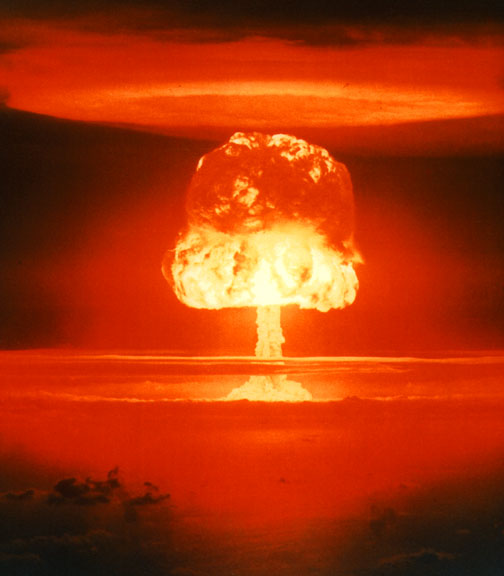 |
| Credit: U.S. Department of Energy/Wikimedia Commons |
The report, "Protecting U.S. Nuclear Facilities from Terrorist Attack: Re-assessing the Current 'Design Basis Threat' Approach," reveals that none of the 104 commercial nuclear power reactors in the United States is protected against a maximum credible terrorist attack, such as the one perpetrated on September 11, 2001 and are not required to be. The most vulnerable reactors are in California, Connecticut, Florida, Maryland, Massachusetts, Missouri, New York, North Carolina, Texas and Virginia.
The NPPP report finds that U.S. nuclear power plants are vulnerable to terrorist attack from the sea, but are not required to protect against such ship-borne attacks. Reactors in this category include Diablo Canyon in California, St. Lucie in Florida, Brunswick in North Carolina, Surry in Virginia, Indian Point in New York, Millstone in Connecticut, Pilgrim in Massachusetts, and the South Texas Project, according to the report.
Three civilian research reactors at the University of Missouri in Columbia, the Massachusetts Institute of Technology in Cambridge, and the National Institute of Standards and Technology, located just miles from the White House in the Washington, D.C/Gaithersburg area are fueled with bomb-grade uranium and pose a serious terrorism threat. The facilities are supposed to convert to non-weapons-grade, low-enriched uranium fuel but are not protected against a terrorist threat, unlike military facilities that hold the same material and will continue to use bomb-grade uranium for at least another decade, according to the report.
"More than 10 years have come and gone since the events of September 2001, and America's civilian nuclear facilities remain unprotected against a terrorist attack of that scale. Instead, our civilian reactors prepare only against a much smaller-scale attack, known as the 'design basis threat,' while the government fails to provide supplementary protection against a realistic 9/11-type attack," said report co-author Professor Alan J. Kuperman."Less than two dozen miles from the White House and Capitol Hill, a nuclear reactor contains bomb-grade uranium but it is not required to protect against even the lesser 'design basis threat' of terrorism. "
Some U.S. government nuclear facilities -- operated by the Pentagon and Department of Energy -- are protected against most of the above threats. But other U.S. government nuclear sites remain unprotected against such credible threats because security officials claim that terrorists do not value the sites or that the consequences would not be catastrophic. The report argues that it is impossible to know which high-value nuclear targets are preferred by terrorists, or which attacks would have the gravest consequences so the NPPP recommends that Washington require a level of protection at all potentially high-consequence U.S. nuclear targets -- including both nuclear power reactors and civilian research facilities with bomb-grade material -- sufficient to defend against a maximum credible terrorist attack.
To meet this standard at commercial facilities, NPPP says the U.S. Nuclear Regulatory Commission should upgrade its "design basis threat," and the U.S. government should provide the requisite additional security that is not supplied by private-sector licensees.
For more:
- see this
report
Sign up for our FREE newsletter for more news like this sent to your inbox!
© 2013 FierceMarkets. All rights reserved. http://www.fierceenergy.com
http://www.fierceenergy.com/story/nuclear-reactors-unprepared-credible-terrorist-attacks/2013-08-16