Roof-top Solar Panels - Who Pays? Who Saves?

Many jurisdictions
around the world are encouraging the installation of
roof-top solar panels by providing a number of
financial and regulatory support mechanisms. These
include direct grants to reduce the cost of
installation, guaranteed prices for solar power sold
back into the grid, and "net metering" whereby only
the net flow of electricity from the grid to the
residence can be charged for by the utility company.
We need to move to a renewable energy base. Most
people would agree with that.
But when it comes to roof-top solar panels there are
some inequities that need to be considered.
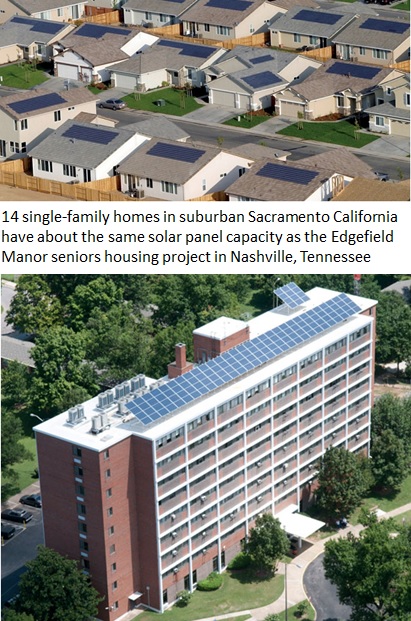
Consider the two residential settings shown in the
pictures.
The amount of rooftop solar real estate available to
the owners of the single-family houses is more than
10 x that available for the seniors living in the
apartment complex. In fact, it would be quite
possible for the single-family homes to generate as
much electricity as they consume so that the local
utility company would actually derive no revenue
from these homes because of "net metering".
In the case of the apartment building this is simply
not possible.
In the late afternoon and into the night both the
single family residences and the apartments will
require electricity from the utility grid. But who
pays for the generation capacity required to supply
this electricity? The only people paying utility
bills are the residents of the seniors apartment.
But the situation is actually quite a bit worse than
that.
The single-family homes will generate the most
electricity between 10:00 am and 2:00 pm. This is
not a "peak" period for electricity demand so that
much of this electricity will flow back into the
grid. The local utility company will have to provide
additional equipment to handle the two-way flow of
electricity to and from these houses. Other
equipment will be required to make sure that the
"back flow" does not damage transformers and meters
that may be a considerable distance from the houses.
Finally, the utility company will have to implement
additional procedures to deal with the intermittent
nature of the electricity generated from the solar
panels. For example, a passing cloud can reduce
solar power generation by 60% or more in a minute or
less. So the utility company will have to be
able to ramp up or cut back production at some of
it's thermal generation facilities on very short
notice resulting in less efficient operation of
those plants and increased costs.
Who will pay for this extra equipment and the
maintenance of a significantly more complicated
electrical distribution system? The only ones paying
utility bills will be the residents of the seniors
apartment.
Now it could be argued that the owners of the
single-family houses paid a lot of money for the
installation of the solar panels and should reap the
benefits in order to get a return on that
investment. That would be a very defensible
position to take if there were not so many subsidies
associated with the whole process.
Construction grants and incentives and tax
write-offs are paid for by all tax-payers,
regardless of whether or not they have the ability
to deploy solar panels where they live. For
example, what about all of the people renting their
accommodation?
Feed-in-tariffs guarantee a fixed price for the
electricity generated from a solar panel regardless
of whether or not there is any actual need for that
electricity at the time it is generated. So
while the owners of these single-family houses are
on vacation and not using electricity all
rate-payers have to compensate them for the power
generated by their solar panels whether it is needed
or not. That could be a very nice revenue
stream for a family that had equipped a vacation
home with solar panels.
And what about the good folks living in the
Mid-West, Ohio, Michigan, Indiana, Vermont, New
York, Maine and especially Canada? Solar
panels don't work too well when they are covered by
snow!
When you combine these inequities with the problems
that roof-top solar introduces into the regional
grid and the negative impact on the operational
efficiency of the system as a whole you have to ask
yourself "what is the real benefit here?"
Roof-top solar panels will never allow us to
actually shut down a coal-fired or natural gas-fired
or nuclear generation plant. Why? Because we have
high electricity demands in the late afternoon and
into the night as well as on very overcast days.
So we have to effectively maintain double the
generation capacity actually needed. Does that
really make sense?
Personally I think there is a case to be made for
requiring roof-top solar installations to be
equipped with a significant amount of battery
storage which would make it possible to time-shift
the electricity generation to better match demand.
The problem with that approach would be that it
would triple the cost of the installation which
would make it very hard to justify for a home-owner
(which is why I have argued
previously that these kinds of residential
generation and storage facilities should be owned by
the local utility).
Another complimentary approach would be to provide
subsidies for the construction of Concentrated Solar
Power plants with Thermal Energy Storage that could
be run
starting in the late afternoon.
All things considered the continued focus on rolling
out roof-top solar without storage is misguided in
my opinion. A more holistic approach which
would allow us to actually decommission thermal
generation facilities would be more appropriate.
I have outlined a number of components of such an
approach in my
Sustainable Energy Manifesto.

Copyright © 1996-2013 by CyberTech, Inc. All rights reserved.
To subscribe or visit go to: http://www.energycentral.com
To subscribe or visit go to: http://www.energybiz.com
http://www.energybiz.com/article/13/07/roof-top-solar-panels-who-pays-who-saves-0