Surprising Source of Arsenic in Your Drinking Water—Will EPA Take Steps to Protect Your Health?

Story at-a-glance
- While naturally-occurring arsenic in groundwater is one of the most common sources of exposure, hydrofluorosilicic acid (fluoride) added to drinking water is commonly contaminated with toxic arsenic
- According to recent research, diluted fluorosilic acid adds, on average, about 0.08 ppb of arsenic to your drinking water
- Low-level chronic exposure to arsenic can lead to a wide variety of health problems, including chronic fatigue, reproductive problems, reduced IQ and other neurological problems, and various cancers
- As petition urges the EPA to change the source of fluoride in US drinking water, as the most commonly used form, hydrofluorosilicic acid, increases lung and bladder cancer risk
- Switching from hydrofluorosilicic acid to pharmaceutical-grade fluoride could save the US $1-6 billion annually and prevent an estimated 1,800 cases of lung and bladder cancer
By Dr. Mercola
Pure water is one of the most important foundations for optimal health. Unfortunately, most tap water is far from pure, containing a vast array of disinfection byproducts, chemicals, heavy metals and even pharmaceutical drugs. Fluoride and arsenic are two prime examples of hazardous water contaminants.
Not only is the level of arsenic in US tap water high due to natural groundwater contamination,1 the most commonly used form of fluoride added to water supplies also tends to be contaminated with arsenic. As reported by the featured article:2
“In early August, the Environmental Protection Agency is set to decide on a petition to change the source of fluoride in US drinking water.
Currently, the source of fluoride in most public water supplies is fluorosilicic acid, according to government records. The petition calls for the EPA to instead require the use of pharmaceutical-grade sodium fluoride in water fluoridation, which is the addition of fluoride to drinking water for the purpose of preventing cavities.
Fluorosilicic acid is often contaminated with arsenic, and recent research has linked the arsenic from fluorosilicic acid in drinking water to as many as 1,800 extra cases of cancer yearly in the United States...”
The petition3 was submitted by William Hirzy, a chemistry researcher at the American University in Washington, D.C. Hirzy previously worked at the EPA for 27 years.
His team recently published a study entitled: "Comparison of hydrofluorosilicic acid and pharmaceutical sodium fluoride as fluoridating agents – a cost-benefit analysis", in the journal Environmental Science & Policy.4
According to their estimation, switching the type of fluoride used to pharmaceutical-grade sodium fluoride would reduce the amount of inorganic arsenic contamination in drinking water by 99 percent!
The Health Dangers of Inorganic Arsenic
Inorganic arsenic is a powerful carcinogen that has been linked to an increased risk of several types of cancer. In 2001, the Environmental Protection Agency(EPA) lowered the maximum level of arsenic permitted in drinking water from 50 ug/L to 10 ug/L (or 10 parts per billion (ppb)) due to the established cancer risk.
The Natural Resources Defense Council5 estimates that as many as 56 million Americans living in 25 states drink water with arsenic at unsafe levels. According to the EPA:6
"Chronic inorganic arsenic exposure is known to be associated with adverse health effects on several systems of the body, but is most known for causing specific types of skin lesions (sores, hyperpigmentation, and other lesions) and increased risks of cancer of the lungs and skin."
Other impacts of chronic arsenic exposure include, according to the EPA:
Kidney damage and failure Anemia Low blood pressure Shock Headaches Weakness Delirium Increased risk of diabetes Adverse liver and respiratory effects, including irritation of mucous membranes During development, increased incidence of preterm delivery, miscarriage, stillbirths, low birth weight, and infant mortality During childhood, decreased performance in tests of intelligence and long-term memory Skin lesions
Water Fluoridation Chemicals Are NOT Pharmaceutical Grade
While naturally-occurring arsenic in groundwater is one of the most common sources of exposure, hydrofluorosilicic acid—the most commonly used form of fluoride added to water supplies—is a toxic waste product from the phosphate fertilizer industry that is commonly contaminated with arsenic, radionucleotides, aluminum and other industrial contaminants.
According to the featured research, diluted fluorosilic acid adds, on average, about 0.08 ppb of arsenic to your drinking water.
Most people are shocked when they realize that the fluoride added to their water supply is actually a toxic byproduct from the fertilizer industry, opposed to a pharmaceutical-grade chemical. The source of most water fluoridation chemicals is explained by Michael Miller, a minerals commodity specialist for the US Geological Survey, in the featured article:7
“During the production of phosphate fertilizer, phosphate ore is reacted with sulfuric acid to produce toxic gases. These are taken out of the air after being sprayed with water, which produces fluorosilicic acid... The solution is sold to water systems nation-wide, where it is diluted and put into drinking water. Occasionally, it is treated to create sodium fluorosilicate. Together, these compounds (called silicofluorides) provide fluoride to 90 percent of U.S. drinking water systems that are fluoridated...”
Water Fluoridation May Be Placing Infants at Great Risk
Not only is there mounting evidence that fluoride poses grave health risks to infants and children—including reductions in IQ—arsenic exposure in utero and during early childhood is also particularly problematic, as it can cause lasting harm to children's developing brains, and endocrine and immune systems.
For example:
- A 2006 study8 found that Chileans exposed to high levels (peaking at 1,000 ppb) of naturally-occurring arsenic in drinking water in utero and during early childhood had a six times higher lung cancer death rate compared to Chileans living in areas with lower levels of arsenic in their water. And their mortality rate in their 30s and 40s from another form of lung disease was almost 50 times higher than for people without that arsenic exposure.
- A 2004 study9 showed children exposed to arsenic in drinking water at levels above 5 ppb had lower IQ scores. Earlier studies have linked chronic arsenic exposure to a range of cognitive dysfunctions, including learning disabilities, memory problems, poor concentration, and peripheral and central neuropathies.
- A study10 published in 2011 examined the long-term effects of low-level exposure on more than 300 rural Texans whose groundwater was estimated to have arsenic at median levels below the federal drinking-water standard. It also found that exposure was related to poor scores in language, memory, and other brain functions.
Is It Worth Increasing Cancer Risk for Minimal, if Any, Benefit to Teeth?
Some proponents of fluoridation believe that the large dilution of these fluoridating chemicals that takes place when they are added at the public water works ameliorates concerns about the known contaminants. However, arsenic is a known human carcinogen, for which there is no safe level.
Inevitably, the addition of contaminated hexafluorosilicic acid to the water supply by definition must increase the cancer rate in the US because of the arsenic it contains, and this is exactly what Hirzy’s research shows. Why would any rational government do that to reduce – at best – a miniscule amount of tooth decay? According to Hirzy:11
"We found that the United States as a society is spending, conservatively speaking, $1 billion to $6 billion treating the excess bladder and lung cancers caused by arsenic in the most commonly used fluoridation chemical, fluorosilicic acid... The switch [to pharmaceutical-grade sodium fluoride] would cost $100 million, but would save billions in reduced cancer costs."
For people living in areas with fluoridated tap water, fluoride is a part of every glass of water, every bath and shower, and every meal cooked using that water. This makes absolutely no sense considering the carcinogenic nature of arsenic—especially in light of the epidemic of cancer.
Hirzy’s study is actually the first risk assessment of arsenic-contaminated fluoride in drinking water. This is particularly shocking considering the fact that fluorosilicic acids have been used since the early 1950s12 (prior to that, sodium fluoride, a byproduct of the aluminum industry, was typically used). Incredibly, while the EPA performs risk assessments for most drinking water contaminants, the agency does NOT oversee the addition of fluoridation chemicals. As stated in the featured article, this policy makes no sense whatsoever.
“Under the Toxic Substances Control Act, the EPA has the authority to regulate or ban almost any substance — including fluorosilicic acid — that poses an 'unreasonable risk' to public health, [Hirzy] said.”
Appropriations Bill Would Prohibit EPA’s Phase-Out of Sulfuryl Fluoride
While we’re on the topic of fluoride, a related news item13 is worthy of note. Drinking water is not the only source of fluoride, as I’ve discussed previously. Fluoride also enters the human food chain via fluoridated pesticides. According to a recent report, the House of Representatives Appropriations Interior and Environmental subcommittee has voted to approve an appropriations bill that cuts the EPA’s budget by nearly one-third.
What’s worse, the bill specifically prevents the EPA from enforcing its decision to phase out sulfuryl fluoride—a neurotoxic fumigant that has been linked to cancer and neurological, developmental, and reproductive damage. If it passes once markups by the Appropriations Committee are completed, it will move to a House vote. According to the news report:
“This is an outrageous attempt to circumvent a basic risk assessment calculation that EPA acknowledges puts the public at risk, given current exposure patterns, to a chemical that is especially hazardous to children.”
In response, Beyond Pesticides, the Environmental Working Group (EWG), and the Fluoride Action Network (FAN) submitted a letter14 to the House Appropriation Committee Chairman and Ranking members, urging them to remove the section in question (section 449) from the bill. You can help by writing or calling your state Representative, asking him or her to uphold the EPA’s ability to protect the health of all Americans by removing this hazardous pesticide from our food production. There’s no need for it, as there are many other viable alternatives, including:
- Temperature manipulation (heating and cooling)
- Atmospheric controls (low oxygen and fumigation with carbon dioxide)
- Biological controls (pheromones, viruses and nematodes)
- Less toxic chemical controls, such as diatomaceous earth
Water Filtration – A Must for Clean Pure Water…
If you have well water, it would be prudent to have your water tested for arsenic and other contaminants. If you have public water, you can get local drinking water quality reports from the EPA.15
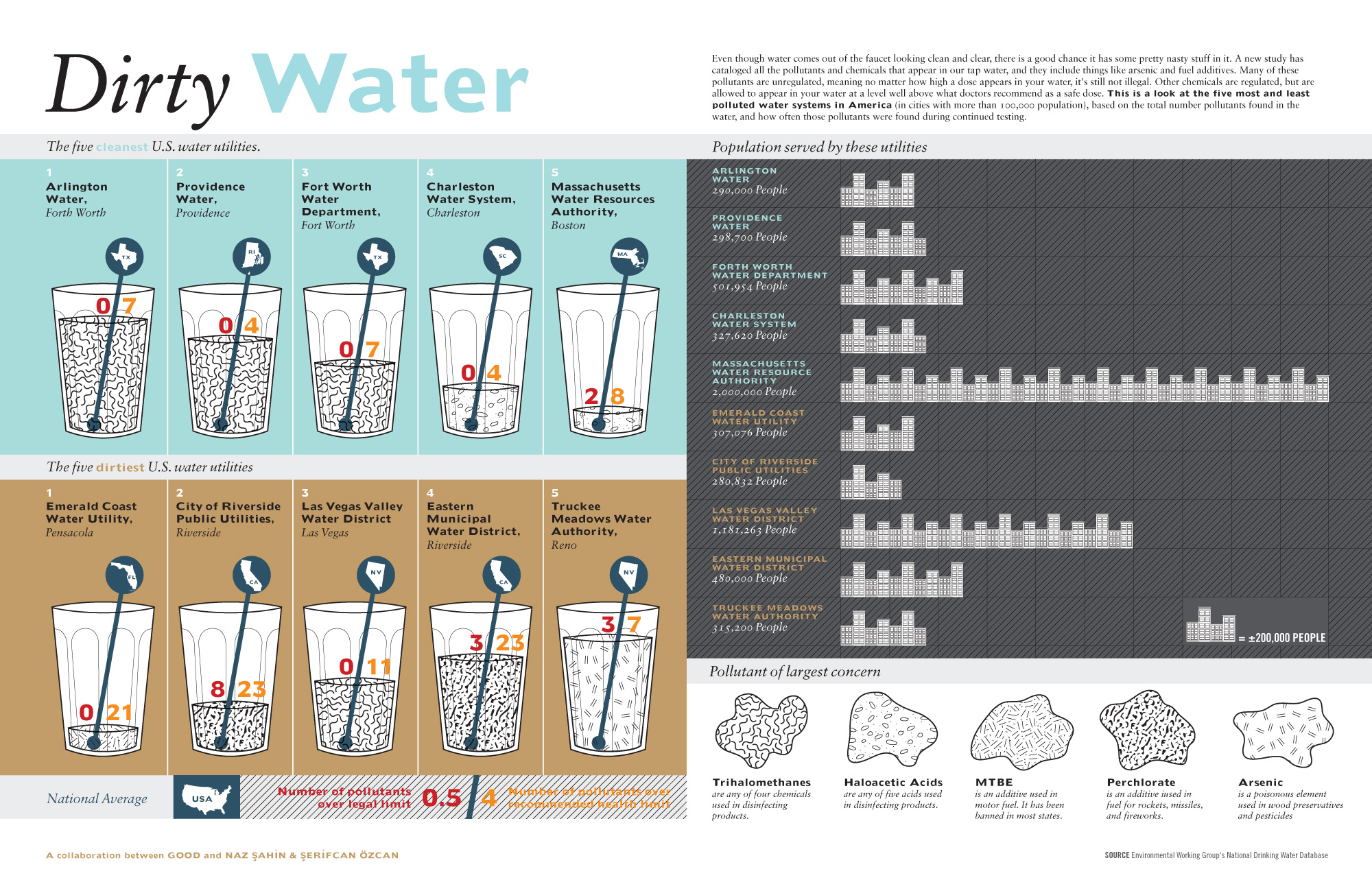
In general, most water supplies contain a number of potentially hazardous contaminants, from fluoride, to drugs and disinfection byproducts (DBPs), just to name a few. You can get a good idea of what types of contaminants could be in your drinking water right now by viewing this awesome graphic from GOOD Environment16 (reprinted with permission.) It gives you a look at the five most and least polluted water systems in America (in cities with more than 100,000 population), including pointing out the pollutants of largest concern.
I strongly recommend using a high-quality water filtration system unless you can verify the purity of your water. To be absolutely certain you are getting the purest water you can, you'll want to filter the water both at the point of entry and at the point of use. This means filtering all the water that comes into the house, and then filtering again at the kitchen sink. I currently use a whole house carbon-based water filtration system, and prior to this I used reverse osmosis (RO) to purify my water.
You can read more about water filtration in this previous article to help you make a decision about what type of water filtration system will be best for you and your family. Since most water sources are now severely polluted, the issue of water filtration and purification couldn't be more important.
Ideal Water Sources
Besides purification, I also believe it’s critical to drink living water. I recently interviewed Dr. Gerald Pollack about his book, The Fourth Phase of Water: Beyond Solid, Liquid, and Vapor. This fourth phase of water is referred to as “structured water” and is the type of water found in all of your cells. This water has healing properties, and is naturally created in a variety of ways.
Water from a deep spring is one excellent source of structured water. The deeper the better, as structured water is created under pressure. There's a great website called FindaSpring.com17 where you can find a natural spring in your area.
But you can also promote structured water through vortexing. I personally drink vortexed water nearly exclusively as I became a big fan of Viktor Schauberger who did much pioneering work on vortexing about a century ago. Dr. Pollack found that by creating a vortex in a glass of water, you’re putting more energy into it, thereby increasing the structure of the water. According to Dr. Pollack, virtually ANY energy put into the water seems to create or build structured water.
My own R&D team is working on a careful study in which we use vortexed water to grow sprouts, to evaluate the vitality and effectiveness of the water. We are conducting extensive internal research to develop the best vortex machine on the market, because we believe an ideal vortexer could be one of the simplest ways to improve people’s health.
Water Fluoridation Is Anything But Safe...
According to Bill Hirzy, water fluoridation remains a government policy because of “institutional inertia [and] embarrassment among government agencies that have been promoting this stuff as safe.” This is probably true, yet it’s shameful that the practice is allowed to continue in the face of overwhelming evidence showing the health hazards of not just fluoride itself, but also of related contaminants such as arsenic.
© Copyright 1997-2013 Dr. Joseph Mercola. All Rights Reserved.
http://articles.mercola.com/sites/articles/archive/2013/08/13/arsenic-dangers.aspx