9 Things Everyone Should Know About Farmed Fish
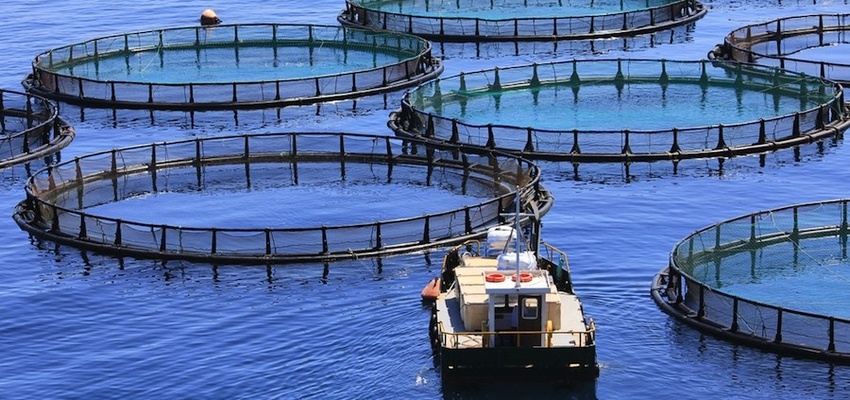
If you eat seafood, unless you catch it yourself or ask the right questions, the odds are pretty good it comes from a fish farm. The aquaculture industry is like a whale on steroids, growing faster than any other animal agriculture segment and now accounting for half the fish eaten in the U.S.
As commercial fishing operations continue to strip the world’s oceans of life, with one-third of fishing stocks collapsed and the rest headed there by mid-century, fish farming is seen as a way to meet the world’s growing demand. But is it really the silver bullet to solve the Earth’s food needs? Can marine farms reliably satisfy the seafood cravings of three billion people around the globe?
This article looks at aquaculture and its long-term effects on fish, people, and other animals. With this industry regularly touted as a paragon of food production, whether you eat seafood or not, you should know these nine key facts about farmed fish.
1. Farmed fish have dubious nutritional value.
Here’s a frustrating paradox for those who eat fish for their health: the nutritional benefits of fish are greatly decreased when it’s farmed. Take omega-3 fatty acids. Wild fish get their omega-3’s from aquatic plants. Farmed fish, however, are often fed corn, soy, or other feedstuffs that contain little or no omega-3’s. This unnatural, high-corn diet also means some farmed fish accumulate unhealthy levels of the wrong fatty acids. Further, farmed fish are routinely dosed with antibiotics, which can cause antibiotic-resistant disease in humans.
2. The farmed fishing industry robs Peter to pay Paul.
While some farmed fish can live on diets of corn or soy, others need to eat fish – and lots of it. Tuna and salmon, for example, need to eat up to five pounds of fish for each pound of body weight. The result is that prey (fish like anchovies and herring) are being fished to the brink of extinction to feed the world’s fish farms. “We have caught all the big fish and now we are going after their food,” says the non-profit Oceana, which blames aquaculture’s voracious hunger for declines of whales, dolphins, seals, sea lions, tuna, bass, salmon, albatross, penguins, and other species.
3. Fish experience pain and stress.
Contrary to the wishful thinking of many a catch-and-release angler, the latest research shows conclusively that fish experience pain and stress. In one study, fish injected with bee venom engaged in rocking behavior linked to pain and, compared to control groups, reduced their swimming activity, waited three times longer to eat, and had higher breathing rates. Farmed fish are subject to the routine stresses of hyperconfinement throughout their lives, and are typically killed in slow, painful ways like evisceration, starvation, or asphyxiation.
4. Farmed fish are loaded with disease, and this spreads to wild fish populations.
Farmed fish are packed as tightly as coins in a purse, with twenty-seven adult trout, for example, typically scrunched into a bathtub-sized space. These unnatural conditions give rise to diseases and parasites, which often migrate off the farm and infect wild fish populations. On Canada’s Pacific coast, for example, sea lice infestations are responsible for mass kill-offs of pink salmon that have destroyed 80% of the fish in some local populations. But the damage doesn’t end there, because eagles, bears, orcas, and other predators depend on salmon for their existence. Drops in wild salmon numbers cause these species to decline as well.
5. Fish farms are rife with toxins, which also damage local ecosystems.
You can’t have diseases and parasites infecting your economic units, so operators fight back by dumping concentrated antibiotics and other chemicals into the water. Such toxins damage local ecosystems in ways we’re just beginning to understand. One study found that a drug used to combat sea lice kills a variety of nontarget marine invertebrates, travels up to half a mile, and persists in the water for hours.
6. Farmed fish are living in their own feces.
That’s right, fish poop too. Farmed fish waste falls as sediment to the seabed in sufficient quantities to overwhelm and kill marine life in the immediate vicinity and for some distance beyond. It also promotes algal growth, which reduces water’s oxygen content and makes it hard to support life. When the Israeli government learned that algal growth driven by two fish farms in the Red Sea was hurting nearby coral reefs, it shut them down.
7. Farmed fish are always trying to escape their unpleasant conditions, and who can blame them?
In the North Atlantic region alone, up to two million runaway salmon escape into the wild each year. The result is that at least 20% of supposedly wild salmon caught in the North Atlantic are of farmed origin. Escaped fish breed with wild fish and compromise the gene pool, harming the wild population. Embryonic hybrid salmon, for example, are far less viable than their wild counterparts, and adult hybrid salmon routinely die earlier than their purebred relatives. This pressure on wild populations further hurts predators who rely on fish like bears and orcas.
8. See: the Jevons Paradox.
This counterintuitive economic theory says that as production methods grow more efficient, demand for resources actually increases – rather than decreasing, as you might expect. Accordingly, as aquaculture makes fish production increasingly efficient, and fish become more widely available and less expensive, demand increases across the board. This drives more fishing, which hurts wild populations. Thus, as the construction of new salmon hatcheries from 1987 to 1999 drove lower prices and wider availability of salmon, world demand for salmon increased more than fourfold during the period. The net result: fish farming cranks up the pressure on already-depleted populations of wild fish around the world.
9. When the heavy environmental damage they cause is taken into account, fish farming operations often are found to generate more costs than revenues.
One study found that aquaculture in Sweden’s coastal waters “is not only ecologically but also economically unsustainable.” Another report concluded that fish farming in a Chinese lake is an “economically irrational choice from the perspective of the whole society, with an unequal tradeoff between environmental costs and economic benefits.” Simply put, aquaculture drives heavy ecological harms and these cost society money. In the U.S., fish farming drives hidden costs of roughly $700 million each year – or half the annual production value of fish farming operations.
Now What?
With its long trail of diseases, chemicals, wastes, and suffering, and the heavy pressure it puts on wild populations through parasites, escapes, and higher demand, the sustainability of fish farms emerges as a fish story. And by the way, farmed or wild, fish are only “healthy” when compared to high-fat foods like red meat. But wild fish is no great nutritional treat either: pound for pound, salmon has just as much cholesterol as ground beef, and virtually all wild fish contains highly-toxic mercury.
Here’s one solution to the farmed fish dilemma: vote with your pocketbook and eat less seafood or give it up completely. Get your omega-3’s from flax, hemp, soy, or walnuts – all without cholesterol or mercury. And just maybe, as George W. Bush hoped in a moment of unintended comedy, “the human being and fish can coexist peacefully.”
Photo Credit: Shutterstock.com
Copyright ©2013 MindBodyGreen, LLC
MindBodyGreen.com is for informational
purposes only and is not a substitute for medical advice, diagnosis,
or treatment.
All content and images found on
MindBodyGreen.com may not be reproduced or distributed, unless
permitted in writing by MindBodyGreen, LLC.
MindBodyGreen® is a registered trademark
of MindBodyGreen, LLC.
http://www.mindbodygreen.com/0-11561/9-things-everyone-should-know-about-farmed-fish.html