Report: Economic, resource wealth do not guarantee energy system success
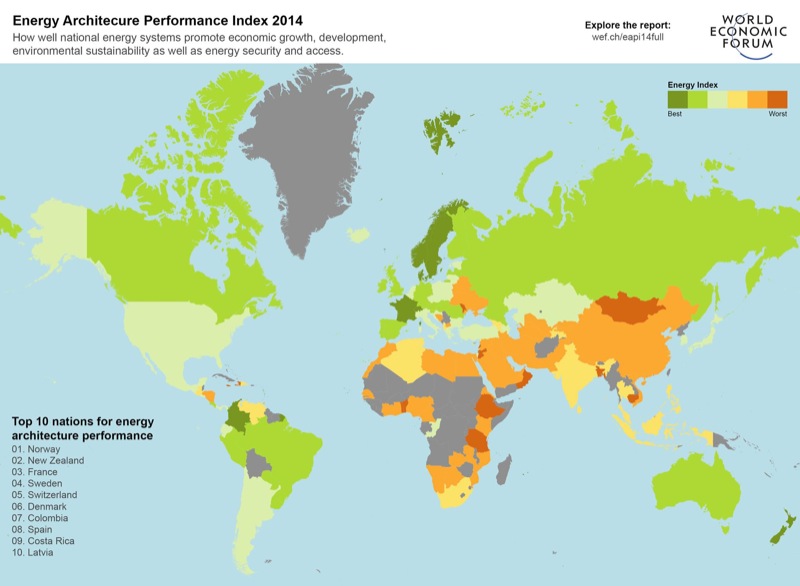
The World Economic Forum has released its annual Global Energy Architecture Performance Index of 124 countries in order to help countries spur their efforts to meet energy challenges and opportunities in innovative ways. The report, prepared in collaboration with Accenture, assesses and ranks 124 countries according to economic growth, environmental sustainability and energy security performance, analyzing the complex trade-offs and dependencies that affect country efforts.
 |
| Click to enlarge. Credit: World Economic Forum |
"Resource wealth or economic development alone do not guarantee high performance on the Index," said Roberto Bocca, senior director, head of energy industries, World Economic Forum. "For an effective energy system countries need to focus on all three sides of the energy triangle -- environmental sustainability, security of supply and affordability."
Norway tops the rankings, followed by New Zealand and France. The top 10 is dominated by EU and OECD countries with the exception of Costa Rica and Colombia; 41 percent of energy supply in the top 10 countries comes from low carbon energy sources, compared to a global average of 28 percent.
European Union and Nordic countries top the rankings, underscoring the ability of service sector economies to prioritize investment in the development of low-carbon economies and address climate change through renewables and energy efficiency. The drive for sustainability has meant some trade-offs in energy affordability, underpinning the policy debate in Europe as utilities and consumers struggle with pricing and an uncertain policy landscape.
The performance of BRICS countries (Brazil, Russia, India, China and South Africa) is impacted by the prevalence of energy- and emission-intensive industries. Ranked 21st, Brazil is the top performer in this cluster, extracting 50 percent more GDP per unit of energy use than the average of the other BRICS countries. China, the world's largest energy consumer, has successfully increased access to energy for its population but continues to struggle with rising energy imports and pollution levels.
ASEAN's performance highlights the disparity in resource allocation across the region where energy systems are fossil-fuel dominated. The demand for energy is expected to rise and put further strain on these energy systems. Interconnections in the gas and electricity systems through the ASEAN 2015 integration plans will play a key role in addressing these challenges.
Performance across North America shows contrasting circumstances, from the import and fossil fuel dependence of the Caribbean nations, to the resource wealth of Canada, the United States and Mexico.
"…there is no single way forward; each country must work with its own resources and constraints, making difficult choices and trade-offs," said Arthur Hanna, managing director, Energy Industry, Accenture, and member of the World Economic Forum's Global Agenda Council on New Energy Architecture. "The Index helps nations take stock of their energy transition challenges and address key barriers to success, such as market distorting subsidies, continued uncertainty around energy policy and funding for research and development of new energy sources and technologies."
For more:
- see this
report
© 2013 FierceMarkets. All rights reserved. http://www.fierceenergy.com