Cosmic rays reveal event in Earth's magnetic field history
Nov 29, 2012
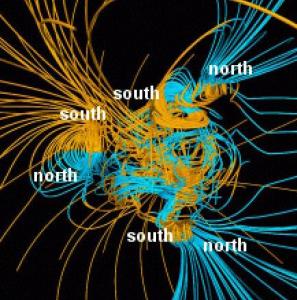
Earth's Magnetic Field in Reversal
41 000 years ago, the Earth's magnetic field faded and practically disappeared, leaving our planet unprotected from the bombardment of cosmic rays. Evidence for this event has been found in ocean sediment cores by a team from the Centre de Recherche et d'Enseignement de Géosciences de l'Environnement (CEREGE, CNRS/Aix-Marseille Université/IRD/Collège de France). In the cores, the researchers measured variations in concentrations of beryllium-10, a radioactive isotope produced by the action of cosmic rays on oxygen and nitrogen atoms in the atmosphere. The work, published in the Journal of Geophysical Research, is an important step towards developing a new method for studying the history of Earth's magnetic field, which should shed light on why its strength has been declining over the past three thousand years.
The Earth's magnetic field forms an efficient shield that
deflects charged particles of cosmic origin headed for Earth. Far
from being constant, the magnetic field has undergone many
reversals, with the North magnetic pole shifting to the South
geographic pole. Such reversals are always accompanied by a
disappearance of the magnetic field. The last such reversal took
place 780 000 years ago. The magnetic field can also undergo
excursions, periods when the field suddenly drops as if it was going
to reverse, before recovering its normal polarity. The most recent
event of this kind, known as the Laschamp excursion, took place
41 000 years ago.
Evidence for the event was uncovered by the researchers in
sediment cores collected off the coasts of Portugal and
Papua New Guinea. In the samples, they found an excess of
beryllium-10, an isotope produced solely by collisions between
particles of
cosmic origin and atoms of nitrogen and oxygen. The beryllium-10
(10Be) produced in the atmosphere then falls to the
Earth's surface where it is incorporated into ice and sediments. In
sedimentary beds dating from the age of the Laschamp excursion, the
researchers found up to twice as much 10Be as normal,
evidence of the intense cosmic ray bombardment that the Earth
underwent for several thousand years.
Traditionally, the presence of various iron oxides, especially
magnetite, in volcanic lavas, sediments and ancient pottery provides
information on the history of the magnetic field by indicating its
direction and strength at the time when these materials solidified.
This so-called paleomagnetic approach does not always allow global
variations in the magnetic field to be quantified accurately. The
researchers combined this method with the measurement of
beryllium-10 concentrations in the same sedimentary records. This
enabled them to demonstrate that peak concentrations of this isotope
are synchronous and have the same dynamics and amplitude in Atlantic
and Pacific sediments as in the previously analyzed Greenland ice
cores. The method based on beryllium-10, which has been developed
over the past 10 years at CEREGE, therefore makes it possible to
obtain a continuous reconstruction of variations in the strength of
the Earth's global magnetic field.
It is also known that over the past 3000 years the magnetic field
has lost 30% of its strength. This trend suggests that in the coming
centuries, the Earth might undergo an excursion similar to the one
that took place 41 000 years ago. Since high energy
cosmic rays can cause mutations and cell damage, such an event
would have a significant impact on biodiversity, and in particular
on humans. This is why the researchers are seeking to find out the
precise rates of the
magnetic field's reversal and excursion sequences, in order to
identify potential regularities in its behavior and thus shed light
on the cause of these phenomena, which originate in the Earth's
core. This is the objective of the MAGORB project, launched in 2009,
funded by the French National Research Agency ANR and run by CEREGE,
the Institut de Physique du Globe de Paris (IPGP) and the
Laboratoire des Sciences du Climat et de l'Environnement (LSCE,
CNRS/CEA/UVSQ).
Explore further: An extremely brief reversal of the geomagnetic field, climate variability and a super volcano
More information: L. Ménabréaz, D. L. Bourlès, N.
Thouveny, in press. Amplitude and timing of the Laschamp geomagnetic
dipole low from the global atmospheric 10Be overproduction:
contribution of authigenic 10Be/9Be ratios in West Equatorial
Pacific sediments. Journal of Geophysical Research. 8
November 2012.