 |
This factsheet provides the number of “green” jobs in the
United States as well as a more specific consideration of
employment in the renewable energy and energy efficiency
sectors. According to Environmental Entrepreneurs, in 2012
alone the clean energy sector created 110,413 jobs. Job
figures in renewable energy and energy efficiency were
obtained by referring to studies and reports published by
the Department of Energy, the Bureau of Labor Statistics and
a host of non-profits, think tanks and national trade
associations.
Green Jobs in the United States
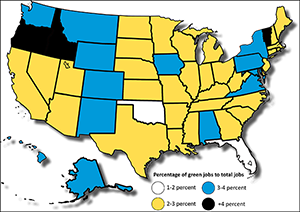
The following map represents the percentage of green jobs to total jobs in each state using the Bureau of Labor Statistics (BLS) figures on green jobs by state.
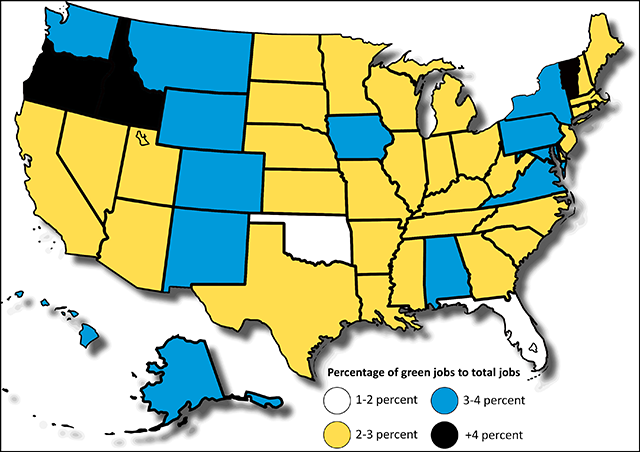
According to a 2013 analysis by the BLS, in the fourth
quarter of 2011 there were 3.4 million green jobs in the
United States. Overall, green jobs represented 2.6 percent
of jobs in the United States, although, as shown in the
previous map, individual states have higher or lower
percentages based on their total state employment.
The BLS defines “green” jobs as those that “produce goods
or provide services that benefit the environment or conserve
natural resources.” Additionally, jobs are categorized as
green if the duties “involve making their establishment’s
production processes more environmentally friendly or use
fewer natural resources.” The BLS definition of green jobs
includes far more than just employment in the renewable
energy and energy efficiency sectors. In addition, the study
includes: pollution reduction and removal; greenhouse gas
reduction; recycling and reuse; organic agriculture;
sustainable forestry; soil, water and wildlife conservation;
government and regulatory administration; education,
training and advocacy related to green technologies and
practices.
A study performed by the Brookings Institution and
Battelle found that 2.7 million people were directly
employed in the “clean economy” in 2010, more than the 2.4
million employed in the fossil fuel industry. The clean
economy is defined as employment “that produces goods and
services with an environmental benefit or adds value to such
products using skills or technologies that are uniquely
applied to those products.” The Brookings-Battelle study
includes: agricultural and natural resources conservation,
education and compliance, energy and resource efficiency,
greenhouse gas reduction, environmental management and
recycling, and renewable energy.
Energy Efficiency & Renewable Energy Employment
The following sections compile the industry specific assessments of employment in the energy efficiency and renewable energy fields from national laboratories, industry groups and non-profits. Many of the assessments include direct and indirect employment. The figures for each technology were collected from different sources; therefore there are differences in data collection methodology and specific job categorizations, which are noted in the tables below.
Energy Efficiency
In 2008, the Lawrence Berkeley National Laboratory estimated
that 380,000 people were employed in the energy
efficiency services sector. According to the American
Council for an Energy-Efficient Economy (ACEEE), robust
investment in energy efficiency could save $1.2 trillion by
2020, and the United States could create 1.3 to 1.9 million
jobs by 2050 through the deployment of energy efficient
technologies. Similarly, the Alliance to Save Energy (ASE)
projects 1.3 million jobs by 2030.
The following table is drawn from the Brookings-Battelle
study, which has identified specific sectors within energy
efficiency. Altogether the sectors provide 823,105
direct jobs.
|
Type of Energy Efficiency |
U.S. Job Estimates |
Relation to Industry |
|
Public Mass Transit |
350,547 |
Direct |
|
Energy-saving Building Materials |
161,896 |
Direct |
|
HVAC and Building Control Systems |
73,600 |
Direct |
|
Green Architecture and Construction Services |
56,190 |
Direct |
|
Professional Energy Services |
49,863 |
Direct |
|
Appliances |
36,608 |
Direct |
|
Energy-saving Consumer Products |
19,210 |
Direct |
|
Battery Technologies |
16,129 |
Direct |
|
Smart Grid |
15,987 |
Direct |
|
Electric Vehicle Technologies |
15,711 |
Direct |
|
Lighting |
14,298 |
Direct |
|
Water Efficient Products |
13,066 |
Direct |
|
TOTAL |
823,105 |
|
Renewable Energy
Biofuels: In a report commissioned by the Renewable
Fuels Association, the consulting firm Cardno-ENTRIX found
that in 2012 the ethanol industry supported 383,260
jobs. Of these jobs, more than 87,000 were direct employment
and the remainder were indirect or induced. For advanced
(non-corn-based) biofuels, Environmental Entrepreneurs
estimates that new refineries alone have the potential to
create more than 18,000 jobs by 2015. Furthermore, if state
and federal clean fuel standards are implemented as planned,
the entire advanced biofuel industry could create up to
48,000 direct, indirect and induced jobs by 2015.
Hydropower: In 2010, the National Hydropower
Association commissioned a Navigant Consulting report which
concluded that between 200,000 and 300,000
people were employed by the U.S. hydropower industry in
project development, manufacturing, project deployment, and
operations and maintenance. According to the same study, 5.3
jobs are created for every megawatt of new small hydropower
installed.
Solar: The Solar Foundation estimated that the
U.S. solar industry employed 119,016 workers as of
November 2012. This is a 13.2 percent increase in employment
from November 2011. When considering the 2.3 percent growth
rate of employment in the overall economy during this time
period, the solar industry’s 13.2 percent growth in
employment means that the solar industry created 1 out of
every 230 American jobs.
Wind: According to the American Wind Energy
Association (AWEA), the wind industry and related fields
employed more than 80,000 Americans in 2012. This
includes jobs associated with development, manufacturing,
construction and operations, as well as services provided.
According to a study by Navigant Consulting, a four-year
extension of the Wind Production Tax Credit (PTC) would
increase industry employment to 95,000 by 2016.
Biodiesel: The National Biodiesel Board
commissioned a report from Cardno-ENTRIX which found that
the biodiesel industry employed 64,044 people in 2012
– when direct, indirect and induced jobs are included. The
same study concluded that with the 2013 extension of the
federal biodiesel tax credit, employment could increase to
more than 112,000 in 2013.
Geothermal: The Geothermal Energy Association
(GEA) estimated in 2010 that 1.7 direct jobs and 4.25
indirect and induced jobs are created for every megawatt of
geothermal capacity installed. Based on the current
installed geothermal capacity of 3,386 megawatts, the U.S.
geothermal power industry employs 20,147 people.
Biomass Power: According to the Biomass Power
Association, the biomass power industry employs 14,000
people.- A 2011 REN21 study attributes a significantly
higher figure of 66,000 jobs to biomass power.
Fuel Cells: In February 2011, Fuel Cells 2000
estimated that 3,615 direct and 7,230 indirect jobs can be
attributed to fuel cells, bringing the total to 10,845
jobs in the United States.
Waste-to-Energy: The Energy Recovery Council
reports that the waste-to-energy sector employs 7,000
Americans. There are 86 plants across the country.
Wave & Ocean Power: According to the Brookings-Battelle Clean Economy Database, wave and ocean power employed 371 people in 2010. The sector experienced a 20.9 percent annual increase in employment from 2003 to 2010.
The following table summarizes the job estimates for each
of the aforementioned renewable energy technologies.
|
Type of Clean Energy |
U.S. Job Estimates |
Relation to Industry |
|
Biofuels |
383,260 |
Direct, Indirect & Induced |
|
Hydropower |
200,000 – 300,000 |
Direct |
|
Solar |
119,016 |
Direct-spend at least 50% of time working on solar |
|
Wind |
80,000 |
Direct & Indirect |
|
Biodiesel |
64,044 |
Direct, Indirect & Induced |
|
Geothermal |
25,000 |
Direct, Indirect & Induced |
|
Biomass |
14,000 – 66,000 |
Unknown |
|
Fuel Cells |
10,845 |
Direct & Indirect |
|
Waste-to-Energy |
7,000 |
Unknown |
|
Wave & Ocean Power |
371 |
Direct |
|
Total |
903,536 – 1,055,536 |
|
The Brookings-Battelle study also reports job figures in renewable energy, but differs from the table above in that only direct jobs are included. Technologies included in that Brookings-Battelle study are: hydropower, wind, solar photovoltaic, biofuels/biomass, solar thermal, waste-to-energy, geothermal, renewable energy services, and wave and ocean power. The sum total of that tally is 138,364 direct jobs.
 |
Download this fact sheet in PDF format (with endnotes) |
Author: Omar Bagnied
Editor: Blaise Sheridan