Ancient Trapped Water
The world is a big place with a lot of cavities and hidden places. Scientists have now discovered water that has been trapped in rock for more than a billion years. The water might contain microbes that evolved independently from the surface world, and it's a finding that gives new hope to the search for life on other planets and how it may appear or act. The water samples came from holes drilled by gold miners near the small town of Timmins, Ontario, about 350 miles north of Toronto. Deep in the Canadian bedrock, miners drill holes and collect samples. Sometimes they hit pay dirt; sometimes they hit water, which seeps out from tiny crevices in the rock.
A UK-Canadian team of scientists has discovered ancient pockets of
water, which have been isolated deep underground for billions of years
and contain abundant chemicals known to support life.
The findings, published in Nature, may force us to rethink which parts
of our planet are fit for life, and could reveal clues about how
microbes evolve in isolation.
Greg Holland, a geochemist at in England, and his colleagues wanted to
know just how long that fluid had been trapped in the rock. So they
looked at the decay of radioactive atoms found in the water and
calculated that it had been bottled a long time — at least 1.5 billion
years.
"That is the lower limit for the age," Holland says. It could be a
billion years older. That means the water was sealed in the rock before
humans evolved, before pterosaurs flew, and before multicellular life.
They found that the isolated water is rich in dissolved gases like
hydrogen, methane and different isotopes of noble gases such as helium,
neon, argon and xenon. Indeed, there is as much hydrogen in the water as
around hydrothermal vents in the deep ocean, many of which teem with
microscopic life.
The hydrogen and methane come from the interaction between the rock and
water, as well as natural radioactive elements in the rock reacting with
the water. These gases could provide energy for microbes to live that
may not have been exposed to the sun for billions of years.
The crystalline rocks surrounding the water are thought to be around 2.7
billion years old. But no-one thought the water could be the same age,
until now.
But how did it end up underneath that gold mine in northeastern Canada?
Where did it come from?
"The fluids that we see now are actually preservations of ancient
oceans," Holland says.
Beneath prehistoric seas, tectonic plates were spreading and magma was
welling up to form new rock. As the rock matured under heat and
pressure, water was trapped inside tiny cracks.
"It's managed to stay isolated for almost half the lifetime of the
Earth," Holland says. It's a time capsule. And it doesn't just hold
water. "There's a lot of hydrogen in these samples."
Mars also has a lot of water in its polar ice caps. If water is also
trapped in the planet's crust, experts say, it could house its own
ancient signs of microbial life.
And that trapped hydrogen, says Holland, "could provide the energy for
life to survive in isolation for 2 billion years."
Holland's colleagues are now testing the water samples for evidence of
microbes. They hope to have results within a year. If life is found, it
would have evolved distinctly from the surface world and might give a
unique insight into the earliest forms of life on Earth. Its discovery
would also give hope to for life in places that are even more remote.
Carol Stoker, a research scientist with NASA, is focused on searching
for life on Mars.
"If you go back to the very early history of Earth and Mars, sort of the
first billion years after the surfaces cooled, Earth and Mars looked
very similar," Stoker says.
For further information see
Trapped Water.
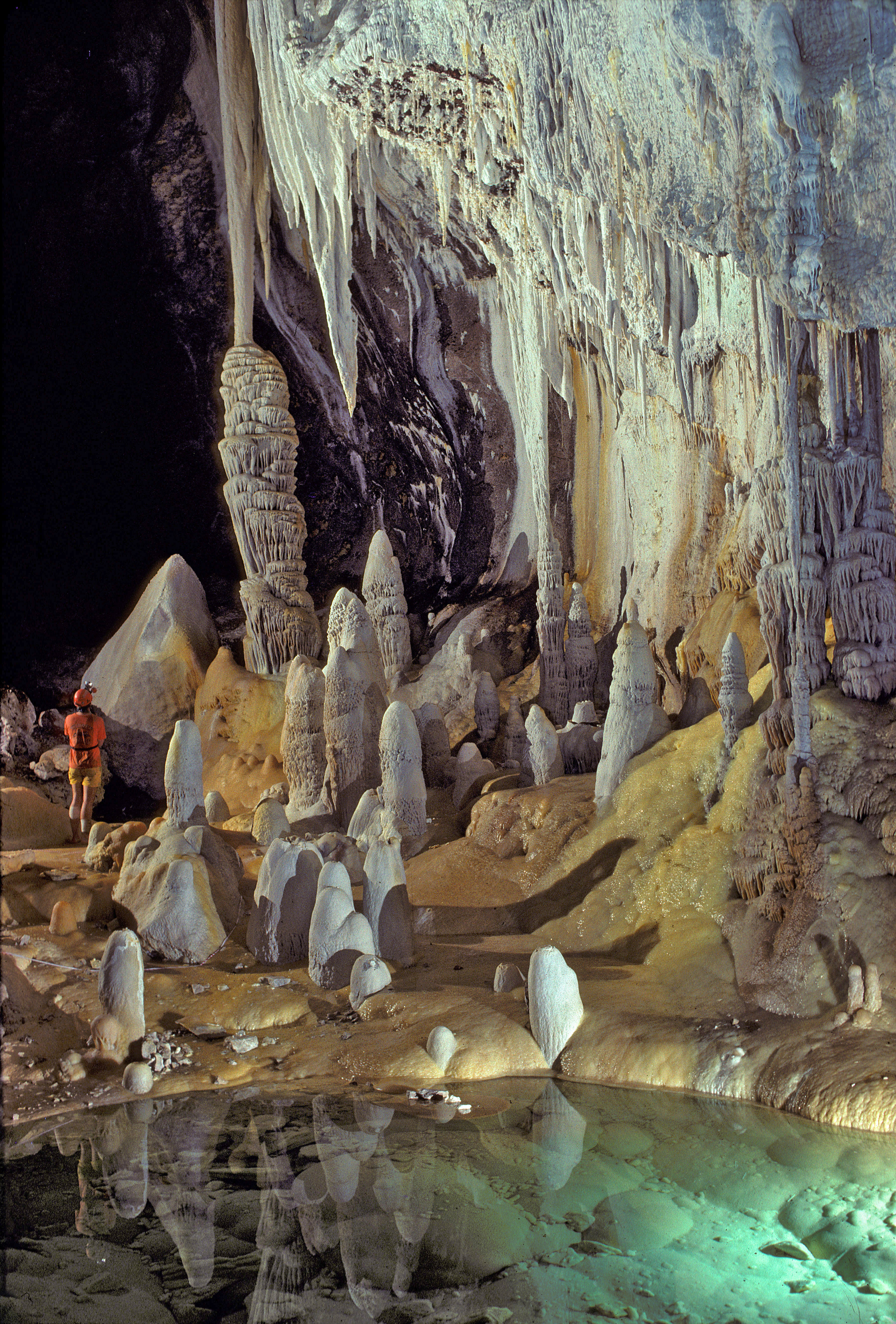
Cave image via Wikipedia.
©2013. Copyright Environmental News Network To subscribe or visit go to: http://www.enn.com