Intermittent Fasting Shown to Improve Diabetes and Reduce Cardiovascular Risk
May 17, 2013

Story at-a-glance
- A new review evaluating intermittent fasting found that overweight or obese individuals with type 2 diabetes who fast on consecutive or alternate days lost more weight while also experiencing enhanced cardiovascular health benefits
- The therapeutic potential of intermittent fasting remained even when total calorie intake per day did not change, or was only slightly reduced
- Other benefits of intermittent fasting include limiting inflammation, reducing blood pressure, improvements in body composition and more
- A typical intermittent fasting strategy is to restrict your daily eating to a specific window of time, such as a six to eight-hour span from around 11am to 7 pm
By Dr. Mercola
Intermittent fasting is a powerful approach to eating that is becoming very popular because it can help you lose weight while reducing your risk of chronic diseases like diabetes and heart disease.
While this approach is just now starting to catch on in the media, there’s nothing “new” about it. Our ancestors rarely had access to food 24/7 like we do today, and it’s likely that our genes are optimized for the more sporadic, intermittent meals that they ate.
Fasting has been an important part of religious traditions for centuries, while the health benefits of intermittent fasting have been appreciated since the 1940s,1 although they are just now achieving more mainstream popularity.
So far, the research overwhelmingly supports this notion that ditching the “three square meals a day” approach in favor of intermittent fasting may do wonders for your health.
The Benefits of Intermittent Fasting Confirmed by the Latest Research
A new review evaluated the various approaches to intermittent fasting, particularly the advantages and limitations for its use in fighting obesity and type 2 diabetes.2
What the researchers found was that overweight or obese individuals with type 2 diabetes who fast on consecutive or alternate days lost more weight, while also experiencing enhanced heart health and cardioprotective benefits.
Studies included in the review showed a broad range of therapeutic potential even when total calorie intake per day did not change, or was only slightly reduced. This includes evidence that intermittent fasting may:
Limit inflammation Improve circulating glucose and lipid levels Reduce blood pressure Improve metabolic efficiency and body composition Cause significant reductions in body weight in obese individuals Help prevent type 2 diabetes, as well as slow its progression Reverse type 2 diabetes Improve pancreatic function Improve insulin levels and insulin sensitivity Reproduce some of the cardiovascular benefits associated with physical exercise Protect against cardiovascular disease Modulate levels of dangerous visceral fat Reduce LDL and total cholesterol levels
What Type of Intermittent Fasting Program is Best?
It's long been known that restricting calories in certain animals can increase their lifespan by as much as 50 percent, but more recent research suggests that sudden and intermittent calorie restriction appears to provide the same health benefits as constant calorie restriction, providing an alternative for those who cannot successfully reduce their everyday calorie intake (or who simply don’t want to!).
Researchers noted in the British Journal of Diabetes & Vascular Disease:3
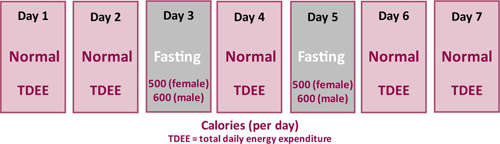
“Intermittent fasting can be undertaken in several ways but the basic format alternates days of ‘normal’ calorie consumption with days when calorie consumption is severely restricted. This can either be done on an alternating day basis, or more recently a 5:2 strategy has been developed [see figure below], where 2 days each week are classed as ‘fasting days’ (with <600 calories consumed for men, <500 for women).
Importantly, this type of intermittent fasting has been shown to be similarly effective or more effective than continuous modest calorie restriction with regard to weight loss, improved insulin sensitivity and other health biomarkers … Despite the seemingly strict nature of the fasting days intermittent fasting has a generally good adherence record.”
Dr. Mosley, one of the study’s researchers, claims to have lost 19 pounds in two months by following this recommendation.
Restricting Your Daily Eating to a Specific Window of Time is Another Option
Another version of intermittent fasting, and the one I actually prefer and use, is when you simply restrict your daily eating to a specific window of time, such as an eight hour window. This is feasible and convenient for most people, but you can restrict it even further — down to six, four or even two hours, if you want, but you can still reap many of the rewards by limiting your eating to a window of about 8 hours.
For instance, this means eating only between the hours of 11am until 7pm, as an example. Essentially, this equates to simply skipping breakfast and making lunch your first meal of the day instead. Personally, I have been experimenting with different types of scheduled eating in my own life for the past two years, and I currently restrict my eating to an 8-hour window each day.
The rationale behind this approach is that it takes about six to eight hours for your body to burn the carbs stored in your body as glycogen. After that your body is stimulated to burn fat as its primary fuel. It takes a few weeks or more to make this transition and during that time one typically does have sugar cravings. But you can use coconut oil as a short-chain fat that is rapidly broken down and can supply your body as fuel during this period to relieve your cravings and provide you with a source of energy until your body can effectively burn your own fat.
I lost about seven pounds when I implemented the approach last year, but the most amazing aspect is not the weight loss, it’s the absence of hunger and sugar cravings once you are “fat adapted.” Your desire to eat unhealthy foods seems to disappear; at least, that was my experience.
One of the best things about intermittent fasting is that you’re NOT supposed to starve yourself. You’re not even required to restrict the amount of food you eat when on this type of daily scheduled eating plan, just choose healthy foods and be careful to minimize carbs and replace them with healthy fats, like coconut oil, olive oil, olives, butter, eggs, avocados and nuts. It typically takes several weeks to shift to fat-burning mode, but once you do your body will actually be able to burn your stored fat and not have to rely on new carbs for fuel.
Three Reasons Why Intermittent Fasting Works
For people who loathe the idea of dieting, intermittent fasting offers a simple alternative that doesn’t involve calorie counting or starvation. In fact, I prefer to think of intermittent fasting as a lifestyle shift rather than simply a diet change. It’s a way of living and eating that can help you live a longer, healthier life without feeling like you’re sacrificing too much. If you’re still skeptical, there are three major mechanisms by which fasting benefits your body, as it extends lifespan and protects against disease, including:
- Increased insulin sensitivity and mitochondrial energy efficiency – Fasting increases insulin sensitivity along with mitochondrial energy efficiency, and thereby retards aging and disease, which are typically associated with loss of insulin sensitivity and declined mitochondrial energy.
- Reduced oxidative stress – Fasting decreases the accumulation of oxidative radicals in the cell, and thereby prevents oxidative damage to cellular proteins, lipids, and nucleic acids associated with aging and disease.
- Increased capacity to resist stress, disease and aging – Fasting induces a cellular stress response (similar to that induced by exercise) in which cells up-regulate the expression of genes that increase the capacity to cope with stress and resist disease and aging.
Adding This to Intermittent Fasting Can Give You Even More Benefits …
If you’re impressed by intermittent fasting’s potential to improve diabetes and offer cardioprotective benefits, you’ll surely want to know about another lifestyle measure that works synergistically with fasting to offer even more benefits: high-intensity interval training (HIIT).
HIIT, which is a foundational part of my comprehensive exercise recommendations, is another aspect of optimal health that I’ve been trying to drill into my readers since the mid-2000s, when the science behind it was showing signs of being really solid. Now the mainstream is finally starting to catch up on this as well, and proof that it really does work as advertised is becoming increasingly evident as people are trying it out. Dr. Mosley also points out the importance of HIIT — especially in conjunction with fasting.
When you exercise while fasting, it essentially forces your body to shed fat, as your body's fat burning processes are controlled by your sympathetic nervous system (SNS), and your SNS is activated by exercise and lack of food. The combination of fasting and exercising maximizes the impact of cellular factors and catalysts (cyclic AMP and AMP Kinases), which force the breakdown of fat and glycogen for energy.
Intensity is KEY for reaping all the benefits interval training can offer. To perform it correctly, you'll want to raise your heart rate to your anaerobic threshold, and to do that, you have to give it your all for 20- to 30-second intervals. I use and recommend the program developed by Phil Campbell, which will also trigger human growth hormone (HGH) production -- a synergistic, foundational biochemical underpinning that promotes muscle and effectively burns excessive fat -- as you go "all out" during the exertion phase.
Who Shouldn’t Fast?
If you're hypoglycemic, diabetic, or pregnant (and/or breastfeeding), you are better off avoiding any type of fasting or timed meal schedule until you've normalized your blood glucose and insulin levels, or weaned the baby. Other categories of people that would be best served to avoid fasting include those living with chronic stress and those with cortisol dysregulation.
Please keep in mind also that proper nutrition becomes even MORE important when fasting, so addressing your diet really should be your first step. Always listen to your body, and go slow; work your way up to 16-18 hour fasts if your normal schedule has included multiple meals a day. Also be sure to address any hypoglycemic tendencies, such as headaches, weakness, tremors or irritability, as it can get increasingly dangerous the longer you go without eating to level out your blood sugar.
© Copyright 1997-2013 Dr. Joseph Mercola. All Rights Reserved.
http://fitness.mercola.com/sites/fitness/archive/2013/05/17/intermittent-fasting-diet.aspx