Occupants, designers, builders need help with net-zero facilities
The increasing global awareness of the impact of building energy consumption on climate change is driving the efficiency of buildings.
 |
|
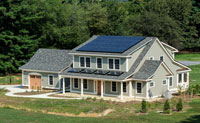
The Net-Zero Energy Residential Test Facility sits on the campus of the National Institute of Standards and Technology. The facility allows researchers to test various high-efficiency and alternative energy systems, materials, and designs. Credit: Young/NIST |
Recent research from Lux Research predicts that materials to boost energy efficiency will reach $16.5 billion in sales in 2017. Floor space for net-zero energy buildings (NZEB) and nearly-zero energy buildings (nNZEB), will rise more than six-fold to 80 million square meters in 2017, according to Lux Research.
"A robust market is emerging despite the fact that no country will meet its 2017 targets for nNZEBs on account of uncertain implementation plans of ambitious policy targets in the European Union and select countries in the Asia-Pacific region," said Aditya Ranade, a Lux Research senior analyst.
Lux Research analysts surveyed the global market, tracked 391 NZEB projects, and assessed key enabling technologies in order to identify drivers and project the market size for building envelope materials over the next five years to find that Europe leads the market now, but Asia-Pacific will catch up in 2017. Europe will garner a whopping 61 percent share of the energy-saving building envelope materials market. However, Asia-Pacific's share of annual nNZEB installations will rise from 23 percent in 2012 to 39 percent in 2017 due to higher rates of new construction.
A few technologies will dominate materials markets in the near term, including high-R value glazing and daylighting skylights which, together, will account for 86 percent, or $14.2 billion, of the total market for building envelope materials. High-R value glazing alone will be worth $8.2 billion.
Commercial and institutional buildings will be a main untapped source of revenue for utilities. Specifically, of the total NZEB floor space available, 93 percent is commercial and institutional.
The residential sector is also a market for utilities to tap. Currently, the residential segment holds a 35 percent market share. The behaviors of homeowners and builders may provide the most complex set of challenges, according to a report from the National Institute of Standards and Technology (NIST). One clear need is to help designers, builders and occupants understand how best to collect and analyze home energy data, according to NIST.
For more:
- see this
report
© 2013 FierceMarkets. All rights reserved. http://www.fierceenergy.com
Sign up for our FREE newsletter for more news like this sent to your inbox!