Pesticide Producers Turn to 'Bee-Washing' to Fight Backlash
Pesticide makers have taken to framing themselves as stewards of the bees as backlash over their products' links to mass bee deaths grows.
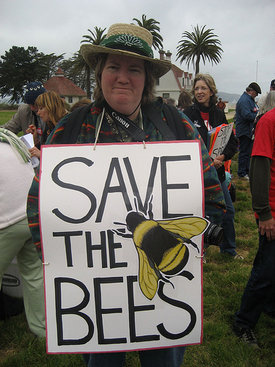
(Photo: Kevin Krejci/cc/flickr) "Scientists, consumer groups, beekeepers and others blame the devastating rate of bee deaths on the growing use of pesticides sold by agrichemical companies to boost yields of staple crops such as corn," Reuters' Carey Gillam reports, and this uproar worries officials at Bayer and Syngenta, who make the pesticides, as well as Monsanto, DuPont and other companies who used them as coatings for the seed they sell.
So just as some companies have tried to "greenwash" their toxic products, these agrichemical companies are engaging in "bee-washing." Gillam continues:
Monsanto Co is hosting a "Bee Summit." Bayer AG is breaking ground on a "Bee Care Center." And Sygenta AG is funding grants for research into the accelerating demise of honeybees in the United States, where the insects pollinate fruits and vegetables that make up roughly a quarter of the American diet.
The agrichemical companies are taking these initiatives at a time when their best-selling pesticides are under fire from environmental and food activists who say the chemicals are killing off millions of bees. The companies say their pesticides are not the problem, but critics say science shows the opposite.
The “Bayer Bee Care Centers”—one in Germany, the other in North Carolina—are an attempt to show the company's commitment to bees and sustainable agriculture, it says.
“Bayer is committed to environmental stewardship and sustainable agricultural practices, including the protection of beneficial insects such as honey bees,” Professsor Wolfgang Plischke, the member of the Bayer AG Board of Management responsible for Technology, Innovation and Sustainability, announced in a statement on the company's website last year. “We have been providing products specifically designed to ensure bee health for more than 25 years,” Plischke said.
Monsanto, too, has stated that it "knows that honey bees are a key component to successful sustainable agriculture globally" and that it "is committed to sustainable agriculture."
In April the European Union put a two-year ban on the use of a class of pesticides known as neonicotinoids. The decision "disappointed" neonicotinoid maker Bayer CropScience. The company "shares the concerns surrounding bee health," it says, and believes that continued use of such pesticide products is "vital."
The agrichemical companies have dismissed numerous studies linking the pesticides to bee deaths, instead pointing to other factors such as mites.
The use of this group of pesticides continues in the U.S., however, despite a recent EPA and USDA study that showed a strong link between the pesticides and mass bee deaths.
_____________________________