The most powerful permanent magnets
Contrary to their name, rare-earth magnets are not made from rare materials; they are nevertheless the most powerful permanent magnets. The term "rare-earth" originates from the 17 elements in the periodic table used in making the magnets: the 15 lanthanides, scandium, and yttirum.
Rare-earth magnets are available in two types:
samarium-cobalt or neodymium, and are excessively brittle
and susceptible to corrosion. For this reason, the magnets
must be plated.
Compared to traditional ferrite and ceramic
magnets, the magnetic field produced by rare-earth magnets
is considerably stronger, measuring 1.4 teslas, the unit of
measuring magnetic flux density, versus the 0.5 to 1.0 tesla
of the other two.
Type 1 Samarium-cobalt
Samarium-cobalt magnets are the first class of rare magnets
invented. Higher cost and weaker magnetic field than
neodymium magnets, makes samarium-bolts less popular than
the latter; however, this types of magnet has a higher Curie
temperature, making it ideal for use in "applications where
high field strength is needed at high operating
temperatures." Do note that while Samarium-cobalt magnets
may resist oxidation, they are prone to chipping and
cracking because they are brittle.
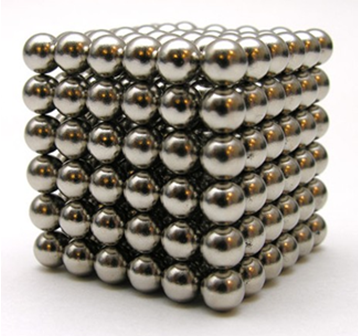
Neodymium magnetic spheres arranged in a cube; image courtest of Orbtronic.
Type 2 Neodymium
Neodymium are both the strongest and cheapest type of
rare-earth magnet. Neodymium magnets created from a
combination of the alloy of neodymium, iron, and boron. This
type of magnet is primarily used in jewelry clasps, magnetic
hold downs, hard drives, and electric motors for cordless
tools, as they strong and compact permanent magnets.
Compared to samarium-cobalt magnets, neodymium magnets exhibit a higher magnetic field strength at the cost of a lower Curie temperature and higher vulnerability to oxidation. Nevertheless, the magnets may be coated in a protective layer made from gold, nickel, zinc, or tin plating and epoxy resin coating to protect against corrosion.
The price of neodymium magnets was significantly higher prior to the 1990's, but expiring patents opened up commerce to more manufacturers, thus creating the competition necessary to lower prices.
Application
Rare-earth magnets are being increasingly used in
applications requiring powerful magnets such as audio
speakers, headphones, bicycle dynamos, high-performance AC
servo motors, hard drives, linear motors, electrodynamic
bearings, launched roller coasters, and even in toys such as
miniature figures.. This strength allows the magnets to be
smelted into a smaller and lighter size.
How are they built?
Once the raw material is grounded, it is combined
in various mixtures to create materials of varying grades of
magnetism, durability, and Curie temperature.
The resulting mixture is then pressed together into a
form. Afterwards, a large electromagnetic is used to arrange
the atomic particles and their electron spin in a specific
direction. Next everything is sintered to form a solid
object by heating the powder right below its melting
temperature thereby forcing the atoms to fuse together into
a solid piece.
Now that a solid shape has been established, it can be
milled to the desired dimensions. At this point the
soon-to-be magnet must be plated to protect against
corrosion; nickel, copper + nickel, epoxy coating, gold,
zinc, or ABS plastic, are all adequate plating materials.
By this stage the materials ready to be magnetized. Do note that neodymium magnets can only be magnetized in the direction that their electrons were aligned in during the preparation stage.
Visit TechXchange to discuss applications for rare-earth magnets.
By Maximilian Teodorescu