NREL quantifies impact of cycling on fossil-fueled power plants
To accommodate higher amounts of wind and solar power on the electric grid, utilities must cycle (start and stop their conventional generators) more frequently to provide reliable power to their customers. New research from the Energy Department's National Renewable Energy Laboratory (NREL) quantifies the potential impacts of increasing wind and solar power generation on the operators of fossil-fueled power plants in the West.
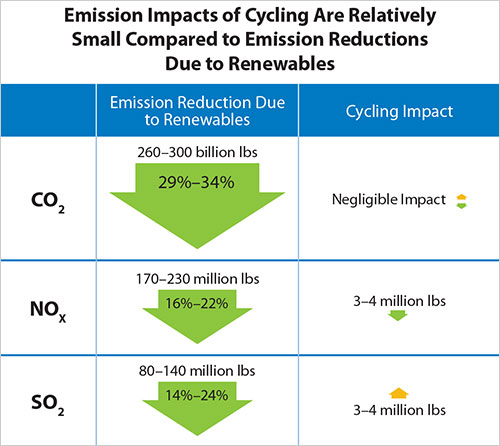 |
| The increase in plant emissions from cycling to accomodate variable renewables are more than offset by the overall reduction in CO2, NOx, and SO2. Click to enlarge. Credit: NREL |
The study finds that the carbon emissions induced by more frequent cycling are negligible (less than 0.2 percent) compared with the carbon reductions achieved through the wind and solar power generation evaluated in the study. Sulfur dioxide emissions reductions from wind and solar are 5 percent less than expected because of cycling of fossil-fueled generators. Emissions of nitrogen oxides are reduced 2 percent more than expected. The study also finds that high levels of wind and solar power would reduce fossil fuel costs by approximately $7 billion per year across the West, while incurring cycling costs of $35 million to $157 million per year. For the average fossil-fueled plant, this results in an increase in operations and maintenance costs of $0.47 to $1.28 per megawatt-hour of generation.
"Grid operators have always cycled power plants to accommodate fluctuations in electricity demand as well as abrupt outages at conventional power plants, and grid operators use the same tool to accommodate high levels of wind and solar generation," said Debra Lew, NREL project manager for the study. "Increased cycling to accommodate high levels of wind and solar generation increases operating costs by 2 percent to 5 percent for the average fossil-fueled plant. However, our simulations show that from a system perspective, avoided fuel costs are far greater than the increased cycling costs for fossil-fueled plants."
The study found that the high wind and solar scenarios reduce CO2 emissions by 29 to 34 percent across the Western Interconnection, with cycling having a negligible impact. Cycling lessens the SO2 benefit by 2 to 5 percent so SO2 emissions are reduced by 14 to 24 percent in the high scenarios. Cycling actually improves the NOx benefit by 1 to 2 percent so NOx emissions are reduced by 16 to 22 percent in the high scenarios.
"From a system perspective, high proportions of wind and solar result in lower emissions and fuel costs for utility operators," Lew said. "The potential cycling impacts offset a small percentage of these reductions."
For more:
- see the report
Sign up for our FREE newsletter for more news like this sent to your inbox!
© 2013 FierceMarkets. All rights reserved. http://www.fierceenergy.com