Utilities could get what they pay for with small nuclear reactors
It will be difficult for small reactors -- which are less than a third the size of a standard 1,000-megawatt nuclear reactor -- to generate less expensive electricity and maintain the level of safety associated with large reactors, according to a new report from the union of Concerned Scientists (UCS).
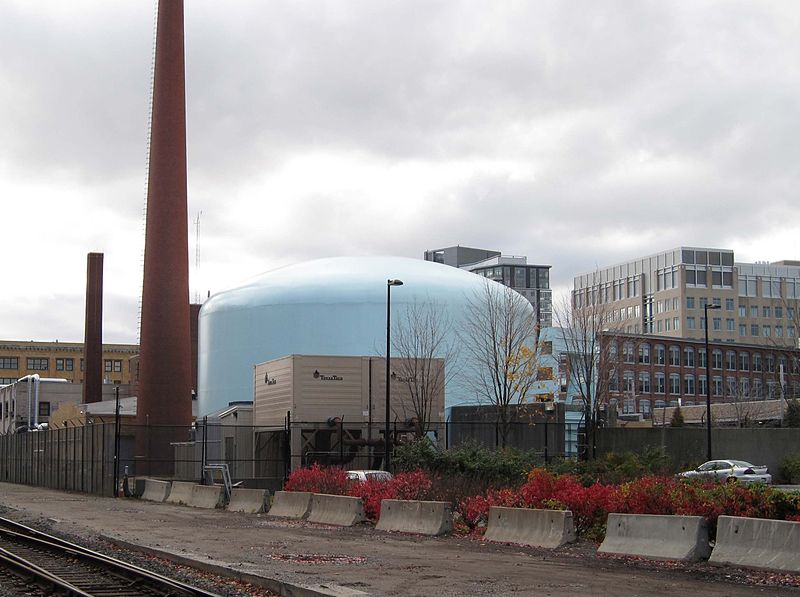 |
| MIT Nuclear Reactor Laboratory. Credit: Crash575/Wikimedia Commons |
The nuclear industry has touted small reactors as way to find new customers (i.e., utilities that cannot afford large reactors in the price range of $8 billion) in the wake of Fukushima and low natural gas prices. The Department of Energy (DOE) is now offering $452 million in matching grants to subsidize design and licensing costs and foresees deployment of a commercial small reactor by 2020. But USC says that nuclear power proponents pinning their hopes on small modular nuclear reactors will likely be disappointed
"Nuclear safety and security don't come cheap," said Edwin Lyman, UCS senior scientist and author of the report. "A utility that thinks it can have its own little nuclear reactor at a bargain-basement price may get exactly what it pays for: a plant more vulnerable to serious accidents and terrorist attacks."
Utilities started building larger reactors because they produce electricity at a lower cost than smaller ones due to the principle of economies of scale, according to the research, so even if small modular reactors were cheaper to build than a large reactor on a per-unit basis, they would be less cost-competitive on a per-kilowatt basis, putting pressure on reactor vendors to slash construction and operation costs to make small reactors cost-effective.
The research contends that in an attempt to reduce capital costs, small reactor vendors are cutting corners on important reactor safety features, such as containment structures, which reduce radiation releases in the event of an accident. To cut operating costs, vendors also are pressuring the Nuclear Regulatory Commission (NRC) to weaken requirements for emergency planning, control room staffing, and security force staffing, the report says.
"Some small modular reactor concepts may have desirable safety characteristics but if they are not carefully designed, licensed, deployed and inspected, they could pose comparable or even greater safety, security and proliferation risks than large reactors," said Lyman.
Experts argue that mass-producing the reactors on an assembly line instead of building customized reactors on site would cut costs. Lyman suggests that this is an unproven proposition and warns that any benefits of manufacturing reactors on a production line could be undercut by generic defects that would spread throughout the entire reactor fleet.
The challenge for small reactor manufacturers will be to figure out how to reduce costs without sacrificing safety and security, the report concludes -- one that calls upon the DOE and the nuclear industry to collaborate on developing nuclear plant designs that would be truly safer than the current generation.
"In the aftermath of Fukushima, the Energy Department and the industry should not be promoting the false idea that small reactors are so safe they don't need 10-mile emergency planning zones," said Lyman. "Nor should they be encouraging the NRC to weaken its other safeguards just to facilitate small reactor licensing and development."
For more:
- see this
report
Sign up for our FREE newsletter for more news like this sent to your inbox!
© 2013 FierceMarkets. All rights reserved. http://www.fierceenergy.com