Will Low Natural Gas Prices Eliminate the Nuclear Option in the US?
A probabilistic comparison of the investment risks of nuclear
power and natural gas-based electricity generating plants has been
carried out using a total-lifecycle power plant model. Although the
cost of the gas plant (with carbon tax) is found to be slightly
cheaper, that choice of fuel carries a far greater cost uncertainty,
suggesting a greater long-term investment risk than nuclear power.
This study is intended to compare the cost of electricity from
natural gas and nuclear power taking each technology's inherent
risks into account. There is investment risk inherent in both
technologies, but from different sources. The risk of nuclear power
resides in uncertain capital costs. For natural gas, the risks are
from the uncertain forward cost of natural gas and the potential for
environmental compliance costs, primarily from the emissions of
greenhouse gases (principally CO2). Because of these uncertainties
it is more revealing to use risk-adjusted (probabilistic or
stochastic) forecasts of the comparative costs of electricity. These
estimates show the probable range of costs for both technologies,
given the uncertainties described above. The costs used are the
levelized costs of generating electricity (LCOE).1 The results were
obtained using the EnergyPath Market Model (EPMM), which financially
simulates the operation of electric generating plants, in part, to
calculate the LCOE (see Appendix A for a description of EPMM). Since
the newest technology nuclear plants are designed to be licensed for
60-year lifetimes, and natural gas generating plants have 30-year
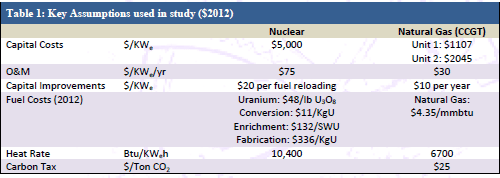
lifetimes, it was necessary to assume that the first gas unit (Unit
1) was retired after 30 years and a second unit (Unit 2) was
constructed. Other Key Assumptions are shown in Table 1 below.
Assumptions used for the risk assessment study are shown in Appendix
B.
The results are shown in Figure 1 and 2, below. Figure 1 shows that the expected levelized generating cost of nuclear power over its 60-year lifetime to be about $87/MWh (all figures are in 2012 dollars). There is a 5% probability that the actual realized generating cost will exceed $99/MWh and a 5% probability that the realized generating costs will be below about $77/MWh. Stated equivalently, there is a 90% probability that the realized generating cost will be between $77/MWh and $99/MWh - a range of $22/MWh.
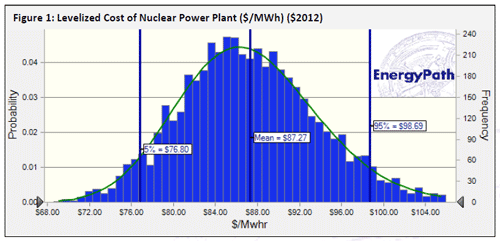
Figure 2, is the same comparison for a high efficiency natural gas plant using a combined cycle technology (and including a carbon tax). Because a second natural gas unit was assumed to be constructed after 30 years, this, introduces the prospect of the second plant having a higher capital cost than the first unit. This was accounted for by assuming that that the capital cost of a natural gas plant grows by 2% per year (in real dollars).
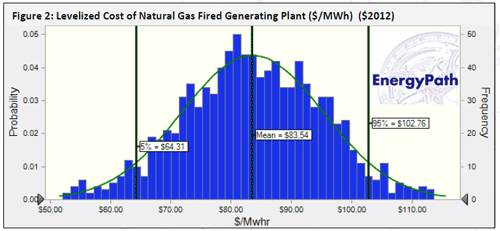
In the case of natural gas the expected value of generation is
about $84/MWh, lower than for the nuclear plant. However, the range
of uncertainty is higher for the natural gas plant. In this case the
90% probability range is over $38/ MWh, or nearly twice the range of
the nuclear plant. This is the result of the volatility of natural
gas over a long time frame and implies a greater investment risk if
a natural gas plant is chosen over a nuclear plant (as will be
discussed below).
This is one key result for this study; but perhaps more important,
not only is the investment risk higher, all the risk occurs after
the build decision is made. Thus, natural gas plant investors are in
the position of having to manage fuel and potential environmental
compliance costs for 60 years after the plant is constructed. To
illustrate this point more dramatically, Figure 3 shows the risks
associated with a nuclear plant in the post- build decision period.
The uncertainty range now has been reduced to about $4/MWh, which
represents the risk of nuclear fuel cost increases. The reason for
this result is that nuclear fuel costs comprise only about 10% of
the levelized cost of generating electricity from a nuclear plant.
For natural gas, the cost of natural gas comprises 60% or more of
the levelized generating cost.
From an investor's standpoint all the risk of a nuclear plant is in
the build decision and can be managed with contractual arrangements
between investors and the plant suppliers before any major costs are
expended. Unlike the previous generation of nuclear plants which
experienced significant cost overruns due to a flawed licensing
process (particularly following the Three Mile Island nuclear
accident in 1979) and led to major rate implications for electric
utilities bearing the financial risk, arrangements in today's
nuclear markets place the majority of risk on the plant supplier,
providing investors with greater certainty about final construction
costs they will bear. In addition, there is a new US licensing
process that combines the construction and operating license into a
single process, further enhancing investor security.
This brings into play the ultimate risk management tool: withdrawal
or delay the project. As a risk management tool this option is
unavailable to natural gas plant investors as nearly all the risk
occurs after plant construction costs are sunk.
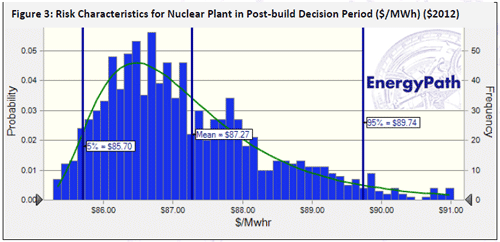
Table 2, below illustrates typical results obtained using only the static (non-simulated) LCOE.2 There are two columns for natural gas, showing the costs both with and without environmental compliance costs - in this case a $25/ton CO2 carbon tax beginning in 2020. This chart clearly shows the tradeoff between capital costs and variable costs (fuel and environmental compliance) between nuclear and natural gas plants. But more important, it illustrates the risks of relying on static LCOE results. The contrast between the risk-adjusted results in Figures 1 through 3 and the point values of results in Table 2 is stark. It is particularly dangerous when making generating technology decisions owing to their dependence on a commodity with a market-derived price over a very long time. This is particularly true for natural gas exposed to not only supply and demand; but also the potential for climate change initiatives directed at carbon-emitting fuels.

The price of natural gas delivered to US electric utilities in
2012 was approximately $4.35/mmbtu. However, this price is
unsustainable as it is below the average cost of producing shale gas
- currently the major source of new drilling in the US-estimated at
between $5-8/mmbtu4. While the prospects that shale gas will extend
the supply of natural gas are positive, like any commodity the
cheapest and most easily mined supply will be produced first.
Further, LNG facilities in the US, once constructed to import LNG,
are being converted into export facilities as natural gas prices
measured in US dollars are as high as $16.50/mmbtu in Japan and
$9.00/mmbtu in the UK5
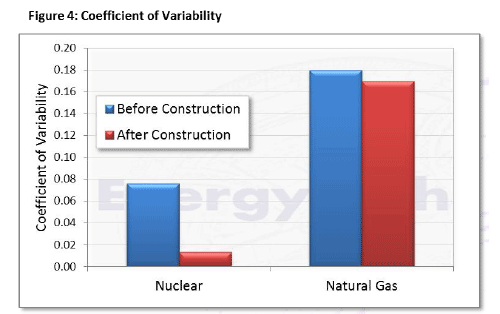
A single metric can be useful in summarizing these results - the
coefficient of variability (COV). The
coefficient of variability is defined as

The coefficient of variability measures the amount of risk
(standard deviation) that an investor has to
bear in order to get the expected levelized costs (mean). The higher
the coefficient of variability, then,
the riskier is the project to investors. The COV results for the
cases described above are shown below in
Figure 4. As shown, nuclear power represents a significantly smaller
financial risk relative to natural gas,
and particularly so after construction.
It may be argued that decommissioning also represents a higher
risk for investors in the case of nuclear power. However, this is
already accounted for in Figures 1 and 3, and moreover, investors
have possibly up to 80 years before the decommissioning decision
must be made-resulting in an annuity that is easily managed. These
results are being validated in real life. In March, 2012 the US
Nuclear Regulatory Commission awarded combined construction and
operating licenses (COL) to two privately-owned nuclear plants in
the Southeast US: the Vogtle 3 & 4 units owned by Southern Company
and the Summer 2 & 3 units owned by South Carolina Electric and Gas.
(First nuclear concrete has recently been poured for Summer 2 and
Vogtle 3.) Both utilities obtained regulatory approval from their
respective state regulatory bodies, largely on the basis of fuel
diversity. It was precisely a reluctance to develop additional gas
resources on the very basis that it left both companies vulnerable
to increased fuel and regulatory compliance costs that was
instrumental in choosing nuclear-in spite of considerable opposition
from parties opposed to nuclear power. While coal would have been an
option, both utilities already have substantial coal capacity and
there is warranted anticipation that coal will be increasingly
targeted by the US Environmental Protection Agency for stringent
emissions controls, including, potentially, controls on CO2
emissions. A third utility-Florida Power and Light-is likely to also
be granted a COL for the construction of Turkey Point 5 & 6, and FPL
has made exactly the same fuel diversity case to the Florida Public
Service Commission. All of these regulatory agencies feel strongly
enough that nuclear power is essential that they granted the
utilities the ability to place their construction costs in the rate
base for recovery prior to actual plant operation-a first for U.S.
electric utilities.
In conclusion, while natural gas currently has lower generating
costs, there is a significantly higher investment risk in natural
gas that does not appear to be reflected in the current "bandwagon
effect" that natural gas is enjoying owing to very low current
natural gas prices and no environmental compliance
Appendix A: EnergyPath Market Model (EPMM)
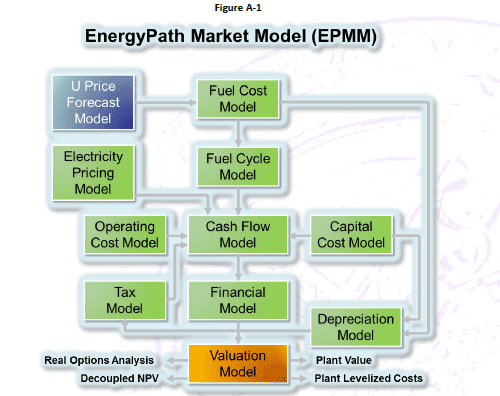
The EnergyPath Market Model (EPMM) is an Excel-based valuation model
which financially simulates the preconstruction development,
licensing, construction, operation and decommissioning of an
electric generating plant. The model also performs levelized cost of
electricity (LCOE) calculations. For this study the model was
configured to simulate both nuclear and natural gas plants over a 60
year lifetime. The model incorporates Crystal Ball© risk
simulation software6. A diagram of EPMM's modules is shown in Figure
A-1 below.
Appendix B EPMM Simulation Model Key Assumptions
Figure B-1 shows the data used in the EPMM simulation model for the
nuclear plant (Figures 1 and 3).
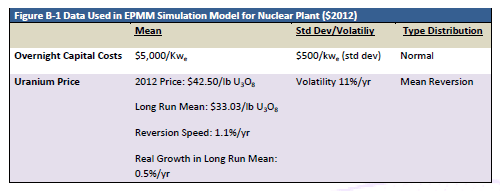
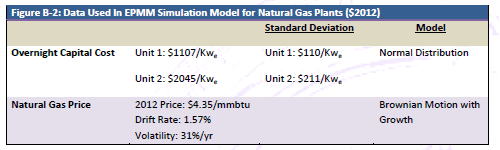
Figure B-2 shows the simulation model data used for the natural gas plants (Figure 2).
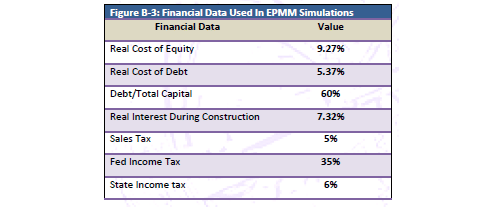
Finally Figure B-3 provides financial data used in both the nuclear and natural gas comparisons.
1 Levelized costs are useful as comparisons of costs between
generating technologies. They can be thought of as the equivalent
annual cost incurred over the life of the generating technology
having the same present value as actual costs which differ from year
to year.
2 By "static results" it is meant that EPMM used only deterministic
input and did not run in the simulation mode. For instance a single
capital cost was used instead of a probabilistic capital cost. When
EPMM is in simulation mode it draws a sample from the probabilistic
capital cost input (and all other probabilistic inputs) and
calculates an LCOE for each simulation. The LCOE output is thus
probabilistic also.
3 Includes both sales taxes and income taxes
4 See, for example, Berman, A.E. and Pittinger, L.F., "US Shale Gas:
Less Abundance, Higher Cost", The Oil Drum (www.theoildrum.com/node/8212,
August 5, 2011. Berman and Pittinger contend that the breakeven cost
of shale gas is currently between $5-$8/mmbtu and that production
from shale gas wells is declining faster than predicted.
5 BP (British Petroleum), "Energy Outlook 2030, Statistical Review
of World Energy 2012", Natural Gas Prices
http://www.bp.com/sectiongenericarticle800.do?categoryId=9037181&contentId=7068643
6 Crystal Ball© is a product of Oracle Corporation (www.oracle.com)



Copyright © 1996-2013 by CyberTech, Inc. All rights reserved.
To subscribe or visit go to: http://www.energycentral.com
To subscribe or visit go to: http://www.energybiz.com
http://www.energycentral.com/generationstorage/fossilandbiomass/articles/2738