Sandia studying falling particle receiver technology for large-scale CSP
Engineers at Sandia National Laboratories are using a falling particle receiver to more efficiently convert the sun's energy to electricity in large-scale concentrating solar power (CSP) plants. Falling particle receiver technology is expected to lead to power-tower systems capable of generating up to 100 MW of electricity.
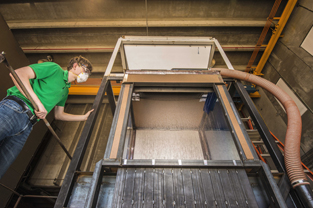 |
| Working with the falling particle receiver, which more efficiently converts the sun's energy to electricity in large-scale concentrating solar power plants. Credit: Randy Montoya |
Since the 1980s, researchers have studied falling particle receiver technology, but several issues hindered greater acceptance of the concept, including mitigating particle loss, maintaining the stability of falling particles, increasing the residence time of the particles in the concentrated beam, and reducing heat losses within the receiver cavity. Sandia's current research addresses these issues.
Falling particle receiver technology can cost-effectively capture and store heat at higher temperatures without breaking down, which is an issue for conventional molten salts. The Sandia falling particle receiver drops sand-like ceramic particles through a beam of concentrated sunlight, and captures and stores the heated particles in an insulated container below, enabling operating temperatures of nearly 1,000 degrees Celsius, which means greater availability of energy and cheaper storage costs because at higher temperatures, less heat-transfer material is needed.
Central receiver systems use mirrors to concentrate sunlight on a target, typically a fluid, to generate heat, which powers a turbine and generator to produce electricity. Currently, such systems offer about 40 percent thermal-to-electric efficiency. The falling particle receiver enables higher temperatures and can work with higher-temperature power cycles that can achieve efficiencies of 50 percent or more.
"Our goal is to develop a prototype falling particle receiver to demonstrate the potential for greater than 90 percent thermal efficiency, achieve particle temperatures of at least 700 degrees Celsius, and be cost competitive," said Cliff Ho, the projects principal investigator. "The combination of these factors would dramatically improve the system performance and lower the cost of energy storage for large-scale electricity production."
The project is funded up to $4 million by the Department of Energy's SunShot Initiative, which aims to drive down solar energy production costs and pave the way to widespread use of concentrating solar power and photovoltaics.
"Given our unique facilities at the National Solar Thermal Test Facility, we have the capability of developing prototype hardware and testing the concepts we've simulated, which include innovations such as air recirculation and particle recirculation. Advanced computing lets us do complex simulations of the falling particle receiver to understand the critical processes and behavior," Ho said.
The progress so far is encouraging. The project is in its first of three years. A test-ready design is expected in 2015.
For more:
- see this
article
Related Articles:
World's largest CSP plant goes live
CSP to offset South Africa's peak power demand
CSP market to double despite volatility
PV steps aside for CSP
Sign up for our FREE newsletter for more news like this sent to your inbox!
© 2013 FierceMarkets. All rights reserved. http://www.fierceenergy.com