Global Economic Outlook, April 2014
UNITED STATES
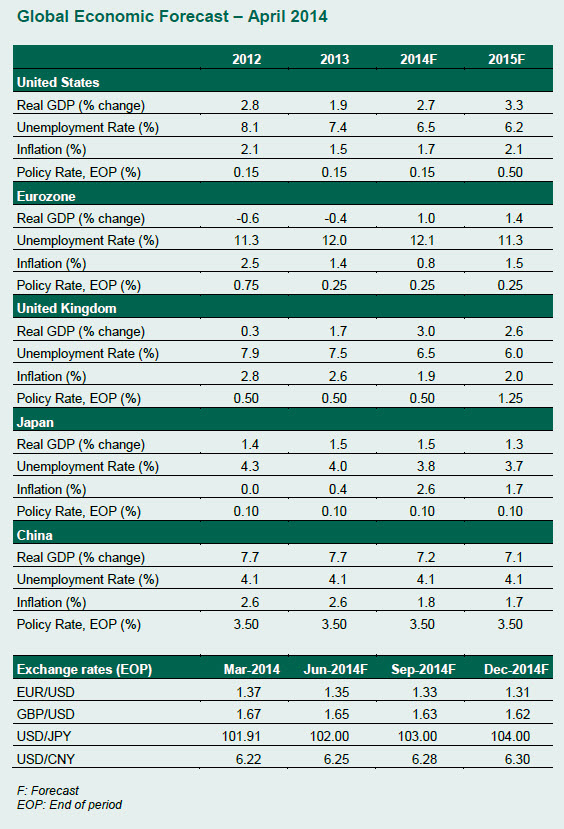
The fundamentals of the U.S. economy suggest a strong
performance in the rest of the year after a weather-related
setback in the first quarter. The absence of a drag from
cutbacks in federal government spending adds to the optimism.
The Fed will complete its asset purchases by year-end, with
labor market and inflation developments driving the timing of
any tightening. A likely increase in the labor force
participation rate should result in a measured decline of the
unemployment rate. The current subdued trend of inflation is
predicted to approach the Fed’s target of 2% as economic
momentum gathers steam. The dollar’s relative position is
expected to strengthen in light of the projected growth. The
shaky status of economic conditions in Europe and China are a
risk to the outlook of the U.S. economy.
EUROZONE
The Eurozone as a whole continues to edge toward recovery, but
the pace of growth remains very uneven across the region.
Germany’s real GDP growth will likely reach 2% or more this
year, up from 0.5% in 2013, but growth in France will likely be
no more than 0.5% in 2014 after a nearly steady reading in 2013,
and Italy is expected to remain mired in recession. Spain’s
headline growth of around 0.8% will not do much to diminish
unemployment that remains higher than 20% and a youth jobless
rate around 50% – levels that risk deep social dislocation and a
“lost” generation of young workers.
Inflation will remain very subdued across Europe, burdening the
European Central Bank (ECB) with a considerable policy dilemma.
It is not clear that cutting the refi rate even lower than the
current 0.25% will do much to stimulate credit growth. Eurozone
banks are focused on boosting their capital accounts as the
ECB’s first asset quality review and stress test gets underway.
Further, businesses and households alike are still deleveraging.
Some form of quantitative easing could kick-start moribund
economies, but crafting such a program across 18 separate
countries with diverse asset markets and differing macroeconomic
priorities would take time. High rates of unemployment will
continue to be a challenge, with the rate for the Eurozone as a
whole remaining just above 12% through 2014.
Sovereign debt yields in “peripheral” economies have fallen back
to levels last seen in 2007, but there is a perennial risk that
renewed debate over an issue such as Greek debt sustainability,
political turmoil in Italy or French policy clashes could
trigger another round of market volatility.
UNITED KINGDOM
Economic recovery continues in the United Kingdom, with real GDP
growth headed toward 3% this year. Inflation continues to abate
and should be just below 2% by the end of the year. The Bank of
England (BoE) has modified its forward guidance policy to
include a range of indicators, not just the unemployment rate,
but continues to signal that policy rates are unlikely to
increase until the first half of next year (and then only
gradually). Signs that the housing market recovery has spread
outward from London has raised concern that another housing
bubble could be in the making. The BoE’s Monetary Policy
Committee will not hike interest rates to curb house prices, but
its Financial Policy Committee (formed last year) is likely to
toughen up affordability tests and to look into other options to
take the froth out of the market.
JAPAN
Economic performance in the second quarter is expected to be
dismal, as consumers adjust to the 3% VAT increase that took
effect at the beginning of April. However, the economy is
expected to get back on track in the third quarter as consumer
sentiment improves and spending increases. Private consumption
is vital for the fledgling recovery as government stimulus
begins to taper off and export growth continues to disappoint.
While the government could add more fiscal stimulus in the
second half of the year or delay the planned 2% VAT increase
next year, the prospects for export-led growth are murkier as
continued soft demand in the United States and European Union
and a weakening Chinese economy combine to pressure exporters.
Real GDP is forecast to expand 1.5% in 2014 as fiscal stimulus
offsets weaker consumer spending due to the consumption tax
hike.
The Bank of Japan (BOJ) will likely maintain the current 0.1%
target policy rate while adding to its massive quantitative
easing program this summer to foster economic activity. After
missing last year, the BOJ is expected to reach its 2% inflation
goal this year as the consumption tax increase push prices up by
2.1%. Meanwhile, the yen is expected to continue weakening
moderately to 104¥/US$ by the end of 2014 while unemployment
remains benign at 3.8%. Risks to Japan’s outlook include the
collapse of Chinese import demand, a sustained decline in
domestic consumer demand and a loss in patience with Abenomics
and the absence of blockbuster announcements regarding the
structural reform arrow.
CHINA
China’s economy expanded at an annualized pace of 7.4%
in the first quarter, below the official 2014 target of 7.5%,
and the government renewed its claim that GDP growth was not as
important as the current job creation target. Beijing has
implemented a series of short-term measures to shore up the
economy, the most notable and controversial being an expansion
of the currency trading band in March, which was followed
immediately by the yuan falling about 3%. While the government
has not spoken about currency competitiveness directly, this
move provided a boost to exporters struggling in the first
months of 2014.
Inflation is slowing on the year, suggesting only weak price
pressures at best from the domestic economy. The government has
dismissed talk of fiscal stimulus, though public spending
measures designated for 2014 have been fast-tracked. There is a
significant concern that slowing growth and rising credit
figures are creating an imbalance that cannot be easily
reconciled without a sharp shock to the economy. GDP growth
appears set to remain just below the official target level this
year, though investment spending will remain at a worrisome
level. If economic growth continues to be bolstered primarily by
excessive and potentially unproductive lending, the excess
capacity and overvalued assets created will only expedite a
painful rebalancing.
The opinions expressed herein are those of the author and do not necessarily represent the views of The Northern Trust Company. The Northern Trust Company does not warrant the accuracy or completeness of information contained herein, such information is subject to change and is not intended to influence your investment decisions.

To subscribe or visit go to: http://www.riskcenter.com
http://riskcenter.com/articles/story/view_story?story=99916590