Published on Tuesday, April 22, 2014 by
Common Dreams
Solar Warriors vs. the Black Snake of Tar Sands
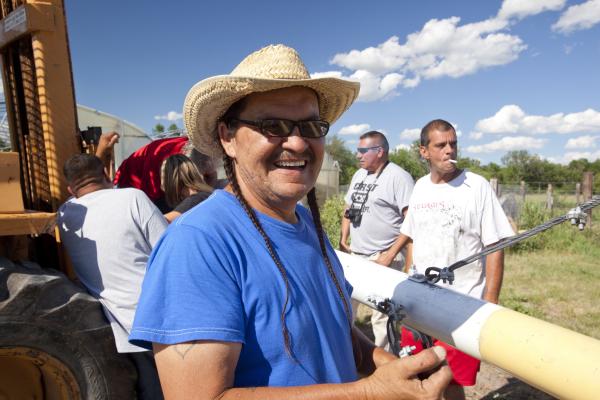 Henry
Red Cloud. (Photo: treeswaterpeople.wordpress.com)There
are two very different ways of recognizing Earth Day In the
Northern Plains and Washington, perhaps illustrating, what
Native people call the choice between two paths, one well
scorched and worn, the other green.
Henry
Red Cloud. (Photo: treeswaterpeople.wordpress.com)There
are two very different ways of recognizing Earth Day In the
Northern Plains and Washington, perhaps illustrating, what
Native people call the choice between two paths, one well
scorched and worn, the other green.
This past week, Henry Red Cloud, a descendent of Chief Red
Cloud and President of Lakota Solar Enterprises,
was recognized as a Champion of Change by President
Obama for his leadership in renewable energy. Red Cloud’s
work has included installation of over 1000 solar thermal
heating units on houses in tribal communities across the
Northern Plains. Those units can reduce heating bills by
almost one quarter, and cost, less than $2000 to install.
The solar thermal panels harken a future with less reliance
on propane and fossil fuels, something which proved deadly
this winter, as the price skyrocketed, and many homes spent
at least that amount to heat. 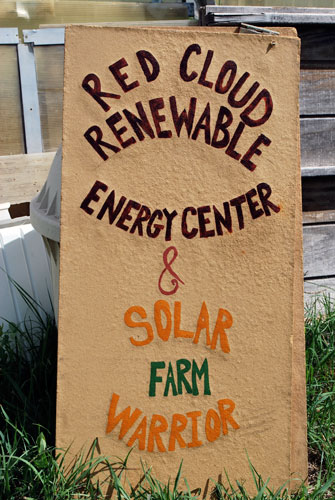
Henry Red Cloud is one of many Lakota people who has been in
DC this past month, and a large number of other Oglala
tribal members will descend on Washington for the
Cowboys Indians Alliance encampment against the Keystone
XL pipeline. Henry Red Cloud sees solar energy as a way to
“honor the old ways in the new times,” and address some of
the fuel poverty which is rampant in northern plains and
north woods first nations, in an era of petroleum, replacing
natural fuels. Annually tribes are forced to pay hundreds of
millions of dollars of propane bills, to keep houses warm,
and fuel poverty is when tribal members have to choose
between heating or eating. "Last year, more than five
million was spent on propane and electricity to keep our
members warm," Red Cloud explained. "We can take that money
and turn it around, start some businesses."
Solar thermal heat, not only keeps people warm, reducing the
hemorrhage of fuel bills but it circulates money into a
local economy. The solar panels are made on the reservation,
and the Red Cloud Renewable Energy center near Oglala, on
the reservation employs nine full time workers and several
part time workers in the busy season. That is money helping
a community and rebuilding infrastructure in that
community.
According to Henry Red Cloud and many others is what we need
to do. After all, about 14% of reservation households are
without electricity, 10 times the national rate. Energy
distribution systems on rural reservations are extremely
vulnerable to extended power outages during winter storms,
threatening the lives of reservation residents. Reservation
communities are at a statistically greater risk from extreme
weather related mortality nationwide, especially from cold,
heat and drought associated with a rapidly changing climate.
Reservations need more than 200,000 new houses, and there is
no money for them, and Pine Ridge, Henry’s home may be one
of the most impacted areas. This is also the home of strong
opposition to the Keystone XL pipeline, also known as the
"fat takers pipeline," by the Lakota people. Brian Brewer,
president of the Oglala Sioux Tribe, told press, “No
Keystone XL Black Snake Pipeline will cross Lakota Lands. We
will protect our lands and waters and we have our horses
ready…"
The proposed Keystone XL pipeline, will put in
infrastructure as well. As Henry and others point out, that
infrastructure will not change the conditions for most
people in the northern plains, whom the pipeline will pass.
Employment will not be local, or of long term. The man camps
of a thousand men will move in, buy some things, stay at
hotels, and then move on. And the infrastructure will not
improve for the people.
The $7 billion price tag of the Keystone XL was studied in
a recent report by Economics for Equity and the Environment.
The study found that spending money on unmet water and gas
infrastructure needs in the five relevant states along the
KXL pipeline route will create more than 300,000 total jobs
across all sectors, or five times more jobs than the KXL,
with ninety five times more long term jobs. Spending money
on the infrastructure in this country, which has received a
D + rating from the national engineers, would provide more
jobs, and more benefits to American people over the long
term, like infrastructure which does not leak or blow up.
In his State of the Union address, President Obama noted
that last year the amount of solar power installed in the
U.S. has increased around eleven fold—from 1.2 gigawatts in
2008 to an estimated 13 gigawatts in 2014. Solar thermal is
even less expensive and applicable to many south facing
walls. Last June, President Obama announced a comprehensive
Climate Action Plan to cut carbon pollution and advance the
clean energy economy. As part of that Plan, the President
set a goal to double solar, wind, and geothermal electricity
generation by 2020 and to more than triple the onsite
renewable energy production in federally assisted
residential buildings.
The simple elegance of local power, solar energy and working
to benefit communities, not corporations, is a good lesson
for Earth Day.
This work is licensed under a Creative Commons License
