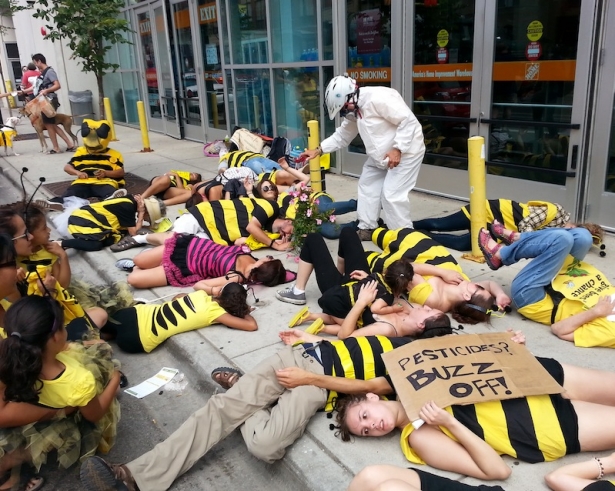
On Saturday, activists in cities from Dallas to Melbourne, Australia, “swarmed the globe” in an international rally to save the world’s bees.
In an action timed to coincide with National Honey Bee Day in the United States, Bee Against Monsanto—a Tampa-based collective that campaigns to protect honey bees and other pollinators—called on organizers worldwide to hold “Swarm the Globe” rallies. Their goal: to raise awareness of the dangers of neonicotinoids, a family of insecticides that kill bees.
Neonicotinoids are the leading suspect in Colony Collapse Disorder, a phenomenon in which entire populations of worker bees disappear, leaving queens and larvae to die in their hives. On average, 30 percent of bee colonies in the United States have died each year since 2006, with similarly high death rates in many parts of Europe.
In Chicago, Swarm the Globe activists marched to the Lincoln Park Home Depot for a “die-in”: A “colony” of activists in bee costumes swarmed around a neonicotinoid-treated plant purchased from the store, then sprawled across the pavement outside the entrance. Afterward, the demonstrators returned the plant for a full refund.
Kristin Garcia, one of the participating “bees,” explained to In These Times why she’d joined the action, “[If] we don’t have bees, we don’t have pollination. We don’t have pollination, we don’t have food.”
Not-so-bee-friendly
Neonicotinoids, the most popular family of insecticides, were developed in the mid-90s when researchers set out to create compounds that were highly lethal to insects but had little effect on mammals. Commonly used to repel insects such as aphids, Japanese beetles and whiteflies, neocotinoids are systemic pesticides that spread to all parts of the plant, including the flowers—which means bees come into contact with the chemicals.
The effects are devastating. A report released in June by Friends of the Earth (FoE), a federation of grassroots environmental groups, describes a July 2013 die-off in which “37 million bees were reported dead across a single farm in Ontario.” In another example, that June, more than 50,000 dead and dying bees littered a Target parking lot in Oregon after the neonicotinoid dinotefuran was sprayed into the trees to prevent aphids from secreting honeydew onto the cars below. Several studies have tied the widespread use of neonics in farming to the staggering rate of bee deaths over the last eight years. Since Italy banned neonicotinoid seed treatments in corn in 2008, the FoE notes, the annual loss rate has dropped from more than 30 percent to a mere 5.3 percent.
Neonics are not always immediately lethal to bees, but can cause a variety of health problems. According to FoE, “low levels of exposure can impair foraging abilities and navigation; disrupt learning, communication and memory; reduce fecundity and queen production; and suppress the immune systems of bees, making them more vulnerable to disease and pests.” And since foraging bees often pick up food contaminated with neonic residues and then bring it home, exposure by a select few bees can poison the whole hive.
The FoE reports that “virtually all corn and a majority of soy, wheat, cotton, canola and sunflower seeds planted in the U.S. [are] pretreated with neonicotinoids, despite research finding that this application does not necessarily increase crop yields or benefit farmers.”
As awareness about the importance of bees has spread in recent years, communities across the United States have begun encouraging backyard beekeeping to offset bee losses, as well as bee-friendly home gardening to provide bees with pesticide-free places to forage. In response to the increased demand, Home Depot, Lowes and other home garden stores have begun to offer plants marketed as “bee-friendly,” meaning attractive and non-harmful to bees.
But in June, Friends of the Earth and the Pesticide Research Institute released a report that found that 51 percent of “bee-friendly” plants in garden centers across the U.S. and Canada have been treated with neonics. And while crops treated with neonics fill many more acres of the United States than do home garden plants, the recommended concentrations of pesticides for garden plants are as much as 220 times higher than those used on crops.
Combined with the presence of neonicotinoids in many of the most popular pesticides sold for home gardening, including the Ortho and Bayer Advanced product lines, this means that bees are almost guaranteed to come into contact with neonics when visiting supposed backyard sanctuaries.
The implications of bee depopulation for humans are alarming, to say the least. Because 85 percent of all flowering plants require pollinators for reproduction, bees and other pollinators are necessary for producing an estimated one out of every three bites of the food we eat. Bee shortages have increased the cost of pollination services for farmers by 20 percent in some areas, and shrinking bee populations could eventually mean dwindling crop yields. As such, many activists, including Saturday's protesters, frame the issue as a threat to the affordability and sustainability of the global food supply.
COPYRIGHT ©2014 IN THESE TIMES AND THE INSTITUTE FOR PUBLIC AFFAIRS. ALL RIGHTS RESERVED