On January 31st, Maryland-based Clean Currents shut its doors for
good.
The renewable energy supplier sent a minor shockwave through the
industry when it abruptly announced it could no longer serve its
8,000 residential and business customers. Speaking to journalists
about the closure, the company president said 'the financials were
fine. None of us suspected that we would be out of business in a
week.'
Clean Currents was a casualty of wholesale price volatility during
the Polar Vortex cold snap, which sent temperatures plummeting
overnight in early January and massively disrupted life on the East
Coast and Mid-Western states.
Essential infrastructure simply seized up: flights were cancelled,
trains stalled, schools were closed and white-outs were common on
icy, snow covered highways. For energy retailers, it was the
ultimate black swan. Already dealing with colder-than-normal fall
and winter temperatures, they quickly found themselves in a
vice-grip of spiking demand, diminished supply and a rapidly
degrading operational capability.
PJM Interconnection, the largest US grid operator, hit a record
winter peak use of 141,500 megawatts - just as 20 percent of its
generators went offline due to the freezing temperatures.
Coal-fired power plants accounted for roughly half the outages,
while diesel generators made up the other half. There were instances
of coal stacks being frozen solid and many diesel generators just
wouldn't work in extreme cold.
Pipeline constraints also caused generation problems by driving up
natural gas prices east of the Rockies. As the most popular American
heating fuel, utilities relying on gas for generation had to compete
with standard natural gas needs when the vortex landed.
The wholesale energy market responded accordingly:
- - PJM's average on-peak power price jumped from $50 to $278
- Henry Hub spot prices spiked from $3.95 to $8.15 MMBtu
- Propane jumped from $2.08 to $4.20 gal.
- North Sea Brent Crude spot price averaged $110 bbl for 8 consecutive months
Source: EIA
OUT IN THE COLD
On the surface, surging demand for electricity should have meant
increased revenues and profits for all. But peak power isn't always
preferred. For electricity retailers with customers on fixed-rate
contracts, demand and price volatility bring risks that can
obliterate margins.
Overextended electricity systems can spell disaster. At the depths
of deep freeze, our customer South Carolina utility SCE&G was forced
to implement rolling 15-minute blackouts to manage demand. Many
others were openly calling on customers to turn down thermostats or
even leave the curtains on South-facing windows open so sunlight
could heat their homes. Most grid operators in the affected states
were compelled to draw on expensive demand response resources from
other suppliers, putting further upward pressure on wholesale
pricing.
Inadequate hedging against such extreme variability in wholesale
pricing left many retailers financially exposed and scrambling to
pay their bills. When it announced its closure, Clean Currents said
spot market prices during the Polar Vortex went up not by 20 or even
50 percent - some jumped by 500 percent. When PJM issued its
collateral call the company simply couldn't afford to pay.
And Clean Currents wasn't the only casualty. Virginia-based Dominion
Resources abruptly exited the retail electricity market in January,
while Illinois' retailer FirstEnergy Solutions announced a coming
June surcharge of $5 to $15 for 220,000 of its customers, to pay for
spikes in wholesale power costs during the deep freeze. It's worth
noting that New Jersey's Systrum Energy lost 5,000 customers in
February when it tried a similar move and passed on higher energy
costs to its non-fixed-rate customers.
In the retail energy sector, unexpected weather and a dynamic book
of customers means that the science behind insuring supply can meet
demand has to be nimble, sophisticated and reliable. While grid
operators and large utilities tend to have robust energy trading and
risk management (ETRM) tools in place to mitigate the impact of
adverse weather, the winter of 2014 caught many on the retail side.
With disruptive weather events becoming more frequent and intense,
retail providers need to take immediate steps to prepare for the
next one, and soon.
EXTREME & UNPRECEDENTED. WELCOME TO THE NEW NORMAL
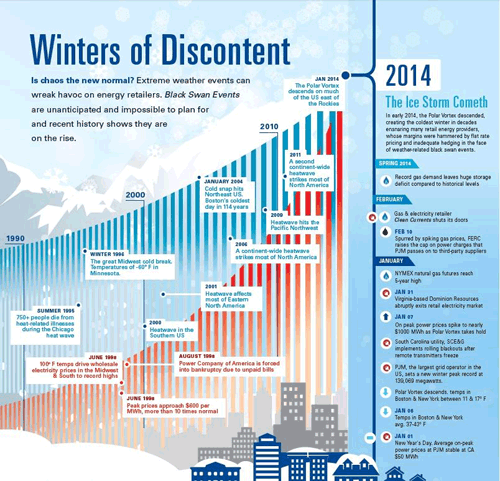
Extreme weather didn't start with the Polar Vortex. The eastern
seaboard has endured a series of harsh winters and extreme
snowstorms from 2009-2011, including the February 2010
"snowmageddon" in Washington that shut down the federal government
for the better part of a week.
At the other end of the thermometer, storms mixed with high
temperature blacked out more than 250,000 homes in the Midwest in
early July. A 1998 heat wave in the mid-west and south drove the
wholesale price of electricity in those states to record highs, from
averages of between $25 and $40 per megawatt-hour (mwh) to thousands
of dollars per mwh at times of peak demand. Commonwealth Edison
Chicago at one point paid nearly $4 million for $100,000 worth of
power. A 2013 study based on models from 21 climate centers
worldwide says more 'unprecedented' heat waves are expected to hit
the US as early as 2020, according to
Nature.
The common feature of these events is their unpredictability. We've
now had nearly a decade of news coverage describing cold snaps, heat
waves, extreme snowfall and hurricanes as 'once in a generation' and
'unprecedented'. If January caught you by surprise, you were in good
company. The Climate Prediction Center (CPC) had actually forecast
higher-than-normal temperatures for much of the lower 48 from
November to January 2014.
Climatology clearly has its limits. In energy markets however,
information can literally be power. Better insight into past and
future events holds the promise of helping energy retailers be more
proactive, and build informed strategies to mitigate the impact of
Polar Vortex-level price volatility.
Here are recommendations to help energy retailers prepare for more
weather-related market volatility.
- 1. To forecast future demand and react quickly when the
unforeseeable happens, trade and usage information need to be
aggregated on a single energy trading and risk management (ETRM)
system. With a solid analytics component, historical data can
then be turned quickly into load forecasts for expected monthly,
long-term, short-term, hourly and even sub-hourly demand.
2. Once your ETRM system in place, measuring usage against past weather parameters like daily minimum and maximum temperatures becomes much easier. Forecasted demand, actual demand and hourly weather can be displayed or charted in a single view.
3. These can then be applied to individual trades. By allowing multiple meters to be assigned to a single retail power contract point, and including counterparty information associated with each meter, multiple meter-level demand forecasts can be aggregated to form the contract-level demand forecast for a trade.
4. Finally, you can run various scenarios to stress demand versus supply and determine if you are within acceptable risk tolerances if not layer in hedges to offset unwanted risk.
Energy retailers will continue to face events that force them to
change their hedging strategy. In a market where price hikes can
bankrupt you or send customers fleeing for their incumbent
utilities; and in a regulatory environment where shaky financial
health could mean having your operating licence pulled by a state
monitoring agency, improving the trading and risk management
capability for energy retailers has become mission critical.
The retail sector needs to prepare for more 'once in a generation'
extreme weather conditions. The winter of 2014 provides a cautionary
tale for all of us, despite the lights somehow staying on.
Michael Keller says

Copyright © 1996-2014 by CyberTech, Inc. All rights reserved.
To subscribe or visit go to: http://www.energycentral.com
To subscribe or visit go to: http://www.energybiz.com