How Pesticide Companies Silence Scientific Dissent
By Dr. Mercola
There are plenty of indications suggesting that the evidence-based paradigm across sciences is built on quicksand, having been largely bought and paid for by many major multinational corporations.
Nowhere is this more evident than in the chemical industry, where pesticide companies posing as "biotechnology" firms specializing in genetics have peddled their wares based on seriously flawed science from the very beginning.
Increasing numbers of scientists are now speaking out in objection to the rampant scientific misconduct muddling the field. Public mistrust in scientists and the corporations that pay them is also on the rise—and rightfully so. Conflicts of interest have become the norm within virtually all fields of science, which creates a completely unworkable situation in the long run.
Our society is largely built on the idea that science can help us make good, solid decisions. But now we're facing a world so rife with problems caused by the very sciences that were supposed to keep us healthy, safe, and productive, it's quite clear that we're heading toward more than one proverbial brick wall.
In a sense, the fundamental role of science itself has been hijacked for selfish gain. Looking back, you can now see that the preferred business model of an industry was created first, followed by "scientific evidence" that supports the established business model.
The injection of industry employees into every conceivable branch of government has led to insanely detrimental health and environmental policies, and the generally accepted idea that scientific integrity is somehow an unassailable fact has allowed the scam to continue for as long as it has. Good old fashioned gangster tactics have also kept the spiel going.
Silencing Scientific Dissent
The featured Corbett Report above and a recent article in The New Yorker1 both discuss the less-than-honorable methods used by industry to silence dissenters—especially scientists whose research doesn't jibe with preconceived industry decisions.
Corbett discusses the case of Gilles-Eric Séralini and colleagues; French researchers who, in 2012, published the first-ever lifetime feeding study2 assessing the health risks of genetically engineered (GE) Roundup Ready corn (NK603). The findings, published in Elsevier's peer-reviewed journal Food and Chemical Toxicology, were a bombshell.
Rats fed a type of genetically engineered corn that is prevalent in the US food supply for two years developed massive mammary tumors, kidney and liver damage, and other serious health problems, including early death. Some of the tumors weighed in at 25 percent of the rat's total body weight.
The study was, and still is, among the best evidence of the toxic effects of GE foods. It was also some of the strongest evidence to date that we really need to exercise the precautionary principle and avoid these foods.
The longest industry-led feeding study was 90 days long—a far cry from two years. Of utmost importance, Séralini's study showed that the major onslaught of diseases really set in during the 13th month of the experiment, although tumors and severe liver and kidney damage did emerge as early as four months in males, and seven months for females.
Still, the industry-funded studies simply didn't evaluate the health effects of their wares long enough for problems to be detected. And based on that, they're marketed as safe.
What Séralini's Research Means in the Big Scheme of Things
The average lifespan of a rat is two to three years. Humans live around 80 years, so we will notice these effects in animals long before we see them in humans. What do you think the effects might be if you feed your child GE foods from day one (yes, many commercial infant formulas even contain GE ingredients) IF the health effects are anything like those found by Séralini?
If 24 months of a rat's life equates to about 80 years of your child's, the 13-month mark would be somewhere in your child's early to mid-40s... GMOs have only been on the market in mass quantities for about a decade. If the effects are as dramatic and as dire as Séralini's research suggests, then we still have about three decades to go before the jig is up and the effects become apparent, en masse, more or less all at once, in the general population.
GMOs are a long-range gamble, and the pesticide industry is gambling that they won't have to deal with the fallout once it occurs. Since the publication of Séralini's 2012 paper, mounting research suggests that glyphosate, the active ingredient in Monsanto's herbicide Roundup, may be to blame for many of the health problems associated with GE foods, although in the Séralini study, the adverse effects were equally dramatic in rats fed GE maize grown without Roundup.
Study Retracted for No Other Reason Than They Don't Want It to Be True?
In November 2013, the publisher (Elsevier) retracted the Séralini study saying it "did not meet scientific standards." However, despite having been reviewed by twice the typical number of referees prior to publication, and having undergone what the publisher called "an intense year-long review" after publication, it wasn't retracted due to errors, fraud, or even the slightest misrepresentation of data. It was retracted because the publisher deemed the findings inconclusive.
The thing is, inconclusiveness of findings is not a valid ground for retraction.3 According to the guidelines for scientific retractions set out by the Committee on Publication Ethics (COPE), the only grounds for a retraction are either clear evidence that the findings are unreliable due to misconduct (data fabrication) or honest error, plagiarism or redundant publication, and/or unethical research.
The reason for the retraction is so ludicrously flimsy, it's virtually impossible to conclude that Séralini's paper was retracted for any other reason than the fact that it seriously disrupted the status quo, which is that genetically modified organisms (GMOs) and genetically engineered (GE) foods are safe and nutritionally equivalent to its non-GMO counterparts.
Conflicts of Interest Are Not Even Hidden Anymore
That conflicts of interest have become the norm is evidenced by the fact that industry doesn't even put much thought into hiding such conflicts anymore. It's right in your face, and when pointed out, you get little more than a shoulder shrug in response.
In this particular case, we have the curious synchronicity of Richard E. Goodman4 being given a position on Elsevier's editorial staff shortly prior to the groundless retraction of Séralini's study. Goodman was a Monsanto scientist for seven years and is an affiliate of the GMO industry-funded group, the International Life Sciences Institute. While Goodman has refuted any involvement in the publisher's decision to retract this most damaging of all GMO studies, the coincidence seems more than a little convenient. And, regardless of Goodman's influence, the retraction is quite simply unethical, and undermines the entire scientific process of discovery.
A group of scientists has drafted an open letter requesting Elsevier reverse its retraction of the Séralini paper or face a boycott. The letter may be signed by scientists and non-scientists alike, so please take a moment to sign the letter, and forward it as widely as possible.

Harassment and Other Gangster Tactics
In the featured New Yorker5 article, Rachael Aviv tells the story of Tyrone Hayes,6 whose Atrazine research turned his life into a paranoid nightmare. In the late 1990s, he conducted experiments on the herbicide for its maker, Syngenta. As reported by Aviv:
"...when Hayes discovered that Atrazine might impede the sexual development of frogs, his dealings with Syngenta became strained, and, in November, 2000, he ended his relationship with the company. Hayes continued studying Atrazine on his own, and soon he became convinced that Syngenta representatives were following him to conferences around the world. He worried that the company was orchestrating a campaign to destroy his reputation."
Two years ago, his work on Atrazine provided the scientific basis for two class-action lawsuits brought against Syngenta by 23 US municipalities, accusing the chemical technology company of contaminating drinking water and "concealing Atrazine's true dangerous nature." Documents unearthed during these legal proceedings revealed that Hayes' suspicions were true—Syngenta had indeed been studying him as deeply as he'd been studying their toxic herbicide for the past 15 years.
What follows reaches a level of creepy that no one should ever have to endure—least of all a scientist who's working to learn and share the truth about a widely used agricultural chemical that has the power to affect all of us, and our ecology. Aviv writes:
"Syngenta's public-relations team had drafted a list of four goals. The first was 'discredit Hayes.' In a spiral-bound notebook, Syngenta's communications manager, Sherry Ford, who referred to Hayes by his initials, wrote that the company could 'prevent citing of TH data by revealing him as noncredible...' Syngenta looked for ways to 'exploit Hayes' faults/problems.' 'If TH involved in scandal, enviros will drop him,' Ford wrote. She observed that Hayes 'grew up in world (S.C.) that wouldn't accept him,' 'needs adulation,' 'doesn't sleep,' was 'scarred for life.' She wrote, 'What's motivating Hayes?—basic question.'"
The Rise of Decision-Based Evidence Making
Ever since the introduction of genetically engineered seeds about 20 years ago, the market for these chemical-dependent crops have spawned a multibillion dollar industry. Funding for the development of more GE crop varieties has come primarily from the privately-owned pesticide industry itself. Over the last 15 years, conflicts of interest within science have exponentially increased, and at this point, it's blatantly obvious that financial conflicts of interest play a major role when it comes to what research is done – what gets published, and what doesn't.
Researchers like Séralini and Hayes are not welcome in a system like this, as the funders of research are really not interested in real science. Their ultimate aim is to use science to further their own agenda, which is to sell patented seeds and chemicals. Studies that cast doubt on the soundness of their business model are simply buried and ignored.
Funding plays such an important role in determining the outcome of a study, you'd be wise to investigate who wrote the check before accepting anything you read in the scientific literature. As revealed in a 2011 study published in the journal Food Policy:7
"In a study involving 94 articles selected through objective criteria, it was found that the existence of either financial or professional conflict of interest was associated to study outcomes that cast genetically modified products in a favorable light. While financial conflict of interest alone did not correlate with research results, a strong association was found between author affiliation to industry (professional conflict of interest) and study outcome."
GMO research in particular is further complicated by the fact that very few independent researchers ever even get the chance to study them, courtesy of strict patent laws. The vast majority of the research done on GMOs is performed by scientists hired by the industry. The results, therefore, are predictable.
Vote with Your Pocketbook, Every Day
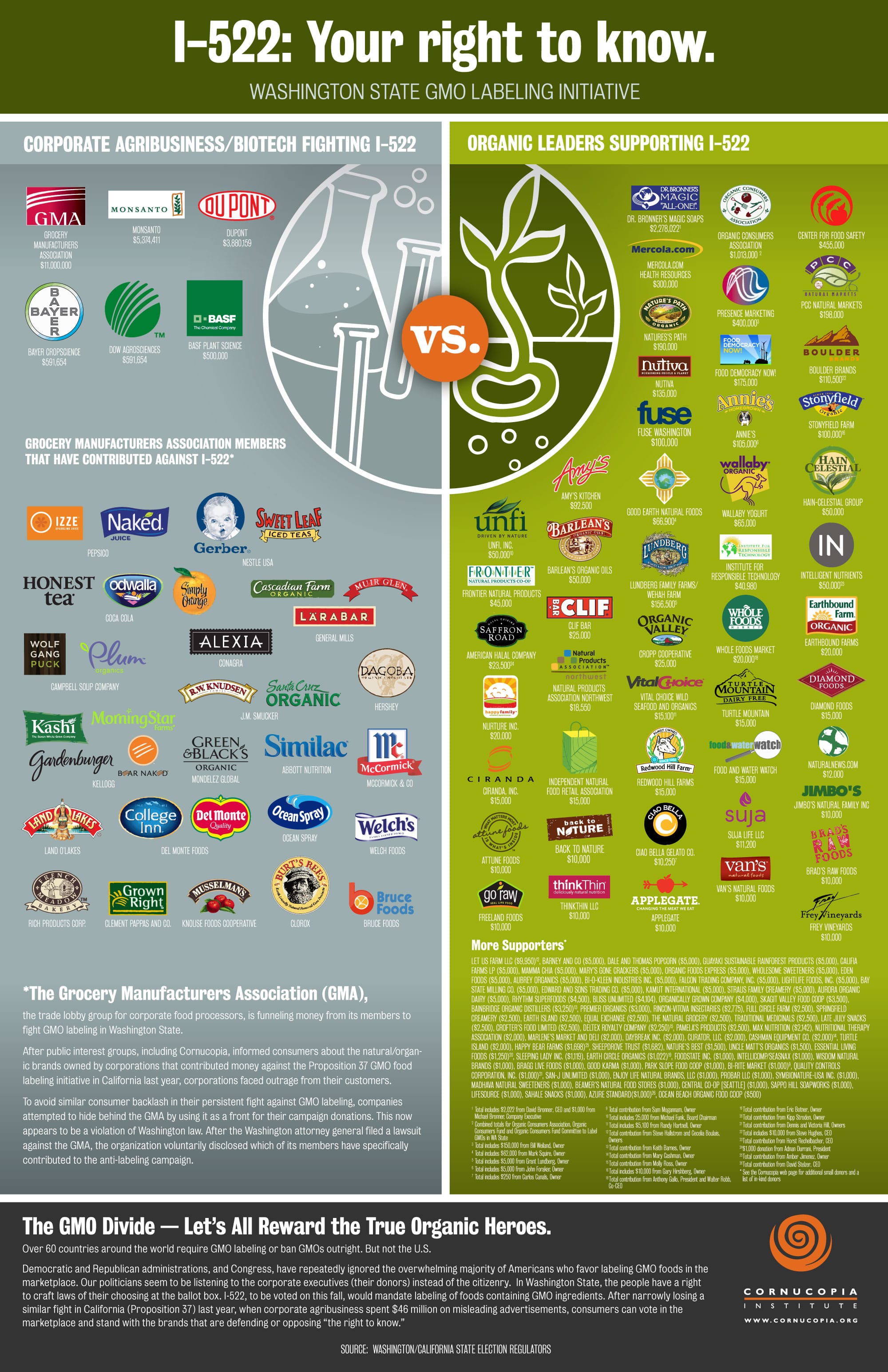
Remember, the food companies on the left of this graphic spent tens of millions of dollars in the last two labeling campaigns—in California and Washington State—to prevent you from knowing what's in your food. You can even the score by switching to the brands on the right; all of whom stood behind the I-522 Right to Know campaign. Voting with your pocketbook, at every meal, matters. It makes a huge difference.
As always, I encourage you to continue educating yourself about genetically engineered foods, and to share what you've learned with family and friends. Remember, unless a food is certified organic, you can assume it contains GMO ingredients if it contains sugar from sugar beet, soy, or corn, or any of their derivatives.
If you buy processed food, opt for products bearing the USDA 100% Organic label, as organics do not permit GMOs. You can also print out and use the Non-GMO Shopping Guide, created by the Institute for Responsible Technology. Share it with your friends and family, and post it to your social networks. Alternatively, download their free iPhone application, available in the iTunes store. You can find it by searching for ShopNoGMO in the applications. For more in-depth information, I highly recommend reading the following two books, authored by Jeffrey Smith, the executive director of the Institute for Responsible Technology:
- Seeds of Deception: Exposing Industry and Government Lies about the Safety of the Genetically Engineered Foods You're Eating
- Genetic Roulette: The Documented Health Risks of Genetically Engineered Foods.
For timely updates, join the Non-GMO Project on Facebook, or follow them on Twitter. Please, do your homework. Together, we have the power to stop the chemical technology industry from destroying our food supply, the future of our children, and the earth as a whole. All we need is about five percent of American shoppers to simply stop buying genetically engineered foods, and the food industry would have to reconsider their source of ingredients—regardless of whether the products bear an actual GMO label or not.
Copyright 1997- 2014 Dr. Joseph Mercola. All Rights Reserved.
http://articles.mercola.com/sites/articles/archive/2014/02/15/silencing-scientific-dissents.aspx