WASHINGTON — As a young naval officer in Vietnam, John Kerry commanded a Swift boat up the dangerous rivers of the Mekong Delta. But when he returned there last month as secretary of state for the first time since 1969, he spoke not of past firefights but of climate change.
Kerry
Quietly Makes Priority of Climate Pact
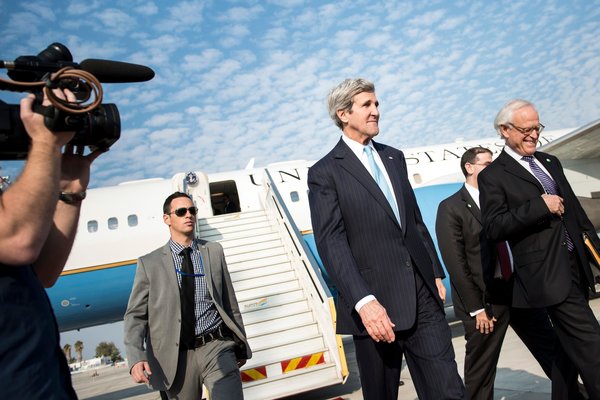
Pool photo by Brendan Smialowski
Secretary of State John Kerry, center, arrived outside Tel Aviv on Thursday. His work on the Middle East has drawn more attention than his environmental efforts.
By CORAL DAVENPORT
Published: January 2, 2014
“Decades ago, on these very waters, I was one of many who witnessed the difficult period in our shared history,” Mr. Kerry told students gathered on the banks of the Cai Nuoc River. He drew a connection from the Mekong Delta’s troubled past to its imperiled future. “This is one of the two or three most potentially impacted areas in the world with respect to the effects of climate change,” he said.
In his first year as secretary of state, Mr. Kerry joined with the Russians to push Syria to turn over its chemical weapons, persuaded the Israelis and Palestinians to resume direct peace talks, and played the closing role in the interim nuclear agreement with Iran. But while the public’s attention has been on his diplomacy in the Middle East, behind the scenes at the State Department Mr. Kerry has initiated a systematic, top-down push to create an agencywide focus on global warming.
His goal is to become the lead broker of a global climate treaty in 2015 that will commit the United States and other nations to historic reductions in fossil fuel pollution.
Whether the secretary of state can have that kind of influence remains an open question, and Mr. Kerry, despite two decades of attention to climate policy, has few concrete accomplishments on the issue. The climate bills he sponsored as a senator failed. At the United Nations climate summit meeting in Copenhagen in 2009, Mr. Kerry, then a senator from Massachusetts, labored behind the scenes to help President Obama broker a treaty that yielded pledges from countries to cut their emissions but failed to produce legally binding commitments.
“He’s had a lot of passion, but I don’t think you can conclude he’s had any success,” said Senator John McCain, Republican of Arizona, who has worked on climate legislation with Mr. Kerry in the past.
Yet climate experts point to one significant, recent accomplishment. As a result of midlevel talks Mr. Kerry set up to pave the way for a 2015 deal, the United States and China agreed in September to jointly phase down production of hydrofluorocarbons, greenhouse gases used in refrigerators and air-conditioners.
“He’s pushing to get climate to be the thing that drives the U.S. relationship with China,” said Timothy E. Wirth, a former Democratic senator from Colorado who now works on climate change issues with the United Nations Foundation.
For decades, the world has been skeptical of American efforts to push a climate change treaty, given the lack of action in Congress. But Mr. Obama has given Mr. Kerry’s efforts some help. In September, the Environmental Protection Agency began issuing regulations forcing cuts in carbon pollution from coal-fired power plants, the largest source of greenhouse gas emissions in the United States.
The rules, which can be enacted without Congress, have effectively frozen construction of new coal-fired plants and could eventually shutter existing ones. Republicans criticize the rules as a “war on coal,” but abroad they are viewed as a sign that the United States is now serious about acting on global warming.
“It has not gone unnoticed that this administration is now much more engaged on climate change,” said Jake Schmidt, the international climate policy director for the Natural Resources Defense Council. “Every international negotiator understands it.” When Mr. Kerry took office, Mr. Schmidt said, “the dynamic changed quite a bit.”
Shortly after Mr. Kerry was sworn in last February, he issued a directive that all meetings between senior American diplomats and top foreign officials include a discussion of climate change. He put top climate policy specialists on his State Department personal staff. And he is pursuing smaller climate deals in forums like the Group of 20, the countries that make up the world’s largest economies.
“He’s approaching this creatively,” said Heather Zichal, who recently stepped down as Mr. Obama’s top climate adviser and worked for Mr. Kerry from 2002 to 2008. “He’s thinking strategically about using other forums.”
But Mr. Kerry’s ambitious agenda faces enormous obstacles.
Not only must he handle difficult negotiations with China — the world’s largest emitter of greenhouse gases — for the 2015 treaty, but the pact must be ratified by a Senate that has a long record of rejecting climate change legislation. “In all candor, I don’t care where he is, nothing is going to happen in the Senate for a long time,” Mr. McCain said.
Related
-
While Kerry Pushes Peace Talks, Israeli Leader Airs Criticism (January 3, 2014)
-
Memo From Jerusalem: Sticking Point in Peace Talks: Recognition of a Jewish State (January 2, 2014)
-
Kerry Calls Typhoon a Warning of Climate Change (December 19, 2013)
The effort is complicated by the fight over the Keystone XL pipeline, which, if approved by the State Department and Mr. Obama, would bring carbon-heavy tar sands oil from the Canadian province of Alberta to refineries on the Gulf Coast — and infuriate environmentalists. Approval of the pipeline could blacken Mr. Kerry’s green credentials and hurt his ability to get a broader climate deal.
Mr. Kerry is nonetheless forging ahead. “One of the reasons the president was attracted to Kerry was that we were going to make climate change a legacy issue in the second term,” said Benjamin J. Rhodes, the White House deputy national security adviser.
Former Vice President Al Gore, who won a Nobel Prize for his efforts to fight climate change, praised Mr. Kerry’s longtime focus on global warming. “He has continued to prioritize the issue even in the face of strong political resistance,” Mr. Gore wrote in an email. Mr. Kerry, he said, “has the rare opportunity to advance international negotiations at a critical time.”
In the 1980s and 1990s, Mr. Kerry worked closely with Mr. Gore, then a senator from Tennessee, on climate change policy on Capitol Hill. In 1992, Mr. Kerry attended the first United Nations climate change summit meeting, in Rio de Janeiro, where he kindled a connection with Teresa Heinz, who attended with a delegation representing the elder President George Bush.
Married three years later, the couple went on to write a 2007 book together, “This Moment on Earth: Today’s New Environmentalists and Their Vision for the Future.” By that time Mr. Kerry had run for president and lost, and then was one of the founders of a think tank, the American Security Project, that defined climate change as a national security threat.
After Mr. Obama was elected president in 2008, Mr. Kerry and his wife began holding salons in their Georgetown home focused on climate policy, with guests like John P. Holdren, the new president’s science adviser. By 2009, Mr. Kerry had joined Senator Lindsey Graham, Republican of South Carolina, and Senator Joseph I. Lieberman, independent of Connecticut, to push an ambitious climate change bill.
At the Copenhagen climate summit meeting in December 2009, Mr. Obama promised the world that the Senate would soon pass that bill — but a few months later, Mr. Kerry’s legislation fell apart. Since then prospects for global warming legislation on Capitol Hill have been poor.
Now, Mr. Kerry hopes to use his position as secretary of state to achieve a legacy on global warming that has long eluded him.
“There’s a lot of scar tissue from the U.S. saying it will do stuff” on climate change and not following through, said Mr. Schmidt of the Natural Resources Defense Council. But he said Mr. Kerry’s push abroad and Mr. Obama’s actions at home were changing expectations among other nations.
“They’re still waiting to see what we’re going to do,” Mr. Schmidt said, “but the skepticism is much thinner than it was a few months back.”
© 2014 The New York Times Company
http://www.nytimes.com/2014/01/03/world/asia/kerry-shifts-state-department-focus-to-environment.html