Wind industry expected to coast through 2018
The wind power industry is "booming," according to research firm IBISWorld, citing an average annual growth rate in revenue of 16.9 percent -- up to $6.9 billion -- in the five years through 2013, including anticipated growth of 8.6 percent in 2013.
 |
|
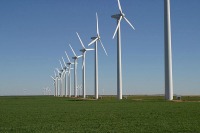
Credit: Leaflet/Wikimedia Commons |
Over the past five years, favorable government assistance has made wind power cost competitive with other electricity-generation sources, increasing wind power's share of the total electricity generated in the United States from 0.4 percent in 2005 to 3.2 percent in 2012. Going forward, stronger economic activity and a focus on energy independence and reducing greenhouse gas emissions will extend this growth, according to IBISWorld.
The federal government's investment tax credits and state government mandates for renewable energy have made it attractive for operators to construct wind farms at what IBISWorld calls a breakneck pace. These incentives lower the cost of wind-power generation, ultimately making it more affordable for mandated utilities to purchase or invest in renewable energy. Cash credits for renewable energy investment were extended only until December 31, 2011, encouraging companies to open wind farms quickly before the expiration of the cash grant program. The production tax credit, a government-funded incentive that pays producers per unit of energy sold, has also helped this trend.
Over the next five years, stronger economic activity and a focus on energy independence and reducing greenhouse gas emissions will contribute to strong ongoing growth in wind power production. IBIS predicts that demand for wind power generation will take off in the next five years, supported by favorable state-level assistance and lower prices.
"Combined with favorable government assistance, the industry will ride the high winds as the economy kicks back in gear and electricity demand rises," said David Yang, IBISWorld industry analyst.
A push for the creation of offshore wind farms is also expected to aid the wind power industry, according to Yang. In August 2012, the first such farm in the United States received federal clearance. As a result of such trends, industry revenue is expected to grow significantly to 2018.
Wind power generation is a capital-intensive process, and the efficiency with which capital is employed has a major influence on the cost of the project. In 2013, IBIS predicts that operators in the wind power industry spent $8.05 on capital investors for every $1.00 spent on wages. The industry requires minimal labor input following the installation of the wind turbine, and turbines have a long economic life. The most significant cost for industry operators is depreciation as the capital required to generate energy is substantial.
For more:
- see this
report
© 2014 FierceMarkets. All rights reserved.
http://www.fierceenergy.com/story/wind-industry-expected-coast-through-2018/2014-01-02