Just in case you don't have enough to worry about.
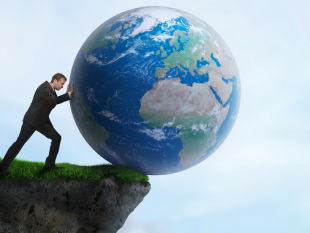 Photo Credit: shutterstock.com
July 26, 2014 |
AMC’s “The Walking Dead” is at the top of the
cultural zeitgeist these days, one of the most popular
television series on the air. In the show, a virus has
ravaged the Earth, killing most of humanity, with the
dead corpses rising to terrorize the few remaining
living souls. While enormously entertaining, it is not a
likely scenario for the end of the human race. Dick
Cheney notwithstanding, zombies aren’t real. The end of
humanity, however, could be. While it is difficult to
envision a world without “us,” there are multiple
scenarios staring at us, right here, right now, not
far-fetched, that could wipe out all or most of
humanity, leaving a wasteland for Mother Nature to
reclaim. Here are some of the possible ways the reign of
man- and womankind might end, no zombies needed.
1. Global Climate Change
Climate change is the Big Kahuna of all scenarios in
which our presence on Earth is ended. Despite what the
climate change deniers would have you believe, climate
change is real. It is being caused by human beings, with
a little help from lots of farting cows emitting
methane, plus
that giant well of methane lurking under the Arctic ice. As
we burn carbon and increase our meat-eating ways, more
and more greenhouse gases are building up in the
atmosphere. It is pretty easy to see the end game of
this scenario. Grab a telescope and look at Venus, a
planet with a thick, heat-trapping atmosphere and a
surface temperature high enough to, well, melt lead. A
few decades ago, climate scientist James Hanson studied
Venus, and saw some parallels with what was happening on
Earth. What he saw alarmed him, and he testified in
Congress in 1988, warning our government that unless we
changed our carbon-burning ways, we were on a course for
disaster. Hanson got through to a single senator: Al
Gore.
Meanwhile, the carbon keeps burning, the CO2 keeps
rising, resulting in a slowly rising average Earth
temperature despite the occasional freezing cold winter.
On average, Earth’s temperature has been rising steadily
since the Industrial Revolution unleashed our
carbon-burning frenzy, resulting in a slow-moving train
wreck. The hottest years in recorded history have
occurred in the last decade. Author and environmental
activist Bill McKibben outlines the situation:
“The Arctic ice cap is melting [releasing more
greenhouse gases], the great glacier above Greenland
is thinning, both with disconcerting and unexpected
speed. The oceans are distinctly more acid and their
level is rising…The greatest storms on our planet,
hurricanes and cyclones, have become more powerful…
The great rain forest of the Amazon is drying on its
margins… The great boreal forest of North America is
dying in a matter of years… [This] new planet looks
more or less like our own but clearly isn’t."
Many environmentalists think we have already passed
the point of no return. Once we pass a certain
threshold, Earth will continue warming even if we do
manage to cut our CO2 emissions. What we do know is
that, if we don’t begin reducing the amount of CO2 we
are releasing into the air, and at least minimize the
damage, a planet-wide disaster is assured.
2. Loss of Biodiversity
If we don’t melt ourselves into extinction, another
possible route to end times is partly a byproduct of
climate change: loss of biodiversity. Human activity is
responsible for massive extinctions of countless species
on Planet Earth. Environment News Service reported as
far back as 1999 that, “the current extinction rate is
now approaching 1,000 times the background rate [what
would be considered the normal rate of extinction] and
may climb to 10,000 times the background rate during the
next century, if present trends continue [resulting in]
a loss that would easily equal those of past
extinctions.”
The Millennium Ecosystem Assessment, a major
environmental report released in 2005, reported 10-30%
of mammals, birds and amphibians on the planet are in
danger of extinction due to human activity, which
includes deforestation (resulting in habitat
destruction), CO2 emissions (resulting in acid rain),
over-exploitation (such as overfishing the oceans), and
invasive species introduction (like boa constrictors in
the Florida Everglades). “This rapid extinction is
therefore likely to precipitate collapses of ecosystems
at a global scale,” said Jann Suurkula, chairman of
Physicians and Scientists for Responsible Application of
Science and Technology. “This is predicted to create
large-scale agricultural problems, threatening food
supplies to hundreds of millions of people. This
ecological prediction does not take into consideration
the effects of global warming which will further
aggravate the situation.”
Amphibians, such as frogs and salamanders, are
considered “marker species," meaning they provide
important clues to the health of the ecosystem. Right
now, the frog population, as well as other amphibians,
has been declining rapidly. In any ecosystem, when one
species dies, it affects other species, which depended
on the now-extinct species for food and perhaps other
necessities. When there is a sudden mass extinction of
many species, a chain reaction can cause catastrophic
results. There have been five mass extinctions in the
history of the Earth, and many scientists are saying we
are in the midst of the sixth. "We are entering an
unknown territory of marine ecosystem change, and
exposing organisms to intolerable evolutionary
pressure,” states the
International
Programme on the State of the Ocean (IPSO), in the
biannual State of the Oceans Report. The next mass
extinction may have already begun." What would that be
like? Well, in the worst one, 250 million years
ago, 96 percent of ocean life and 70 percent of land
life perished. What can we expect from mass extinction
number six? We probably would prefer not to find out.
3. Bee Decline
Bees are dying—a lot of them, due to CCD, Colony
Collapse Disorder. “One of every three bites of food
eaten worldwide depends on pollinators, especially bees,
for a successful harvest,” says Elizabeth
Grossman, author of Chasing Molecules: Poisonous
Products, Human Health. Plants depend on spreading their
pollen to produce food. Bees are pollinators. No bees,
no food (or at least much less). As many as 50% of the
hives in the United States and Europe have collapsed in
the past 10 years. The suspect in bee deaths is a class
of chemicals called neonicotinoids, pesticides used on a
massive scale in commercial farming. It is believed the
chemicals impair the bees’ sense of direction,
preventing them from returning to the hive.
With reduced pollen in the hive, fewer queen bees are
produced, and eventually the colonies collapse. The
European Commission has imposed a ban on these
pesticides after the European Food Safety Agency
concluded that they posed a “high acute risk” to
honeybees. The United States, however, has declined to
join Europe in banning neonicotinoids, citing other
possible causes of CCD, including parasites. Meanwhile,
as Nero fiddles, Rome is burning and bees are quickly
disappearing. It is not hard to imagine a scenario where
resulting acute food shortages bring on mass starvation,
war and human extinction.
4. Bat Decline
Bees aren’t the only pollinators dying off. Bats,
too, are dropping like flies. As a result of
deforestation, habitat destruction and hunting, combined
with a fatal fungal disease spreading among the bat
population called White Nose Syndrome, bats are
disappearing at an alarming rate. Besides contributing
to the pollination crisis, the dwindling bat population
brings about another possible human extinction
scenario. As their habitats are destroyed, bats are
increasingly crossing paths with the human population,
in search of food and shelter. With bats come bat
viruses. "It's very easy to see how pathogens can jump
from animals to humans," says Jon Epstein, at the
EcoHealth Alliance, a non-profit agency dedicated to
conservation and biodiversity. Every year, on average,
five new infectious diseases pop up, and about 75% of
these new diseases come from animals. It is already
suspected that human killers like Ebola emerged from the
bat population. Might some new human-killing pathogen
mutate from bats to humans and decimate mankind?
5. Pandemic
Which leads us to a related extinction scenario: a
worldwide pandemic. New diseases emerge every year.
Some have the potential to devastate the population. In
1918, a strain of influenza spread worldwide and killed
between 20 and 50 million people—more than were killed
in all of World War I. In the past several years,
diseases like SARS have come close to igniting into
worldwide pandemics, and it is not at all inconceivable
that, in our airplane-riding, interconnected world, some
other virus could arrive on the scene with the virulence
and transmissibility to decimate, if not destroy, the
human population. “It is not in the interests of a virus
to kill all of its hosts, so a virus is unlikely to wipe
out the human race,” says Maria Zambon, a virologist
with the Health Protection Agency Influenza Laboratory.
“But it could cause a serious setback for a number of
years. We can never be completely prepared for what
nature will do: nature is the ultimate bioterrorist."
6. Biological /Nuclear Terrorism
In the interim, there are plenty of down-and-dirty,
run-of-the-mill terrorists and the grand prize they all
hope to get their hands on is a weapon of mass
destruction like a nuclear bomb or a vial of smallpox
virus. “Today's society is more vulnerable to terrorism
because it is easier for a malevolent group to get hold
of the necessary materials, technology and expertise to
make weapons of mass destruction,” says Paul Wilkinson,
chairman of the advisory board for the Center for the
Study of Terrorism and Political Violence at the
University of St. Andrew. “The most likely cause of
large scale, mass-casualty terrorism right now is from a
chemical or biological weapon.The large-scale release of
something like anthrax, the smallpox virus, or the
plague, would have a huge effect, and modern
communications would quickly make it become a
trans-national problem. There is a very high probability
that a major attack will occur somewhere in the world,
within our lifetimes.”
As for the nuclear threat, with increasing numbers of
unstable countries like Pakistan and North Korea in
possession of atomic weapons, the availability to
terrorists seems only a matter of when and not if.
7. Super-Volcanoes
There are volcanoes, and then there are
super-volcanoes. "Approximately every 50,000 years the
Earth experiences a super-volcano. More than 1,000
square kilometers of land can be obliterated by
pyroclastic ash flows, the surrounding continent is
coated in ash and sulphur gases are injected into the
atmosphere, making a thin veil of sulphuric acid all
around the globe and reflecting back sunlight for years
to come. Daytime becomes no brighter than a moonlit
night.”
This lovely scenario is brought to us by Bill
McGuire, director of the Benfield Hazard Research Center
at University College London. About 74,000 years ago,
the most powerful super-volcano eruption in human
history occurred in Indonesia. It was close to the
equator, and thus gases quickly passed into both
hemispheres. Sunlight was blocked, and temperatures on
Earth dropped worldwide for the next five to six years,
below freezing even in the tropical regions. A
super-volcano eruption is 12 times more likely than an
asteroid hitting the Earth. Known super-volcanoes exist
in Yellowstone National Park in the U.S. and Toba in
Sumatra, Indonesia. And then there are the unknown
ones….
8. Asteroid Impact
Recent films like Deep Impact and Armageddon have
dramatized this human extinction scenario, an asteroid
hitting the Earth. Hollywood is Hollywood, but in 2013,
a real-life asteroid appeared without warning in
Chelyabinsk, Russia. About 20 meters wide, it hurled
into the Earth’s atmosphere at over 40,000 miles per
hour. Only the angle it came in at and its relatively
small size prevented damage and destruction on a massive
scale. But what would happen if a not-at-all uncommon
mile-wide asteroid hit the Earth at this speed? Quite
probably it would wipe out the human race. The
tremendous explosion it would cause upon impact would
fling so much dust into the atmosphere that the sun
would be completely blocked off, plant life and crops
would die, severe acid rain would kill ocean life, and
fiery debris would cause firestorms worldwide.
This has already happened at least once. The likely
reason you don’t see any dinosaurs around the
neighborhood is that they were wiped out by just such an
incident. Donald Yeomans of NASA: “We expect an event of
this type every million years on average.”
9. Rise of the Machine
We look to Hollywood again to dramatize our next
scenario. The Terminator movies entertained us with
killer androids from a future where war was being waged
on man by super-intelligent machines. OK, we are not
there yet, but as we program more and more intelligence
into our computers, exponentially increasing their
capabilities every year, it is only a matter of time
before they are smarter than we are. Already we
entrust computers to run our stock markets, land our
planes, correct our spelling, Google our trivia, and
calculate our restaurant tips. In development are robots
that look like us, talk like us and recognize our facial
movements. How long before they are us, as we download
our thoughts and memories into our hard drives, the
so-called “singularity”? How long before these machines
are self-aware?
Futurist and author Ray Kurzwell believes computers
will be as smart as us by 2029, and by 2045 will be
billions of times smarter than us. What then? Will they
decide we are superfluous? Or maybe we ourselves will
decide. Sounds far-fetched, I know, but some very smart
people buy into this scenario; people like genius
physicist Stephen Hawking: “The danger is real that they
[super-computers] could develop intelligence and take
over the world.”
10. Zombie Apocalypse
I know. I said zombies aren’t real. But there is a
parasite called
toxoplasmosa gondii. This terrifying little bug
infects rats, but it can only reproduce inside the
intestines of a cat, so it evolved a nifty little trick
wherein it actually takes over the rat’s brain and
compels it to hang out around cats. Naturally, the cat
eats the rat. The cat is happy. The parasite is happy
because it gets to reproduce in the cat’s intestines.
The rat? Not so happy, one would suppose. Why should we
care about unhappy rats? Because rats and humans are
actually very similar, which is why we conduct so many
medical experiments on rats. And humans are infected
with the
toxoplasmosa gondii parasite. About half the
population of the Earth, in fact. Now it so happens that
toxoplasmosa gondii does not affect humans the
way it does rats. But what if it did? Viruses mutate.
Viruses are manipulated in bio-weapons laboratories.
Suddenly half the population would have no instinct for
self-preservation. Half the population unable to think
in a rational manner. Half the population suddenly very
much resembling zombies. Nah. Couldn’t happen. Could it?
Larry Schwartz is a Brooklyn-based freelance
writer with a focus on health, science and
nutrition. He works at Scholastic Inc. in
the classroom magazine division on
Superscience and Science World.
http://www.alternet.org/10-biggest-threats-human-existence?paging=off¤t_page=1#bookmark