‘The Brown Shirt Laws’: Medical Staff Allegedly Threatened with Arrest If They Spoke of Conditions for Illegal Immigrant Children
Medical workers at a San Antonio Air Force base where illegal immigrant children are being held and treated are allegedly so disturbed by the conditions that they broke confidentiality agreements, facing threats, in order to share what they say is going on there.
TheBlaze has already reported on a case of swine flu, which officials called “isolated,” at Lackland Air Force Base, prompting the shipment of thousands of vaccines. Now, unnamed sources speaking with conservative commentator Todd Starnes not only shared information about other rampant diseases but alleged that security forces have been brought in to create “a very submissive atmosphere” among staff.
“There were several of us who wanted to talk about the camps, but the agents made it clear we would be arrested,” a psychiatric counselor told Starnes. “We were under orders not to say anything.”
The security team, which Starnes wrote in his commentary piece on Fox News, calls themselves the “Brown Shirts.”
“Once you stepped onto the grounds, you abided by their laws — the Brown Shirt laws,” the counselor told Starnes. “Everyone was paranoid. The children had more rights than the workers.”
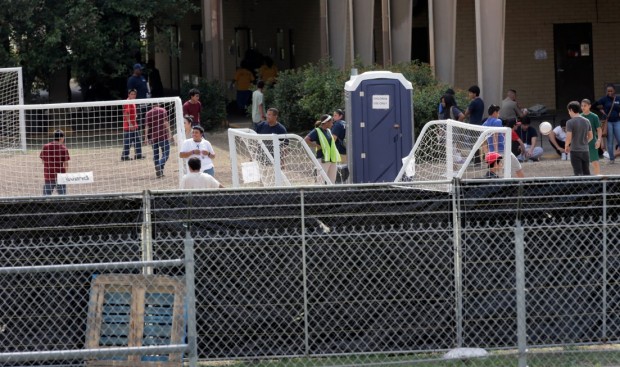
A temporary shelter for unaccompanied minors who have entered the country illegally is seen at Lackland Air Force Base, Monday, June 23, 2014, in San Antonio. (AP/Eric Gay)
The medical issues cited by this counselor included measles, scabies, chicken pox, strep throat, lice and emotional issues that included suicidal thoughts.
One counselor told Starnes she kept a detailed journal of the conditions. She said after officials learned of it they demanded she return to the base and turn over the journal. She did neither.
“When people read that journal they are going to be astonished,” she said. ‘I don’t think they will believe what is going on in America.”
Another unnamed source echoed some of the conditions mentioned by the counselor.
“When they found out the kids had scabies, the charge nurse was adamant — ‘Don’t mention that. Don’t say scabies,’” a nurse told Starnes. “But everybody knew they had scabies. Some of the workers were very concerned about touching things and picking things up. They asked if they should be concerned, but they were told don’t worry about it.
“You could see the bugs crawling through their hair,” she added. “After we would rinse out their hair, the sink would be loaded with black bugs.”
In this June 19, 2014 photo, a Guatemalan child deported from the United State poses for photo in front of a map of the Guatemala City at an immigration shelter in Guatemala City. The number of unaccompanied minors detained on the U.S. border has more than tripled since 2011. (AP/Luis Soto)
What concerned this nurse even more, Starnes reported, was that the children were allegedly going to be transported on domestic buses and airplanes.
“That’s what alerted me,” the nurse told Starnes. “Oh, my God. They’re flying these kids around. Nobody knows that these children have scabies and lice. To tell you the truth, there’s no way to control it.”
Baptist Family & Childen’s Services, an organization hired to support the Department of Health and Human Services with “shelter operatiosn for Unaccompanied Alien Children” at Lackland, said it takes these allegations seriously.
“There are a number of checks and balances to ensure children are receiving appropriate and adequate mental health care,” BFCS spokeswoman Krista Piferrer told Starnes, adding that its 58 medical professionals at Lackland are supervised by HHS field specialists. “Every illness, whether it is a headache or something more serious, is recorded in a child’s electronic medical record and posted on WebEOC — a real-time, web-based platform that is visible to not only BFCS but the U.S. Department of Health and Human Services.”
Piferrer confirmed the presence of “Brown Shirts,” calling them the “incident management team personnel” who wear tan shirts.
Read more about the alleged conditions from sources speaking to Starnes in his piece on Fox News.
—
Update: In response to what it’s calling “misinformation reported in the news,” BCFS released this statement in an email to TheBlaze addressing various points about the care of children and the security team at Lackland:
— Protection and Privacy of Children. The children at Lackland Air Force Base are under the conservatorship of the federal government and, like any child in foster care, their personal information is private. As a result, all persons involved in providing care and service to the children must agree to protect the identities and health records of the children in our care, just as any hospital or childcare operation requires. Breaching personal health information or professional standards of care or ethics is unacceptable and grounds for dismissal.
Contrary to allegations by anonymous former employees of our temporary staffing agency, none of our Lackland shelter professionals have been arrested or threatened with arrest for any activities related to shelter operations.
— Health Screenings & Illnesses. The children cared for at Lackland are ALL medically screened and immunized based on CDC guidelines on vaccinations. If a child feels ill, he or she is taken to an on-site clinic, staffed with a pediatric ER physician as well as mid-level providers, nurses, paramedics and a pharmacy tech.
To date, 119 children have been treated for lice, 22 children have been treated for scabies, and 1 child was sent and admitted to a local children’s hospital where they were diagnosed with the H1N1 Flu. The most common illnesses seen at Lackland are fever, headache, upper respiratory colds, and ingrown toenails (another result of the children’s travels from Central America).
— Multiple Layers of Behavioral Health Resources Consultation. A 16-person team of mental health clinicians are currently assigned to the Lackland shelter and have direct access to a psychologist for consultation 24/7. Clinicians are supervised closely by the U.S. Department of Health and Human Services – Office of Refugee Resettlement Federal Field Specialist, who ultimately has decision making authority regarding all health and mental health matters.
The same is the case for medical care. Every illness, whether it is a headache or something more serious, is recorded in a child’s electronic medical record and posted on WebEOC – a real-time, web-based platform providing epidemiological tracking of all clinic visits is visible to the U.S. Department of Health and Human Services and state health authorities.
At BCFS’ request, Metro Health (the local health authority for San Antonio), Department of State of Health Services, and U.S. Public Health authorities have inspected our facility and had access to freely converse with our medical staff and children.
— Communication. Similar to standards in crisis centers and schools, staff are not permitted to have their cell phones on the shelter premises in order to protect the safety and privacy of the children we are serving. Additionally, we want our staff’s full focus to be on the children and operational activities while they are on duty. To ensure rapid and effective workplace communication, all staff are given two-way radios and access to land lines throughout the shelter.
— Professional Security. To protect the children and staff, security is provided by off-duty law enforcement officers. Our incident management team personnel (whose uniform includes khaki shirts and navy pants) have extensive training in the National Incident Management System and all-hazards response. These personnel serve in various roles to support the coordination of the operation and logistical requirements and primarily have first responder backgrounds, such as emergency management, fire service, and medical services. Also, all personnel at the shelter actually wear a colored shirt or vest to denote their particular role and responsibility. For example, child care personnel wear blue shirts, medical personnel wear gold vests, and custodial personnel wear gold shirts. This procedure is common practice not only for emergency response operations, but in many work environments so as to be able to readily identify a person’s role where large numbers of people are present.
Comment:
Caught a news story about this earlier this morning. They have hired guards from the outside specifically to watch the medical staffs, and other workers. Their conversations are monitored, and cell phones are often confiscated and their text messages and other information is checked. Brown Shirts is definitely an appropriate title for this crowd.
© 2014 TheBlaze Inc