The Surprising Leading Contributor to Pollution: Agriculture
Story at-a-glance
- The modern agricultural system is responsible for putting more carbon dioxide into the atmosphere than the actual burning of fossil fuels
- One important factor that some experts believe is KEY for reversing environmental devastation is to return to system of cattle grazing
- A new methodology to measure carbon sequestration on sustainably managed grasslands has recently been granted international certification, which may encourage farmers to embrace sustainable grazing methods
- Returning to more sustainable organic farming methods is also necessary in order to support the regeneration of soils, which, ultimately, dictates how nutritious the food grown in it will be
- Agriculture Secretary Tom Vilsack has called for the European Union to ease restrictions on GE foods, and to reconsider labeling requirements for GE foods, in order to come to an agreeable trans-Atlantic trade pact
By Dr. Mercola
Did you know that the modern agricultural system is responsible for putting more carbon dioxide into the atmosphere than the actual burning of fossil fuels? Understanding this reveals an obvious answer to pressing global problems.
There are only three places for carbon to go: land, air, and water. Our agricultural practices have removed massive amounts of valuable carbon from land, transferring it into air and water. Carbon management is critically important regardless of one's views of climate change.
By paying greater attention to carbon management, we have the opportunity to make a dramatic difference in this area, which is having major negative consequences to our agriculture, our air, and our oceans, lakes, streams and rivers.
One important factor that some experts believe is KEY for reversing environmental devastation like desertification, which is when land turns to desert, is to return much of our land to grasslands and build a network of herbivore economics.
There is no better way to improve the conditions for animals, solve the carbon problem, bring more revenue to farmers, and improve our health by purchasing nutritious foods from properly pastured animals - vs the horrible CAFO model based on the monocultures of corn and soy fed to the animals in questionable conditions in which they are proactively fed antibiotics to make them fat and keep them alive in such atrocious conditions.
Returning to more sustainable organic farming methods is also necessary in order to support the regeneration of soils which, ultimately, dictates how nutritious the food grown in it will be.
The featured video of Vandana Shiva, recorded at a Food Otherwise conference in the Netherlands earlier this year, does a magnificent job of putting modern agriculture into proper perspective.
In order to make food production sustainable, we have to join forces to keep genetically engineered monoculture and pesticide resistant or pesticide producing crops at bay. This is surely not an easy task in light of the financial (and hence political) clout wielded by the chemical technology industry. And yet we must embrace that challenge.
The easiest thing that anyone can do is to simply stop buying processed foods (including organic traitor brands, which are actually owned by multi-national processed food giants).
The Importance of Grazing Cattle
By mimicking the natural behavior of migratory herds of wild grazing animals—meaning allowing livestock to graze freely, and moving the herd around in specific patterns—farmers can support nature's efforts to regenerate and thrive.
This kind of land management system promotes the reduction of atmospheric CO2 by sequestering it back into the soil where it can do a lot of good. Once in the earth, the CO2 can be safely stored for hundreds of years, and adds to the soil's fertility. As noted in the featured blog post by The Carbon Pilgrim:1
"It's more complicated than that, of course. But here's the really exciting part: if land that is bare, degraded, tilled, or monocropped can be restored to a healthy condition, with properly functioning carbon, water, mineral, and nutrient cycles, and covered year-round with a diversity of green plants with deep roots, then the added amount of atmospheric CO2 that can be stored in the soil is potentially high.
Globally... soils contain about three times the amount of carbon that's stored in vegetation and twice the amount stored in the atmosphere. Since two-thirds of the earth's land mass is grassland, additional CO2 storage in the soil via better management practices, even on a small scale, could have a huge impact."
The thing is, while carbon is important for optimal soil health (carbon is the main component of soil organic matter), too much carbon in the air is detrimental.
As described in the featured article, the natural carbon cycle has broken down; due to modern agricultural methods, we've lost between 50 and 80 percent of the carbon that used to be in the soil, so there's plenty of "room" to put it back in.
This is also why ethanol subsidies are so disastrous. While claiming to be a 'green' fuel - what has actually happened is millions of acres of grasslands and forests have been destroyed to make room for more corn. Our tax dollars have been used to destroy the environment and create this dangerous imbalance for the sake of these pesticide producing, life patenting, GMO dealers. Unfortunately, this fabrication has of corn as a 'green' fuel had done exactly the opposite and greatly accelerated the damage we were told would be part of the solution.
Senator Dick Durbin has been one of the most vocal GMO ethanol subsidy supporters, and Hillary Clinton has joined Kansas congressman Mike Pompeo in the cheerleading for biotech companies.
The good news is that we don't need to invent yet another chemical or a new piece of farm equipment to solve this problem. We simply need to revert back to a system that works with nature rather than against it. And this involves grazing cattle. My previous article discussing the work of ecologist Allan Savory goes into this process in greater detail.
Besides the environmental benefits, grass-fed, pastured livestock is also an excellent source of high-quality meat. In fact, it's the only type of meat I recommend eating, as raising cattle in confined animal feeding operations (CAFOs) alters the nutritional composition of the meat—not to mention such animals are fed antibiotics, growth promoters and other veterinary drugs.
New Land Management Methodology Wins International Certification
Fortunately, there's good news on this front. The Food and Agriculture Organization of the United Nations (FAO), together with the Chinese Academy of Agriculture Science (CAAS), the World Agroforestry Center (ICRAF), and China's Northwest Institute of Plateau Biology (NWIPB), have developed a new methodology to measure carbon sequestration on sustainably managed grasslands.
The method, which involves sampling soil and/or using computer modeling based on soil types and farming activities, has now gained international certification. This will hopefully encourage more farmers to embrace sustainable grazing methods, which will help restore degraded soils, and reduce atmospheric CO2 levels. According to the FAO:2
"Tested over the past several years using field data from a project site in Northern China and computer modeling, the methodology has now won approval by the non-profit Verified Carbon Standard (VCS), a voluntary greenhouse gas accounting program used by projects around the world to verify and issue carbon credits in voluntary emissions markets.
According to findings from the case study in Northern China, herders could sequester an average of 3 tCO2 per hectare of grassland each year over the next 20 years, through the application of improved practices, such as reduction and rotation of grazing pressure on overstocked sites and the sowing of improved pastures and fodder crops close to households."
EPA Faked Science of Sewage Sludge Safety, Whistleblower Contends
Clearly, the harm inflicted by modern chemical-based monoculture doesn't end with its detrimental impact on soil health and atmospheric CO2 levels. The chemicals used are a significant threat to both nature and man. What's worse is that there's little scientific backing for our current chemical-based methods. As just one of many examples, former EPA employee and whistleblower David Lewis, PhD3 claims that the Environmental Protection Agency (EPA) actually faked science to uphold the status quo of using sewage sludge as fertilizer.
While still an employee of the EPA, Dr. Lewis published evidence showing that a teenager living in New Hampshire died as a result of living near land where sewage sludge was applied. He also provided evidence showing that cows at two Georgia farms were poisoned as a result of grazing on sludged land. He later wrote a book on the subject, called Science for Sale. He contends that multiple agencies, including the EPA and the US Department of Agriculture (USDA) engaged in a coordinated scheme to "misleadingly present sewage sludge as scientifically safe."
The deception revolves around the issue of whether the toxins found in the sludge are rendered non-bioavailable. According to the EPA, there are "unique properties" in the sludge matrix that prevent harmful toxins from being taken up by plants, animals, and humans. These properties, the EPA claims, sequester metals and other toxins, thereby rendering them harmless.
According to Dr. Lewis, this is patently false. So what are some of the toxins in question, that the EPA claims cannot harm you when applied in the form of sewage sludge to farms, forests, parks, school playgrounds, and gardens? Independent Science News4 reports:
"According to a recent EPA survey,5 biosolids contain a wide range of mutagenic and neurotoxic chemicals, which are present at a million-fold higher concentrations (ppm versus ppt) compared with their levels in polluted air and water. Biosolids contain all of the lipophilic (fat-soluble) chemical wastes that once polluted our rivers and lakes, but which now settle out at sewage treatment plants and become concentrated in sewage sludges. Most biosolids contain ppm concentrations of heavy metals, including chromium, lead, and mercury.
They contain similarly high levels of polycyclic aromatic hydrocarbons (PAHs) and semi-volatiles, such as bis (2-Ethylhexyl) phthalate, Benzo(a)pyrene), and polybrominated diphenyl ether congeners (PBDE flame retardants). Most biosolids also contain pathogenic agents and ppm levels of many common drugs, including ciprofloxacin (Cipro), carbamazepine (Tegretol, Equetro), and fluoxetine (Prozac)."
Monsanto Calls for Europe to Accept GMOs
No discussion on the hazards of modern agriculture can be complete without mentioning genetically engineered (GE) crops. Four years ago, US diplomatic cables released by WikiLeaks6 showed the US government conspired to find ways to retaliate against Europe for refusing to use GE seeds, mainly by engaging in aggressive trade wars against reluctant nations.
Earlier this month, this action plan seems to have played out when Agriculture Secretary Tom Vilsack again called for the European Union (EU) to ease restrictions on GE foods and feed crops in order to come to an agreeable trans-Atlantic trade pact. Moreover, as reported in the New York Times:7
"'Europe should also reconsider requirements to label genetically modified foods,' said Mr. Vilsack, who added that consumers could use smartphones to scan packaging to check the contents."
The European Union (EU) has historically taken a strict, cautious stance regarding GE crops, much to the chagrin of Monsanto and in stark contrast to the United States. Hopefully, the EU will not falter now—especially with regards to removing GMO labeling!
GMO Push Intensifies in India with Indian Intelligence Being Seemingly Enlisted
As Henry Kissinger once said, "Food is a weapon," and never has this statement been more descriptively accurate than when applied to GE patented seeds and foods. Who ever imagined that one day people all over the world would have to fight for "seed freedom"? Yet that's exactly what we have to do today.
The reason why there's such heated controversy over the allowance of GE crops is due to their many health dangers, and the fact that their genes are capable of "horizontal transfer" to non-GE plants, which means you cannot contain them. They absolutely WILL contaminate their conventional and organic counterparts, so one day soon there may be no such thing as "GE-free," because everything will be contaminated.
The "seed freedom movement" has perhaps no greater voice than Vandana Shiva, who in the video above and in a recent article expressed her dismay over the biotech lobby's latest efforts to stifle movements for seed and food sovereignty in countries like India:8
"Intelligence agencies are supposed to protect the safety and security of a nation and its citizens from external threats. Tragically, we now have a report from the [Indian] Intelligence Bureau that promotes the very foreign interests that are threatening our seed and food sovereignty, the livelihood of our farmers and the health of our citizens.
The IB report... blindly promotes genetically-modified organisms (GMOs). GMOs are the source of genetically modified foods. The report names seven agitations pursuing 'anti-developmental activities.' The 'Anti-Genetically Modified Organisms (GMO)' activism is ranked third and this section begins with this sentence: 'The pro-GMO debate in India centers round the resounding success of Bt cotton in the last 10 years.'
This sounds more like propaganda of the GMO industry than the result of an investigation by an Indian intelligence agency. A later paragraph further reinforces the evidence that the IB was not investigating but transmitting messages from the foreign GMO industry and its lobbyists. In paragraph 35, the report cites Ronald Herring of Cornell University. Herring has systematically attacked Indian farmers, scientists and plant breeders and Cornell University has become a hub of the pro-GMO lobby."
Organic Farming and Holistic Herd Management Are the Solutions for World Hunger and Environmental Sustainability
As Vandana Shiva and other activists keep pointing out, we absolutely must shift our focus to emphasize the biological system as a whole. Unfortunately, farmers and the chemical seed technology in particular tend to see "production" as the goal of farming, when in fact the crucial, pressing need is sustainability so that the entire planet can be functional... If we keep going in our current direction, our crop lands will eventually stop producing anything capable of sustaining health.
Soil, for example, is not a static "thing." It's a living symbiotic system, and a voluminous body of research has emerged demonstrating that the microbial balance in soil is critical for growing bountiful, nutritious crops. This is where the real nutrition your plants require is derived from. These organisms take the mineral material that's in your soil and convert it into a plant-available form. Without these bioorganisms, your plants cannot get the nutrients they need.
GE plants have been shown to destroy soil microbes—just as they've been shown to destroy gut microbes in both animals and humans. Take the genetically engineered Bt plants, for example. In these plants, a specific genetic material for a single toxin protein has been separated from the bacteria (Bacillus thuringiensis, or Bt) and placed into the genetic material of a plant, such as corn, soybean, and potatoes. There's clear evidence that Bt plant material harms animals. Typically, they end up with severe ulceration, starting in the digestive system.
Adding to the problem is the fact that GE plants use more pesticides. Many are designed to withstand otherwise lethal doses of glyphosate, the active ingredient in Monsanto's broad spectrum herbicide Roundup. These are the so-called Roundup-Ready crops. And guess what? Glyphosate has also been found to kill off soil and gut microbes! As a result, we're seeing a rapid rise in associated health problems. Remember, about 80 percent of your body's immune system resides in your gut, and when pathogenic bacteria are allowed to take over your gut, disease is virtually inevitable.
What Can You Do?
That said, rebuilding functional ecosystems from the ground up WILL restore them to their fullest potential, and this needs to be our overriding focus. Perhaps you can't do anything about how large-scale commercial farms are being run at the moment, but you can make a difference for yourself, for your family and community that might have residual effects. Buying organic, thereby avoiding any and all GE foods is, I believe, a crucial step. This includes buying grass-fed or pastured animal products, such as beef, chicken, milk, and eggs. Besides that, you can also:
- Grow your own organic vegetables. Organic gardening isn't something extra you do – in fact it's quite the opposite. It's what you don't do that makes the difference: no chemicals, pesticides, fungicides, and herbicides on your plate! When you take control of what you eat, you'll naturally enjoy better health, ensure and protecting future generations.
- Composting is another way to make what you already have work for you in the future. Save those scraps, from egg shells to coffee filters, and use them to feed your vegetable garden.
When shopping for food, be informed regarding where that food was produced. A guide to help you can be found by clicking here. If you take advantage of the farm-fresh sustainability that's becoming more prevalent as people take control of what they're consuming, you'll realize many benefits. First, you'll know where the foods you and your family eat come from, ensure optimal nutrition, and protect the health of future generations.
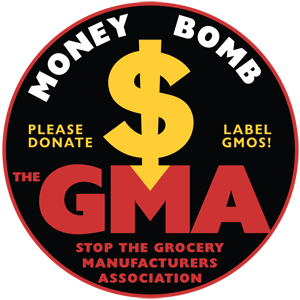
I recently named the GMA “the most evil corporation on the planet,” considering the fact that it consists primarily of pesticide producers and junk food manufacturers who are going to great lengths to violate some of your most basic rights—just to ensure that subsidized, genetically engineered and chemical-dependent, highly processed junk food remains the status quo.
The insanity has gone far enough. It’s time to unite and fight back, which is why I encourage you to boycott every single product owned by members of the GMA, including natural and organic brands. To learn more about this boycott, and the traitor brands that are included, please visit TheBoycottList.org. I also encourage you to donate to the Organic Consumers Fund. Your donation will help fight the GMA lawsuit in Vermont, and also help win the GMO labeling ballot initiative in Oregon in November.
Voting with your pocketbook, at every meal, matters. It makes a huge difference. By boycotting GMA member Traitor Brands, you can help level the playing field, and help take back control of our food supply. And as always, continue educating yourself about genetically engineered foods, and share what you’ve learned with family and friends.
Copyright 1997- 2014 Dr. Joseph Mercola. All Rights Reserved.
http://articles.mercola.com/sites/articles/archive/2014/07/01/agriculture-pollution.aspx