Watching Too Much TV Linked to Early Death
Story at-a-glance
- Watching TV for three or more hours a day doubles your risk of premature death compared to watching TV for one hour or less
- For every two additional hours spent watching TV, a person’s risk of death from heart disease rose by 44 percent and risk of death from cancer climbed by 21 percent
- Part of what makes TV viewing so damaging to your health is that it increases your time spent sitting
- People who sit for the longest periods of time are twice as likely to have diabetes or heart disease compared to those who sit the least
- If you must watch TV, engaging in intermittent movement every 15 minutes or so can help to decrease its negative health effects
By Dr. Mercola
If you watch television for three or more hours a day, your risk of premature death is double that of someone who watches only one hour or less, according to new research published in the Journal of the American Heart Association.1 The health risks of too much sedentary behavior, including too much sitting, are now widely known.
An earlier study, published in 2009, also linked sitting with biomarkers of poor metabolic health, showing how total sitting time correlates with an increased risk of type 2 diabetes, heart disease, and other prevalent chronic health problems,2 which explains why it could easily increase your risk of premature death.
What's interesting about the current study, however, is that it didn't compare television watching to other more active activities… it compared it to computer usage and driving time – two activities that also involve sitting.
Somewhat surprisingly, computer use and driving time were not associated with an increased risk of death the way television watching was, which begs the question, is TV damaging to your health in other ways beyond sitting?
How Does Watching TV Damage Your Health?
While no link was found between using a computer or driving and premature death, for every two additional hours spent watching TV, a person's risk of death from heart disease rose by 44 percent and risk of death from cancer climbed by 21 percent.3
The researchers were skeptical, so they set out to examine other variables that might be driving up death rates linked to TV watching, like increased consumption of processed foods and sugary drinks (widely known to rise with television viewing), smoking, an unrelated serious illness, following (or not following) a Mediterranean diet, age, sex, and weight.
The results linking television time and premature death still held strong, which suggests television may be uniquely damaging. The study's authors suggested part of the problem may be the extremely sedentary nature of television watching. When you're driving or working at a computer, your body moves (albeit minimally) and your mind is engaged, which are not the case when watching TV.
Although not addressed in the study, exposure to light at night, even from your television, can also interfere with your body's circadian rhythm and hormone production, wreaking havoc on your health. So this may be yet another way television is associated with chronic disease.
Furthermore, watching TV actually has a major impact on your brain chemistry, and the longer you watch, the easier your brain slips into a receptive, passive mode, meaning that messages are streamed into your brain without any participation from you. Dr. Aric Sigman, a British psychologist, analyzed 35 different scientific studies on television and its effect on the viewer.4
He found the damage comes not from the TV programs themselves, but from the vast amount of time kids, in particular, are spending watching television and computer screens. This activity produces an almost narcotic effect on your brain, actually numbing areas that would be stimulated by other activities, like reading. Dr. Sigman has identified 15 negative effects that he believes can be blamed on watching television, stating:5
"Watching television, irrespective of the content, is increasingly associated with unfavorable biological and cognitive changes. These alterations occur at viewing levels far below the population norm.
Given the population's sheer exposure time to this environmental factor it is more than puzzling to consider how little awareness and action has resulted."
The risks Dr. Sigman revealed include:
Obesity Delayed healing Heart trouble Decreased metabolism Damaged eyesight Alzheimer's disease Decreased attention span Hormone disturbances Cancer Early puberty Autism Sleep difficulties Increased appetite Limited brain growth Diabetes
TV Increases the Time You Spend Sitting in a Completely Relaxed State
Too much sitting, whether in front of a computer, in your car or watching television, should be avoided for optimal health. And it makes sense that TV watching may be the worst of the sitting offenders, drawing your body and mind into a completely sedentary, passive state. At least with driving and computer usage, the study's author explained:6
"You have tension in your muscles. You are moving little parts of your body, like your hands. You are not completely relaxed as you are when you are watching television."
Instead of parking yourself in front of the TV at night, consider doing something else, or at the very least engage in some minor activity while the TV is on. The reason this is so critical for your health is that when you move, you increase the force of gravity on your body.
Anti-gravity environments speed up cellular deterioration; this we know from astronauts in outer space. Dr. Joan Vernikos,7 former director of NASA's Life Sciences Division and author of Sitting Kills, Moving Heals, was in fact one of the primary doctors assigned to keep NASA astronauts from deteriorating in space.
In an anti-gravity situation, your body deteriorates at a far more rapid pace, and interestingly enough, sitting for an extended period of time simulates a low-gravity type environment for your body. The key is to disengage from this low anti-gravity situation as much as possible using intermittent movement.
The Health Damage of Too Much Sitting Is Well Established
There may be some differing health effects between sitting for different activities (television versus reading, for instance), but as these continue to be explored, know this: even if you are a fit athlete who exercises regularly, you may still endanger your health simply by sitting too much. For example, one 2012 analysis that looked at the findings from 18 studies found that those who sat for the longest periods of time were twice as likely to have diabetes or heart disease, compared to those who sat the least.8
Besides increasing your risk of metabolic problems, researchers warn that the combination of sitting too much and exercising too little can more than double the risk of heart failure in men.9 Last year, a Swedish study also concluded that those who live a generally active life have better heart health and live longer than those who remain sedentary for most of the day.10 This held true even for those who didn't engage in a regular exercise routine. The study revealed:11
- Those who reported overall higher levels of daily intermittent movement suffered fewer heart-related problems
- For every 100 of the sedentary people who experienced a heart attack or stroke, only 73 of the highly active group had such an event
- For every 100 of the least active who died, only 70 of the most active died
- Those who had high daily activity levels and engaged in a regular exercise program had the lowest risk profiles overall
Try These Intermittent Movement Activities While You Watch TV
There are many reasons to limit the amount of television in your life, but when you do watch it, make it a point to get up every 15 minutes. Dr. Vernikos' research demonstrated that the minimum number of times you need to interrupt your sitting in order to counteract its cardiovascular health risks is in the neighborhood of 35 times per day. Her research clearly shows that sitting down and standing up repeatedly for 35 minutes does NOT have the same effect as standing up once, 35 times over the course of the entire day.
I suggest you take a break to do one set of three exercises, anywhere from once every 15 minutes to once per hour. I personally am very disciplined and committed to doing these movements at least once every 15 minutes. This is important not only during television watching but also during other types of screen time or while you're doing desk work.
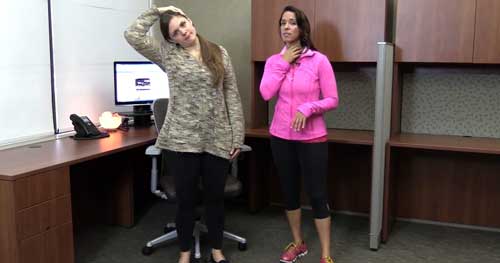
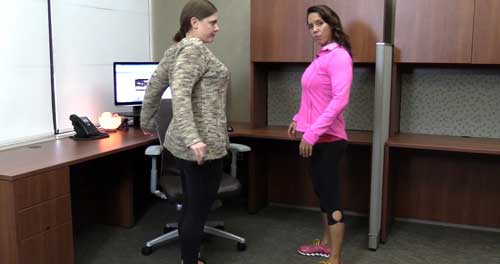
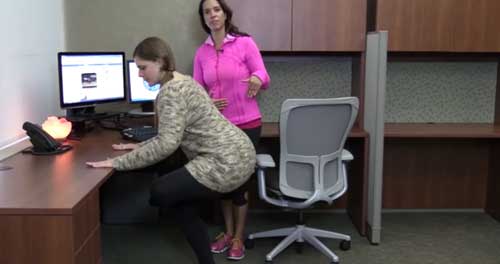
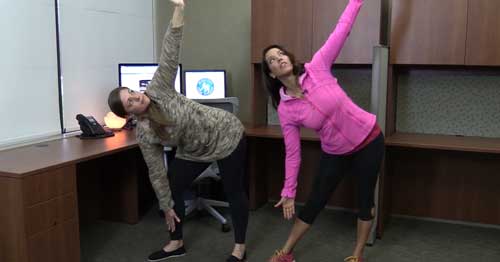
The following videos, featuring Jill Rodriguez, offer a series of helpful intermittent movement beginner exercises you can do virtually anywhere. For a demonstration of each technique, please see the corresponding video in the table below. The videos use a desk for demonstration purposes, but you could also use the back of a chair, a coffee table, or the back of your couch for support.
Technique #1: Standing Neck-Stretch: Hold for 20 seconds on each side.
Technique #2: Shoulder Blade Squeeze: Round your shoulders, then pull them back and pull down. Repeat for 20-30 seconds.
Technique #3: Standing Hip Stretch: Holding on to your desk, cross your left leg over your right thigh and "sit down" by bending your right leg. Repeat on the other side.
Technique #4: The Windmill: Stand with feet shoulder-width apart, then pivot your feet to the right. Push your hip out to the left. Raising your left arm skyward, and your right arm toward the floor, lower your body toward the floor while looking up, then raise your torso back to standing position. Repeat on the other side.
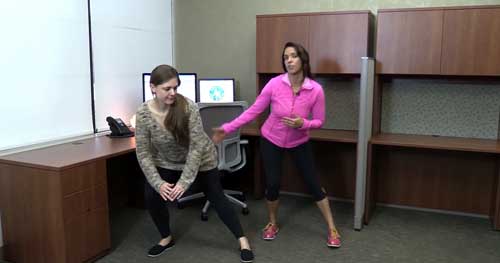
Technique #5: Side Lunge: Starting with your feet together, take a medium step sideways, and bend down as if you're about to sit. Use your arms for balance by reaching out in front of you. Return to starting position, and repeat 10-20 times. Repeat on the other side.
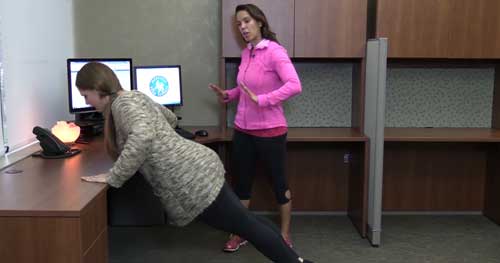
Technique #6: Desk Push-Up: Place hand a little wider than shoulder-width apart on your desk. Come up on your toes to make it easier to tip forward. Lower your chest to the edge of the desk, and push back up. Do 10 repetitions.
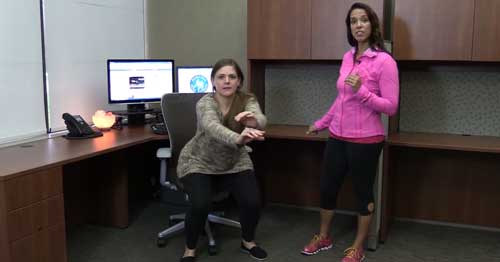
Technique #7: Squat to Chair: With your feet shoulder-width apart, sit down, reaching forward with your hands, and stand back up in quick succession. Do 15-20 repetitions.
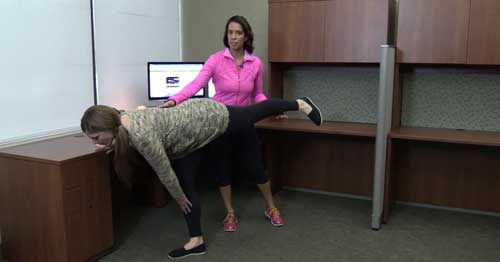
Technique #8: Single Leg Dead Lift: Place your right hand on your desk, and place your weight on your right leg. Fold your torso forward, while simultaneously lifting your left leg backward. Do 10 repetitions on each side.
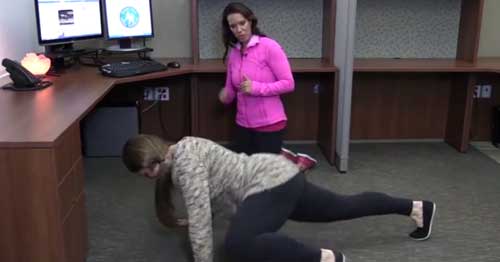
Technique #9: Mountain Climber: Get into a push-up position on the floor. Pull your right knee forward to touch your right wrist or arm, then return to push-up position. Repeat on the other side. Try to pick up the pace, and do 20 quick repetitions.
Standing Neck Stretch
Shoulder Blade Squeezes
Standing/Seated Hip Stretch
Windmill
Side Lunge
Push-Up
Squat to Chair
Single Leg Dead Lift
Mountain Climber
Can You Stay Fit While Sitting?
I'm not aware of any studies on the topic, but it would appear that you can significantly decrease the health damage of too much sitting by regularly engaging in intermittent movement. Once you've mastered the beginner exercises above, try the 10 exercises that follow for an even greater challenge. Try to do at least one of these exercises every 15 minutes when you're sitting.
#1: Standing Hip Flexor Stretch
#2: Standing Calf Stretch
#3: Standing Inner Thigh Stretch
#4: Standing Back/Buttocks Stretch
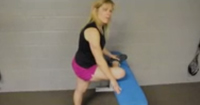
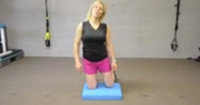
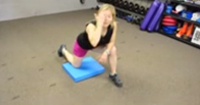
#5: Kneeling Lunge Matrix
#6: Hip Flexor, Hamstring, and Quad Stretch
#7: Side Line Twisting Back Stretch
#8: Chest Stretch
#9: Back Butt Stretch
#10: Pole Stretch for the Back
Standing Hip Flexor Stretch
Standing Calf Stretch
Standing Inner Thigh Stretch
Standing Back/Buttocks Stretch
Kneeling Lunge Matrix
Hip Flexor, Hamstring, and Quad Stretch
Side Line Twisting Back Stretch
Chest Stretch
Back Butt Stretch
Pole Stretch for the Back






Tips for Breaking Free of the TV
Limiting television time can easily become a family affair, and you'll be amazed at how much time you free up when you're no longer addicted to its spell. The first step to cutting back is to remove the television from your bedroom, as one study found that having a TV in the bedroom increased viewing time by nearly nine hours a week.12 Next, change up your routine. Plan special activities for the times you would ordinarily be watching TV. If it's during the day, do something active, like taking a walk, exercising, or working in your yard.
You can also try a new hobby, cook a meal, or go outside for a game of tag with your kids. If it's later at night, engage in a quiet activity, like taking a bath or reading a book to help wind down from your day. If you must watch TV, remember to engage in intermittent movement throughout as described above. Another option is to ditch your TV entirely and opt for services like Netflix instead. This allows you to watch a carefully chosen film for a treat without getting sucked into TV overload (and as an added bonus, it is advertisement-free).
© Copyright 1997-2014 Dr. Joseph Mercola. All Rights Reserved.
http://fitness.mercola.com/sites/fitness/archive/2014/07/11/watching-tv-premature-death.aspx