Immediate Ban on Dental Amalgam in Philippines Pushed
Story at-a-glance
- Mercury vapor concentrations in certain Philippine dental institutions and dental stores exceeded the standard reference levels set by the US Environmental Protection Agency (EPA)
- Some areas in dental institutions had mercury concentrations of >10,000 ng/m3, which is considered as the evacuation alert level by the US EPA
- In the Philippines, mercury is supposed to be phased out of health care facilities by the end of 2016, but environmental groups are calling for an immediate ban to protect human health and the environment
- Anyone who has mercury fillings in their mouth is at risk from the mercury vapors they release. However, dental practitioners are particularly vulnerable to mercury intoxication while working with this toxic substance
By Dr. Mercola
Last year, a legally binding international treaty to control the use of toxic mercury was signed into action. The treaty marked the beginning of the end for dental amalgam around the world, as it mandates that each nation phase down amalgam use.
The Philippines was among those nations that signed the treaty last year, with the country saying they planned to have mercury-free health care facilities by the end of 2016. It's a major victory… but, for those working with this deadly poison on a daily basis, it may not be soon enough.
Environmental activist groups in the Philippines are now calling for an immediate ban on dental mercury, following a new study that has revealed just how high levels of mercury vapor really are in dental institutions.
Mercury Vapors in Some Dental Institutions Are So High They Should Trigger Immediate Evacuations
Anyone who has mercury fillings in their mouth is at risk from the mercury vapors they release. However, dental practitioners – including dentists, dental hygienists, dental students, clinical instructors, and even dental supply traders – are particularly vulnerable to mercury intoxication while working with this toxic substance.
A new study conducted by environmental justice group BAN Toxics (BT) in partnership with the International Association of Oral and Medicine & Toxicology-Philippines, World Alliance for Mercury-Free Dentistry, and Asian Center for Environmental Health, revealed just how high levels of mercury vapor actually are.
The mercury vapor concentrations in five Philippine dental institutions and three dental stores exceeded the standard reference levels set by the US Environmental Protection Agency (EPA).1 As reported by BAN Toxics:2
"It was found that mercury concentration values varied from 967ng/m3 to a high of 35,617ng/m3—the majority of which were at levels beyond recommended reference standards such as the Agency for Toxic Substances and Disease Registry (ATSDR) action level of 1,000 ng/m3. Some areas posted a concentration of >10,000 ng/m3, which is considered as the evacuation alert level by the US EPA."
Rather than waiting until the end of 2016 for the phase-out, exposing dental students and workers to dangerous levels of mercury for essentially three more years, the environmental groups are calling for an immediate ban on dental amalgam in the Philippines, along with a change to the dental curriculum so that the future generation of dentists will know how to use mercury-free alternatives.
Pakistan Hospital Bans Mercury Due to Indoor Air Pollution
Similar to in the Philippines, research conducted in collaboration with the Zero Mercury Working Group (ZMWG) and the Sustainable Development Policy Institute found that some dental hospitals in Pakistan had hazardous levels of mercury pollutants in the air.3
The study found some dental teaching hospitals with indoor air levels of mercury between eight and 20 times higher than the permissible level for human health, posing risks not only to patients but also to medical staff. In response to the study, Polyclinic Hospital in Pakistan became the country's first to ban mercury fillings, citing hazards to human health.
One Dentist's Poignant Warning About Mercury Dangers
The mercury used by dentists to manufacture dental amalgam is shipped as a hazardous material to the dental office. Any amalgam leftover is also treated as hazardous waste and requires special precautions to dispose of, yet it's supposed to be "safe" to keep it in your mouth for years to come.
Sadly, many live with toxic reactions for extended periods of time, never connecting the dots between their failing health and the mercury in their teeth and their environment. This is even the case for dentists like Dr. Stuart Scheckner, who did not realize the risks of mercury poisoning until it was too late.
In his case, a bottle of mercury was spilled onto the rug in his dental office while a silver amalgam filling was being prepared. The accidental spill occurred in 1978. Today in 2014, he is still feeling the effects. As reported by the Herald Tribune:4
"Scheckner didn't realize that he was working over what was essentially a toxic spill. Mercury is the most poisonous non-radioactive element known on Earth. It doesn't have an odor, and breathing in the fumes is a terrible hazard. The dentist started to experience physical tremors, nausea, digestive problems and anxiety attacks. He also lost weight."
Eventually, his symptoms of mercury poisoning became so bad that he had to stop working and close his dental practice. After receiving little help from conventional medicine, Dr. Scheckner spent two decades trying a variety of chelation therapies and nutritional supplements to help undo the damage the mercury did to his system.
Although he has slowly improved, prolonged mercury exposure, as he experienced, often causes permanent, irreversible damage. To this day, Dr. Scheckner still experiences tremors related to the mercury exposure in his dental office decades ago.
After his personal ordeal, Dr. Scheckner has devoted himself to warning others about the dangers of amalgam fillings in his book, Time Bomb from Within: Mercury Poisoning and Dentistry. As he told the Herald Tribune, it's essential to be informed and take steps to reduce your exposure to mercury.
Unfortunately, right now in the US and around the globe, many dentists are still implanting this poisonous metal into people's mouths, including in extremely vulnerable populations like children and pregnant women. Dr. Scheckner stated:"The good news is that knowledge is power… If we are informed and take steps to have good nutrition, and lessen our exposure to mercury, we can protect ourselves and keep ourselves healthy."
Use of Dental Mercury Is a Leading Cause of Environmental Mercury Pollution
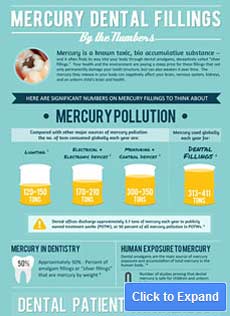
Dental mercury is a danger to dental practitioners, patients, and the environment. In fact, in the US dentist offices are the largest source of mercury in wastewater entering publicly owned treatment works. Once there, dental mercury converts to methylmercury, a highly toxic form of mercury known to be hazardous to brain and nervous system function, particularly in fetuses and young children.
Mercury is extremely dangerous once in the air, water, and soil -- levels gradually increase over time, as it accumulates. It's no wonder then that contaminated fish and other seafood are the largest dietary source of mercury in the US, courtesy of polluted waterways. Several studies show that about 50 percent of the mercury entering municipal wastewater treatment plants can be traced back to dental amalgam waste.
This mercury waste amounts to about 3.7 TONS each year! An estimated 90 percent is captured by the treatment plants generally via sewage sludge5 -- some of which ends up in landfills, while other portions are incinerated (thereby polluting the air) or applied as agricultural fertilizer (polluting your food), or seep into waterways (polluting fish and wildlife).
In 2010, the EPA announced it would create a rule requiring dentists who use dental amalgam to at least use best-management practices and install amalgam separators. An amalgam separator is a wastewater treatment device installed at the source, in the dental office, that can remove 95-99 percent of the mercury in the wastewater. As originally proposed, EPA said the regulation would be finalized by 2012. Unfortunately, the EPA is on the verge of withdrawing the rule that would order dentists to buy amalgam separators. The costs – and health risks –that ensue will be passed on to American taxpayers and families.
Pro-Mercury Groups Are Already Engaging in Stalling Tactics
In order to protect human health and the environment, mercury should be phased out as soon, and as quickly, as possible. The international treaty, named the United Nations Minamata Convention on Mercury, requires the phasing out of many mercury-containing products, including thermometers, by 2020, and also calls for an end to all mercury mining within 15 years. The treaty takes effect only after its ratification by 50 nations, which can take three or four years.
Instead of working for the phase-down and ultimate phase-out of amalgam use, FDA and the ADA are pushing stalling tactics, saying that before phasing out amalgam we should go through a litany of diversions like (1) prevention of tooth decay, (2) research and mercury inventories, and (3) mercury waste management – none of which actually phase down amalgam use, as required by the Minamata Convention.
These stalling tactics can appear attractive at first glance. But don't be fooled by the World Dental Federation: all three of their "amalgam phase-down measures" are designed to delay the demise of mercury fillings. No more research is needed before we take action – the many effective, affordable, and available mercury-free alternatives have already been researched for over half a century, and we certainly don't need any more research telling us that mercury is a problem. And the realistic solution to waste management, of course, is to stop creating more mercury waste – i.e., stop using amalgam.
Clearly, if the World Dental Federation gets its way, amalgam will be around for a long time. But groups like BAN Toxics, which is calling for an immediate ban on amalgam in the Philippines, and others are pushing to get mercury phased out around the globe quickly and for good.
Why Wait? The Sooner Mercury Use Ends, the Better
The Campaign for Mercury-Free Dentistry, the project organized and led by Charlie Brown of Consumers for Dental Choice, has made amazing progress toward mercury-free dentistry. But there's still hard work ahead as Consumers for Dental Choice is now running education programs for consumers… holding training sessions for dentists… and organizing briefings for governments around the world. You can help stop dental mercury today! Will you please consider a donation to Consumers for Dental Choice, a 501(c)(3) non-profit organization dedicated to advocating mercury-free dentistry?
Donations are tax-exempt and can be made online at www.toxicteeth.org. Checks can be mailed to:
Consumers for Dental Choice
316 F St., N.E., Suite 210
Washington DC 20002For updates on the movement for mercury-free dentistry, join Consumers for Dental Choice on Facebook or sign up to receive their newsletter. You can also take a stand with us and tell the EPA not to let polluting dentists off the hook: It's time to stop dental mercury dumping.
The Philippines campaign was launched by Dr. Lillian Lasaten Ebuen, founder and president of the organization IAOMT-Philippines and vice president-East Asia for the World Alliance for Mercury-Free Dentistry. (The World Alliance is the coalition that spearheaded the successful campaign to include amalgam in the new international mercury treaty, the Minamata Convention.) Working with Charlie Brown, president of the World Alliance, Dr. Ebuen organized a conference in December 2012; its theme was "Philippines Toward Mercury-Free Dentistry." Now BAN Toxics, Dr. Ebuen, and Brown continue their collaboration, reaching out to important stakeholders and developing a step-by-step amalgam phase-out plan for the Philippines.

Copyright 1997- 2014 Dr. Joseph Mercola. All Rights Reserved.
http://articles.mercola.com/sites/articles/archive/2014/03/25/philippines-dental-amalgam.aspx