Advanced building controls save more than originally thought
Commercial buildings could cut their heating and cooling electricity use by an average of 57 percent with advanced energy efficiency controls, according to a year-long study of the controls at malls, grocery stores and other buildings across the country, which demonstrated higher energy savings than what was predicted in earlier computer simulations by the same researchers.
 |
|
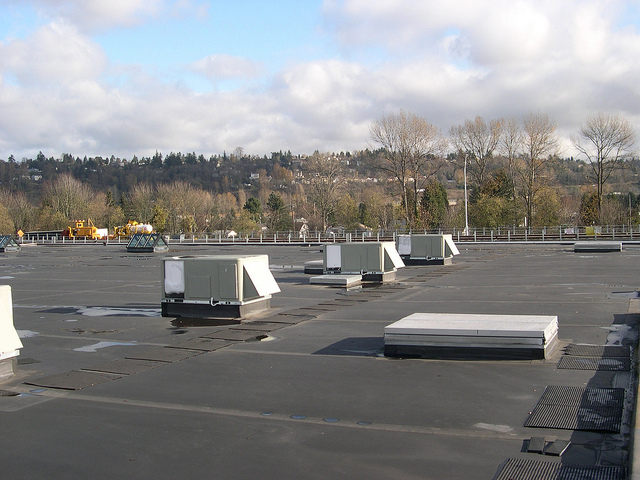
PNNL researchers found commercial buildings could substantially cut their power bills if they retrofitted their packaged rooftop heating, ventilation and air conditioning units, such as those shown here in the Seattle area. Credit: Pacific Northwest National Laboratory |
"We've long known that heating and cooling are among the biggest energy consumers in buildings, largely because most buildings don't use sophisticated controls," said the study's lead researcher, Srinivas Katipamula of the Department of Energy's Pacific Northwest National Laboratory. "But our tests of controls installed at real, working commercial buildings clearly demonstrate how much more energy efficient air conditioning systems can be."
In 2011, the PNNL researchers set out to enable packaged HVAC units to automatically adjust their operations based on conditions inside and outside a building. Using sensors and variable-speed motors, the controls decide when and how fast ventilation fans should run, and if the units can use naturally cold air from the outside instead of mechanically cooling indoor air.
In 2012, the team installed the already commercially available control kits on 66 rooftop HVAC units -- chosen mainly because they most closely resembled the advanced controls PNNL had envisioned -- at eight volunteer commercial buildings in Washington, Ohio, California and Pennsylvania.
The researchers found that, compared to standard operations, the HVAC units using advanced controls cut their energy use by an average of 57 percent. The actual energy savings ranged from 20 to 90 percent. Larger buildings such as malls, which need bigger HVAC units, saved more energy than smaller buildings. Buildings that ran ventilation fans more, such as stores open long hours, tended to save more energy.
Translating the energy savings into dollars saved depends on local power costs. When using the national average, researchers found all the field-tested HVAC units would have saved an average of $1,489 annually per unit and estimated that it would take a building owner an average of three years to see a return on investment.
For more:
- see this
article
© 2014 FierceMarkets, a division of Questex Media Group LLC. All rights reserved.
http://www.fierceenergy.com/story/advanced-building-controls-save-more-originally-thought/2014-05-28