Deadly explosions hit Homs and Damascus |
|
|
Scores of people have died in pro-government Syrian neighbourhoods after a dual attack in the cities.
Last updated:
29 Apr 2014 19:39
|
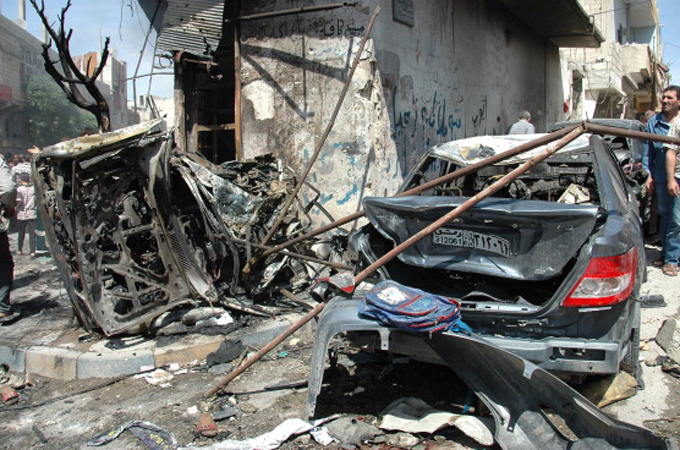
Mortar attacks have increased in frequency according
to residents in Homs. [Getty Images]
|
|
A car bomb has exploded in the central Syrian city of Homs killing around 36 people, just hours after an attack in Damascus killed 14, government officials said. Tuesday’s attacks came a day after Bashar Al Assad, the Syrian president, nominated himself for the June 3 presidential elections, a race he is likely to win amid a raging civil war aimed at undermining the leader and his government. A Syrian government official said the car bomb that hit Homs exploded in the city's predominantly Alawite district of Zahra. The attacks seemed to have targeted the Alawite and Shiite areas of the two cities which contain forces loyal to Assad. Along with the 36 killed, 85 people were wounded in the blast, the official told The Associated Press over the telephone from Homs. Meanwhile, in Damascus, several mortar shells slammed into the predominantly Shiite neighborhood of Shaghour in the morning hours, killing 14 people and wounding 86, Syria's official SANA news agency and state TV reported. It was the deadliest mortar attack in the Syrian capital since the conflict began in March 2011. No one immediately claimed responsibility for the Homs and Damascus attacks on Tuesday. Opposition fighters have frequently fired mortars into the capital from opposition-held suburbs and residents say mortar attacks have increased in recent weeks. Armed opposition groups have also attacked Syria's cities with car bombs in previous months. An al-Qaeda-linked group has previously claimed responsibility for several car bombs in the capital and other cities. SANA has blamed the attacks on “terrorists”, a term used by Assad's government for rebels. Many of the opposition-held neighbourhoods around Damascus have been under a crippling government blockade for months, with no food and medicine allowed to reach trapped civilians inside. Chemical weapons The attacks follow accusations regarding the use of chlorine gas by Bashar Al Assad's forces in recent months. The Syrian government has denied these allegations. The Organisation for the Prohibition of Chemical Weapons said on Tuesday the Syrian government had agreed to a mission to investigate the use of chlorine gas. The OPCW team is expected to depart for Syria soon. Under a US-Russian deal negotiated last year, Syria signed up to the Chemical Weapons Convention and agreed to hand over its entire chemical arsenal by June 30 of this year. Syria already missed an April 13 deadline to destroy all the weapons in accessible locations. As well as the remaining chemical material, there is a dispute over whether Syria will have to destroy 12 remaining chemical weapons production sites. |
http://www.aljazeera.com/news/middleeast/2014/04/deadly-explosions-hit-major-syrian-cities-201442914172120998.html