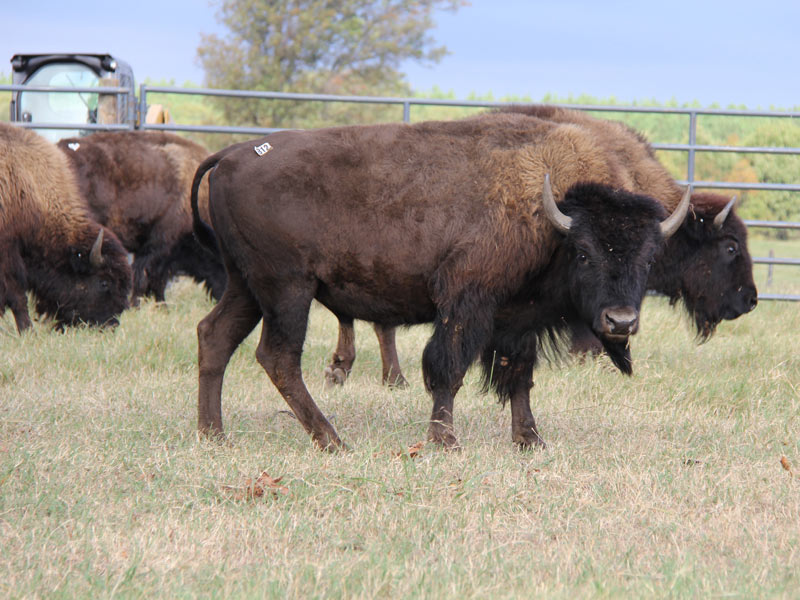
Female bison graze on Cherokee Nation land in Delaware
County. Cows can weigh up to 1,100 pounds and bulls can
weight up to 2,000 pounds. JAMI MURPHY/CHEROKEE PHOENIX



BULL HOLLOW, Okla. – In the early morning hours of Oct. 9, after
a near 40-year absence, the Cherokee Nation received its
long-awaited herd of bison, popularly referred to as buffalo, in
this small Delaware County community.
Thirty-eight female bison, already bred, were delivered via stock trailers from the Badlands National Park in South Dakota. This herd, and approximately 10 bull bison set to arrive later in October from North Dakota, will reside on up to 1,000 acres of tribal land.
According to a release, the bison are each about 2 years old and weigh about 600 pounds. The cows can weigh as much as 1,100 pounds, while bulls can grow up to 2,000 pounds.
A Cherokee blessing greeted the bison upon their arrival. The tribe owned several heads of bison in the 1970s as a tourist attraction. In centuries past, some bison roamed east of the Mississippi River where Cherokees hunted them. According to a CN press release, the Cherokee people have a long, deep connection and history with bison as a source of food, tools and clothing and in traditional ceremonies.
“Our main purpose is to return bison back to Indian Country, and that’s what’s happening here. It’s a big part of our culture since we are connected to them spiritually. So for the Cherokee Nation it’s a great day, and for us as well, to bring bison to their Nation,” Ervin Carlson, president of the InterTribal Buffalo Council, said.
Carlson, a citizen of the Blackfeet Tribe in Montana, said he came to Oklahoma to witness the historic return of bison into Cherokee country.
“The organization (ITBC) has been around for about 25 years,” he said. “GV Gulager (CN Natural Resources director) was working with some other people trying to bring the buffalo back here. Didn’t really know about the InterTribal Buffalo Council. (He) found out about that and joined the organization. We have agreements with the park’s services on the surplus animals that they have. And each year we give those animals out to tribes. So GV, he got with our technical people and let him know what’s available to them that we do – put in a request for them and we help. Of course, ITBC is about returning buffalo back to Indian Country.”
Gulager summed up the bison transfer with one word – “success.”
“It means a lot. We’ve been at it since 2012 of December and now we finally got them here in Delaware County, in the heart and soul of Cherokee Nation, glad to have them,” Gulager said. “I want to thank the Indian Tribal Buffalo Council and everyone who made this possible.”
CN Management Resources Executive Director Bruce Davis said bringing in the bison has been a joint effort between many departments.
“All of my departments are here today and all of us are excited to have the buffalo come in,” Davis said. “It started approximately two years (ago). They said we had buffalo here say 40 years ago. It’s exciting to have everyone involved. To bring the buffalo back to the Cherokee Nation, it’s a part of our heritage, our culture, so it’s a good feeling for us to be able to do that through Natural Resources.”
Principal Chief Bill John Baker said the herd offers economic development benefits, too.
“To reconnect with the buffalo, to get them back as part of our culture and as part of our tribe that’s important. Obviously, the tourism factor being able to place these around. Then the lean meat that they produce that we can use in our donated foods, all USDA and disease-free,” Baker said.
Thirty-eight female bison, already bred, were delivered via stock trailers from the Badlands National Park in South Dakota. This herd, and approximately 10 bull bison set to arrive later in October from North Dakota, will reside on up to 1,000 acres of tribal land.
According to a release, the bison are each about 2 years old and weigh about 600 pounds. The cows can weigh as much as 1,100 pounds, while bulls can grow up to 2,000 pounds.
A Cherokee blessing greeted the bison upon their arrival. The tribe owned several heads of bison in the 1970s as a tourist attraction. In centuries past, some bison roamed east of the Mississippi River where Cherokees hunted them. According to a CN press release, the Cherokee people have a long, deep connection and history with bison as a source of food, tools and clothing and in traditional ceremonies.
“Our main purpose is to return bison back to Indian Country, and that’s what’s happening here. It’s a big part of our culture since we are connected to them spiritually. So for the Cherokee Nation it’s a great day, and for us as well, to bring bison to their Nation,” Ervin Carlson, president of the InterTribal Buffalo Council, said.
Carlson, a citizen of the Blackfeet Tribe in Montana, said he came to Oklahoma to witness the historic return of bison into Cherokee country.
“The organization (ITBC) has been around for about 25 years,” he said. “GV Gulager (CN Natural Resources director) was working with some other people trying to bring the buffalo back here. Didn’t really know about the InterTribal Buffalo Council. (He) found out about that and joined the organization. We have agreements with the park’s services on the surplus animals that they have. And each year we give those animals out to tribes. So GV, he got with our technical people and let him know what’s available to them that we do – put in a request for them and we help. Of course, ITBC is about returning buffalo back to Indian Country.”
Gulager summed up the bison transfer with one word – “success.”
“It means a lot. We’ve been at it since 2012 of December and now we finally got them here in Delaware County, in the heart and soul of Cherokee Nation, glad to have them,” Gulager said. “I want to thank the Indian Tribal Buffalo Council and everyone who made this possible.”
CN Management Resources Executive Director Bruce Davis said bringing in the bison has been a joint effort between many departments.
“All of my departments are here today and all of us are excited to have the buffalo come in,” Davis said. “It started approximately two years (ago). They said we had buffalo here say 40 years ago. It’s exciting to have everyone involved. To bring the buffalo back to the Cherokee Nation, it’s a part of our heritage, our culture, so it’s a good feeling for us to be able to do that through Natural Resources.”
Principal Chief Bill John Baker said the herd offers economic development benefits, too.
“To reconnect with the buffalo, to get them back as part of our culture and as part of our tribe that’s important. Obviously, the tourism factor being able to place these around. Then the lean meat that they produce that we can use in our donated foods, all USDA and disease-free,” Baker said.