Pro-GMO Industries Increase Spending and Launch Attack to Discredit World-Famous Environmentalist

Story at-a-glance
- Between 2012 and mid-2014, Monsanto and the Grocery Manufacturers Association (GMA) successfully blocked GMO labeling legislation in over 30 states, at a price tag of more than $100 million
- According to the most recent analysis, opponents of GMO labeling spent more than $27 million on lobbying in the first six months of this year alone. This is about three times more than they spent during all of 2013
- Vermont successfully signed into law a mandatory labeling bill in May. More than 20 other states are presently considering GMO labeling laws
- The chemical technology industry has begun a massive coordinated attack against Vandana Shiva, who is perhaps one of the most vocal and most well-respected environmentalists and anti-GMO activists in the world
By Dr. Mercola
Between 2012 and mid-2014, Monsanto and the Grocery Manufacturers Association (GMA) successfully blocked GMO labeling legislation in over 30 states, at a price tag of more than $100 million.
These funds were received from the 300+ members of the GMA, which include chemical/pesticide, GE seed, and processed food industries.
Together, these industries are working in a symbiotic fashion to grow, subsidize, and manufacture foods that have been clearly linked to growing obesity and chronic disease epidemics.
According to the most recent analysis, opponents of GMO labeling spent more than $27 million on lobbying in the first six months of this year alone. This is about three times more than they spent during all of 2013, when they shelled out $9.3 million.
"The Grocery Manufacturers Association (GMA) and major food makers such as Coca-Cola Co and PepsiCo Inc and top biotech seed makers Monsanto Co and DuPont were among heavy spenders on GMO labeling-related lobbying, among other food issues, according to a report issued by the Environmental Working Group," Reuters1 reports.
Chemical Technology Industry Running Scared
Such a dramatic rise in expenditure to keep genetically engineered (GE) foods and genetically modified organisms (GMOs) hidden is probably understandable in light of the fact that one state—Vermont—successfully signed into law a mandatory labeling bill in May.
The law will require food manufacturers to label genetically engineered (GE) foods sold in Vermont, and prohibits them from labeling foods with GE ingredients as "natural" or "all natural."
In response, the Grocery Manufacturers Association (GMA) along with the Snack Food Association, International Dairy Foods Association, and the National Association of Manufacturers, sued Vermont in federal court2 the following month (June).
The GMA also sued the state of Washington last year after getting caught in a money laundering scheme during the state's GMO labeling campaign.3 Caught red handed, the GMA was forced to reveal the donors to their aggressive anti-labeling campaign.4
But rather than admitting its wrongdoing, the GMA sued Washington State, arguing the association should be allowed to hide their donors—which is a direct violation of state campaign disclosure laws—in order to "speak with one voice" for the interests of the food industry.5
As noted by Reuters,6 more than 20 other states are presently considering GMO labeling laws. Both Colorado and Oregon have GMO labeling on their November ballots. Two counties in Oregon have already voted to ban the growing of GE crops.
This escalating trend undoubtedly has the industry running scared that their jig might soon be up...
Clearly, as more states move forward on their labeling bills, keeping up the lawsuit strategy could turn into a major headache for the GMA, which is why it's pushing a Congressional bill called "The Safe and Accurate Food Labeling Act of 20147," (dubbed "DARK"—Denying Americans the Right to Know Act) that would simply preempt all states from passing GMO labeling laws.8
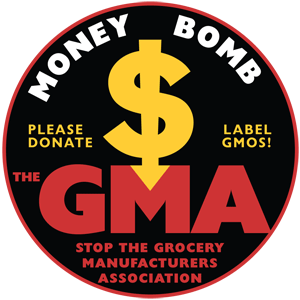
To help Vermont defend its GMO labeling law against these multi-national giants, consider making a donation to the Organic Consumers Fund, which has been set up to raise funds for this purpose. The fund has also pledged $500,000 to help Oregon pass a GMO labeling initiative in November.
Coordinated Attack to Discredit Vandana Shiva
It's also quite clear that the pro-GMO cartel, which includes the GMA, Monsanto and other leading chemical technology companies, along with leading processed food companies, have begun a massive coordinated attack against Vandana Shiva.
She is perhaps one of the most vocal and most well-respected environmentalists and anti-GMO activists in the world. As recently noted by Counter Punch9 in an article titled "Gunning for Vandana Shiva:"
"Perhaps nothing symbolizes the decline of The New Yorker magazine more than the hatchet job on Vandana Shiva that appears in the latest issue.10
Written by Michael Specter, the author of 'Denialism: How Irrational Thinking Hinders Scientific Progress,' the article is a meretricious defense of genetically modified organisms (GMO) relying on one dodgy source after another.
This is the same magazine whose reputation was at its apex when Rachel Carson's groundbreaking articles on DDT appeared in 1962. If DDT was once a symbol of the destructive power of chemicals on the environment, GMO amounts to one of the biggest threats to food production today.
It threatens to enrich powerful multinational corporations while turning farmers into indentured servants through the use of patented seeds. Furthermore, it threatens to unleash potentially calamitous results in farmlands through unintended mutations."
Not surprisingly, Michael Specter turns to two well-oiled propaganda mouthpieces: Pamela Ronald and Mark Lynas, to defend GE crops and refute Shiva's warnings. I've discussed both in previous articles. For example, Ronald, a GMO advocate and scientist, recently had two of her scientific papers retracted due to sizeable scientific errors that rendered her findings null and void.
Vandana Responds to Her Critics
Vandana Shiva issued a response11 to Specter's article stating that "Specter's piece starts with inaccurate information, by design." She notes several of the discrepancies in his reporting, including his attempt to discredit her by claiming he could not find any evidence of her education. She writes:
"Specter has reduced my M.Sc. Honors in Physics to a B.Sc. for convenience. Mr. Specter and the Biotech Industry (and The New Yorker, by association) would like to identify the millions of people opposing GMOs as unscientific, romantic, outliers. My education is obviously a thorn in their side.
'When I asked if she had ever worked as a physicist, she suggested that I search for the answer on Google. I found nothing, and she doesn't list any such position in her biography.' Specter has twisted my words, to make it seem like I was avoiding his question. I had directed him to my official website... The Wikipedia page about me has been altered to make it look like I have never studied science. The Biotech Industry would like to erase my academic credentials...
Quantum theory taught me the four principles that have guided my work: everything is interconnected, everything is potential, everything is indeterminate, and there is no excluded middle. Every intellectual breakthrough I have made over the last 40 years has been to move from a mechanistic paradigm to an ecological one..."
Why Do So Many Indian Farmers Commit Suicide?
The introduction of genetically engineered seeds, and the coercion of Indian farmers to use them, has led to the largest wave of recorded suicides in human history. In India, it's been estimated that a farmer commits suicide every 30 minutes, typically by ingesting pesticide. But why? The short answer is crop failures, which leaves them in financial ruin.
What many fail to realize is that it's the genetically engineered (GE) seeds that fail (especially Bt cotton), and GE seeds must be repurchased every year. You're not allowed to save patented GE seeds, as has been done since the beginnings of agriculture. Bt cotton is much more expensive than traditional cotton seed, requires more water and pesticides, and has failed to produce the increased crop yields promised by Monsanto. A single failed crop combined with lack of financing options can therefore bankrupt a farmer. Others keep going, taking out more and more loans, until they simply cannot ever pay them back.
Michael Specter tries to make light of such statistics stating that the Indian suicide trend is similar to that in France. In my view, we should be horrified to realize that the business of growing food has gotten so financially challenging that even in a country like France a farmer commits suicide every two days12—again due to being financially ruined, just like the farmers in India. Interestingly, poisoning by pesticide has actually become the leading method of suicide around the world, according to the World Health Organization.13
GMO Promises Fall Flat Because They're Not Rooted in Truth
David Friedberg is the latest poster boy for Monsanto, as it tries to clean up its image. According to the St. Louis Business Journal:14 "Friedberg, a 34-year-old lifelong vegetarian, is emerging as 'an unlikely champion' of Monsanto and its genetically modified products... Friedberg, who formerly was a Google Inc. executive, oversees Monsanto's precision agriculture services... The Wall Street Journal reports that Friedberg's 'Silicon Valley pedigree' is helping open doors for him to advocate for Monsanto in a region that has been anti-GMO... Friedberg said he believes Monsanto's products help sustain food production for the world's growing population."
The claim that GE crops are "necessary" to feed a growing population is a popular mantra among those who do not have an understanding of the whole picture. It's actually 180 degrees from the truth, as what we really need is to focus on strategies that will promote soil health, and GE crops decimate soil fertility.
Also, besides killing critical soil microbes needed for plant health and nutrition, what many fail to take into account is that GE plants typically require more water, not less, and while many varieties are designed to produce their own internal pesticides, which was meant to reduce pesticide requirements, these plants actually require more pesticides too—just to keep up with the proliferation of resistant pests and weeds!
For example, earlier this summer Bloomberg15 reported that "BASF, the world's biggest chemical maker, plans to produce 50 percent more dicamba weedkiller in Texas to keep pace with anticipated demand from a new generation of genetically modified crops."
Dicamba is a weed killer linked to non-Hodgkin's lymphoma, a type of blood cancer. And Texas is gearing up to dump 50 percent more of it on its crops in the near future. How is this benefiting anyone's health and well-being? How are GE crops "saving the world" when they are poisoning the environment and the people eating the food? This is NOT a sensible solution to world hunger. The fact is that 30-50 percent of the four billion tons of food produced around the world each year never reaches a human mouth. Cutting food waste is a critical aspect of preventing hunger as the population grows.16
The list of failed GMO promises goes on and on... And countries that recognize these facts and risks are even being more or less blackmailed into accepting GE crops, especially if they're in need of aid. El Salvador is one such example.17 If saving the world was really that high on the list of priorities, the chemical technology industry, led by Monsanto, would hardly engage in the kind of mafia tactics they've become famous for...
GMOs Have Labeling Requirements in More Than 60 Countries, Why Not in the US?
The words, "Contain GMOs," are required on labels in 64 other countries around the world. It is truthful information, and just like added flavors must be labeled "natural or artificial," and juice must state if it is from concentrate, whether or not an ingredient is genetically engineered falls under truth in labeling. To take it a step further, it prevents fraud.
Free market principles require certain understandings. If you label a product "salmon," a buyer and seller understand what salmon is. If you splice eel genes into salmon, it is no longer plain, regular old salmon. If you continue to mislabel this eel-spliced fish as salmon, the seller is committing fraud. Labeling GMOs—transgenic plants and animals—is a truthful right of the consumer. We consider non-labeled transgenic products to be fraud that the federal government has allowed based on "substantial equivalence"—a term invented to monopolize and patent life between a few gigantic corporate interests.
I recently named the GMA “the most evil corporation on the planet,” considering the fact that it consists primarily of pesticide producers and junk food manufacturers who are going to great lengths to violate some of your most basic rights—just to ensure that subsidized, genetically engineered and chemical-dependent, highly processed junk food remains the status quo.
The insanity has gone far enough. It’s time to unite and fight back, which is why I encourage you to boycott every single product owned by members of the GMA, including natural and organic brands. To learn more about this boycott, and the traitor brands that are included, please visit TheBoycottList.org. I also encourage you to donate to the Organic Consumers Fund. Your donation will help fight the GMA lawsuit in Vermont, and also help win the GMO labeling ballot initiative in Oregon in November.
Voting with your pocketbook, at every meal, matters. It makes a huge difference. By boycotting GMA Member Traitor Brands, you can help level the playing field, and help take back control of our food supply. And as always, continue educating yourself about genetically engineered foods, and share what you’ve learned with family and friends.

Copyright 1997- 2014 Dr. Joseph Mercola. All Rights Reserved.
http://articles.mercola.com/sites/articles/archive/2014/09/16/us-gmo-labeling-expenses.aspx