North Carolina realizing its solar potential
North Carolina is quicky becoming a solar leader, and seven new projects are adding even more renewable energy to its grid.
 |
|
Credit: SEIA |
FLS Energy has announced the construction of seven new utility-scale solar photovoltaic (PV) farms, which will have a total capacity of 33 megawatts (MW) and will produce around 50 million kilowatt-hours (kWh) of electricity each year.
The new farms are being constructed as a bundle, as the fourth phase of 250 MW of solar energy facilities FLS Energy will be building in 2015.
"This portfolio of projects is another example of how the North Carolina solar industry continues to create high paying jobs while making our state the emerging clean tech hub of the eastern U.S.," said Dale Freudenberger, CEO of FLS Energy.
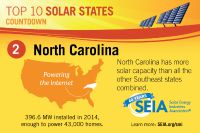
The new farms add to North Carolina's solar capacity, which is now fourth in the nation with 1,011 MW of solar capacity, more than all other Southeast states combined. They were also the fourth state in the country to achieve 1 gigawatt (GW) of installed capacity, according to the Solar Energy Industries' Association (SEIA).
"The FLS Energy expansion of its solar portfolio in NC is yet another feather in our cap when it comes to elevating the overall clean energy landscape of our state," NC Sustainable Energy Association's (NCSEA) Allison Eckley told FierceEnergy. "Projects like these advance North Carolina in the development of clean energy jobs, economic opportunity and affordable energy to benefit our entire state."
In 2014, there was 397 MW of solar capacity installed in the state, which was the second-most in the country. There are currently more than 177 solar companies in the state -- employment more than 5,600 people.
"These companies provide a wide variety of solar products and services ranging from solar system installations to the manufacturing of components used in photovoltaic panels," SEIA said, which includes "31 manufacturers, 13 manufacturing facilities, 76 contractor/installers, 20 project developers, 14 distributors and 36 engaged in other solar activities including financing, engineering and legal support."
The state is also powering the technology industry. In 2013, the Apple Data Center Solar Farm -- a 20 MW project -- was built in the state. And several other large retailers have gone solar in North Carolina, including Verizon, SAS, and IKEA -- the latter having installed 1 MW of solar capacity at their location in Charlotte. The Capital Partners Solar Project has also completed a 20 MW project -- one of the largest solar installations in the state.
"Solar is just one of ten energy efficiency and renewable technology sectors found in North Carolina along with wind, geothermal, energy storage, and building efficiency. Strong energy policies, including the Renewable Energy Investment Tax Credit (REITC) and Renewable Energy and Energy Efficiency Portfolio Standard (REPS) have played a key role in bringing these reliable, advanced technologies to our state, whose energy market is still controlled by a select few, highly regulated electric utilities," Eckley added. "These policies provide a limited but valuable window of opportunity for these technologies to compete with conventional resources, and in the process, signal to innovative companies and investors across our nation that North Carolina is open for business. As a result, our growing clean energy economy has created jobs, revitalized rural communities with new economic development opportunities and perhaps most importantly, reduced electric bill costs for both companies and individuals."
In 2014, a total of $652 million was invested on solar installations in North Carolina.
For more:
- view this
report
© 2015 FierceMarkets, a division of Questex, LLC. All rights reserved.
http://www.fierceenergy.com/story/north-carolina-realizing-its-solar-potential/2015-08-11