The steady decline of the middle class is yet another sign of
economic polarization, said Rakesh Kochhar, associate director
of research at Pew. Not only are more Americans shifting into
the upper and lower classes, but they are moving into the higher
range of the upper class and the lower range of the lower class.
“There are fewer opportunities that place people in the middle
of the income distribution,” Kochhar said.
To be sure, being a member of the middle-class has long been
treated as an American badge of honor.
“For decades, the middle class had been the core of the country.
A healthy middle class kept America strong,” experts and
politicians told
CNN Wire. “But more recently, these residents have
struggled under stagnating wages and soaring costs. Presidential
candidates on both sides of the political aisle are campaigning
on ways to bolster the nation’s middle class and increase
opportunities to climb the economic ladder,” CNN Wire reported.
Most Americans have traditionally identified themselves as
middle class, even those at the top and bottom, reflecting a
kind of cultural heritage tied to the American dream of
self-reliance, The
Sacramento Bee explained. “But the Great Recession
and subsequent slow recovery have shaken that image.”
A recent Gallup poll showed that just 51 percent of U.S. adults
considered themselves middle or upper middle class, with 48
percent saying they are part of the lower or working class.
Patrick Egan, a politics professor at New York University, says
the Pew findings and the Gallup surveys suggest that the public
may be more open to policies of redistribution.
"Americans are always kind of reluctant to embrace open-class
warfare," Egan said. But "if more Americans are under the idea
of placing themselves at the bottom, you'll see politicians
follow," he told Tribune.
Pew: The American Middle Class Is Losing Ground Under Obama
By F McGuire | Thursday, 10 Dec 2015
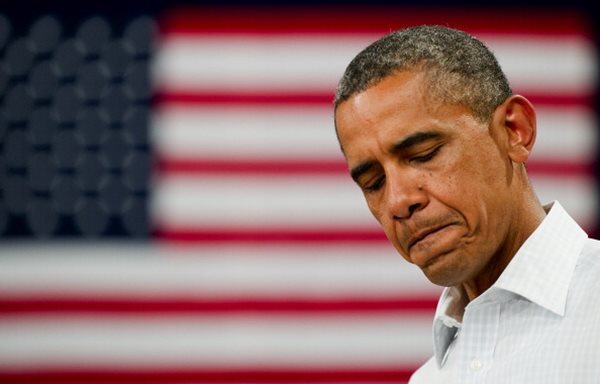
The nation's working middle class, commonly seen as the economic backbone of the nation, is now less than half of the U.S. population and continues to financially struggle under President Barack Obama, a new report warns.
The middle class “is declining and no longer constitutes a majority under President Barack Obama,” Breitbart News reported, citing a Pew Research Center study, which found that “after more than four decades of serving as the nation’s economic majority, the American middle class is now matched in number by those in the economic tiers above and below it.”
Middle class Americans now comprise less than half, or 49.9%, of the nation’s population, down from 61% in 1971, according to the Pew report. “The share living in the upper-income tier rose from 14% to 21% over the same period. Meanwhile, the share in the lower-income tier increased from 25% to 29%,” Breitbart reported.
For Pew, middle class Americans live in households earning between two-thirds to two times the nation’s median income. In 2014, that ranged from $41,900 to $125,600 for a three-person household.
Some 120.8 million adult Americans lived in middle-class households this year, according to Pew. That’s slightly less than the combined number of upper-income adults (51 million) and those at the lower tier (70.3 million).
While households across the spectrum have seen higher earnings over the past several decades, upper-income households have seen their pay rise the most, Bloomberg reported.
The median income of those families was $174,625 in 2014, up 47 percent since 1970, Pew data show. That compares with a 34 percent gain for the middle class and a 28 percent increase for the poorest households.
The "state of the American middle class is at the heart of the economic platforms of many presidential candidates ahead of the 2016 election," Pew researchers Rakesh Kochhar and Richard Fry wrote in their report. Meanwhile "a flurry of new research points to the potential of a larger middle class to provide the economic boost sought by many advanced economies."
And middle-income Americans have fallen further behind financially in the new century.
In 2014, the median income of these households was 4% less than in 2000. Moreover, because of the housing market crisis and the Great Recession of 2007-09, their median wealth (assets minus debts) fell by 28% from 2001 to 2013, Pew reported.
The middle class holds 43 percent of U.S. aggregate income, the smallest share in Pew’s data back to 1970.
Almost half of aggregate earnings in the U.S. is now commanded by the wealthiest families, who are "are on the verge of holding more in total income than all other households combined," Kochhar and Fry wrote. "This shift is partly because upper-income households constitute a rising share of the population and partly because their incomes are increasing more rapidly than those of other tiers."
© 2015 Newsmax Finance. All rights reserved.
Read more: Pew Study: Middle Class Declining, No Longer Majority
Important: Can you afford to Retire?