Published In:
Issue #165, January / February
2015
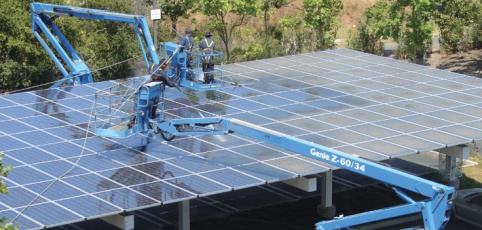
Dirt and dust buildup on the modules can reduce your PV array’s energy output, so implementing a regular cleaning protocol can be important.
The newly updated PV energy calculator PVWatts assumes that module soiling can cause a 2% reduction in array energy output—making losses over the array’s lifetime add up. In some locations that are particularly dusty and have little rainfall, losses in dusty or heavily industrial areas could easily be 25% to 30% of the array’s potential output. On the other hand, if you have no local industrial polluters, but have regular rainfall—and your PV modules are at a steep-enough angle to allow rain to wash down the glass—the effects of soiling on the system’s output could be minimal, and not worth worrying about.
Determining if it is worthwhile to spend time cleaning a PV array is a value judgment that calls for more information than just the local soiling and rainfall conditions. For example, those additional kWh may not be worth trying to capture if the array is on a roof that is difficult or dangerous to access, or if getting running water to the roof is troublesome. A ground-mounted array is likely to be easy to clean, and there’s little reason not to do it at least seasonally.
Commercial window-washing has brought telescopic soft-fiber brushes to the market that are appropriate for washing PV modules. Some can even be coupled to a hose, bringing water right to the bristles. (Shop for “boat-cleaning” brushes—about $35.)
Some PV array washing companies use purified water to avoid hard-water stains and spots, but usually it’s sufficient to scrub—or even just rinse—them with tap water. However, water alone might not remove grime. In that case, use a mild detergent that won’t damage aluminum—usually something suited for washing your car will be acceptable. Follow the suds with a water-only rinse.
For time or safety reasons, you may consider hiring out the array-washing task. In metropolitan areas, there are businesses that specialize in cleaning arrays. Check with local installers—they will likely know of cleaning companies or may even be able to offer you a maintenance contract that includes periodic cleaning.
Not everyone agrees that it makes economic sense to regularly wash a home-scale PV array. Differences in regional circumstances aside, a study published by the University of California at San Diego showed that California arrays that had not been rained on or washed during 145 days of summer drought conditions lost only 7.4% of their efficiency, which equated to about $20 worth of energy in a 5 kW array. It would likely be impossible to hire someone to do the job for that small amount of money.
Automated washing systems are becoming available for home-scale rooftop PV systems. While I cannot vouch for their effectiveness, one washing system can mimic a rainstorm by spraying from sprinkler heads permanently installed between the rows of modules. For a periodic deeper washing, they can also spray a detergent mixture and then follow with rinse water. Another system under development uses a solar-powered robot, similar to a household robotic vacuum cleaner, that activates during rainstorms to scrub the array.
Copyright © 1987-2015 Home Power Inc. All Rights Reserved