Documentary Reveals Shocking Extent of Government-Big Business Collusion to Eradicate Freedom of Choice
Story at-a-glance
- New film shows how the US government, in collusion with big business, is progressively whittling away your freedom of choice
- No longer do we have a representative form of government; most regulations benefit only a select few with the most money and power
- The demonization of raw milk has nothing to do with safety but everything to do with eliminating the competition for the pasteurized milk industry
By Dr. Mercola
"America would be far, far healthier if the government had never told us what to eat." - Joel Salatin in "Freedom From Choice"
Life is about choice. Every day we make choices that determine how we want to live—what we eat, what we read, whom we elect, and so on. But what if these choices are just an illusion?
In an era when regulations and red tape rule every industry, with lobby groups and big business wielding more influence than ever before, your daily choices have become increasingly limited. And when your options are so deliberately handpicked, are you really making any choices at all?
These are the questions explored in the documentary "Freedom From Choice," which offers a glimpse at the myriad of ways your life is being secretly influenced and controlled, and who is profiting.
Milk is a perfect example of how your choices are being limited today. Raw milk is banned in many states on the basis of claims that it's unhealthy and may make you sick.
Yet toxic herbicides and pesticides are dumped on our crops by the tankful, and this is touted as perfectly safe. If this reasoning seems nonsensical, then your reality testing is intact.
Government and industry are marked by massive corruption that has permeated essentially all of the major regulatory bodies, from food to drugs to finance. The fight for food freedom isn't just for those who love raw milk—it's for everyone who wants to be able to obtain the food of their choice from the source of their choice.
Maybe It's Time to Cry Over Spilled Milk
In sharp contrast to the US, France, Croatia, Switzerland, Austria, the Netherlands and Italy sell raw milk in vending machines. In some cases, US standards for raw milk are even higher than pasteurized milk.
For example, California has among the highest raw milk standards—farmers must meet or exceed pasteurized milk standards, without pasteurizing.
The vast majority of foodborne illnesses in the US are actually linked to factory farmed and highly processed foods, not raw foods. Disease-causing bacteria are the result of industrial farming practices that lead to diseased cows, which then produce contaminated milk.
While Congress has never outright banned raw milk, it's the only food banned from interstate commerce. This makes it challenging (although not impossible) for small farmers to share their raw milk products with people living across state lines.
As a result, private agreements called herdshares are often formed between farmers and individuals, which entitle you to the benefits of owning a "share" of a cow, such as a certain amount of milk each week.
Despite these legal agreements, federal agents now conduct aggressive armed raids against raw-milk farmers. Why go to all of this trouble? It's certainly NOT to protect your health!
Major milk manufacturers are a primary lobby within the FDA. Those choosing raw milk, which is a far superior food product, present a significant economic threat to the larger pasteurized milk industry.
The Telltale Squeak of the Revolving Door
The US food system revolves around money. To run for office, you need a vast amount of it. If you want to run for office but you aren't independently wealthy, the way our system works is that you have to go to the people willing to put up large sums of money to finance your campaign.
Of course, they'll want something in return. This arrangement confers an enormous advantage to big businesses. Therefore, what we have is not a "free market" but a massive collusion between government and big business, which are facilitated through lobbying.
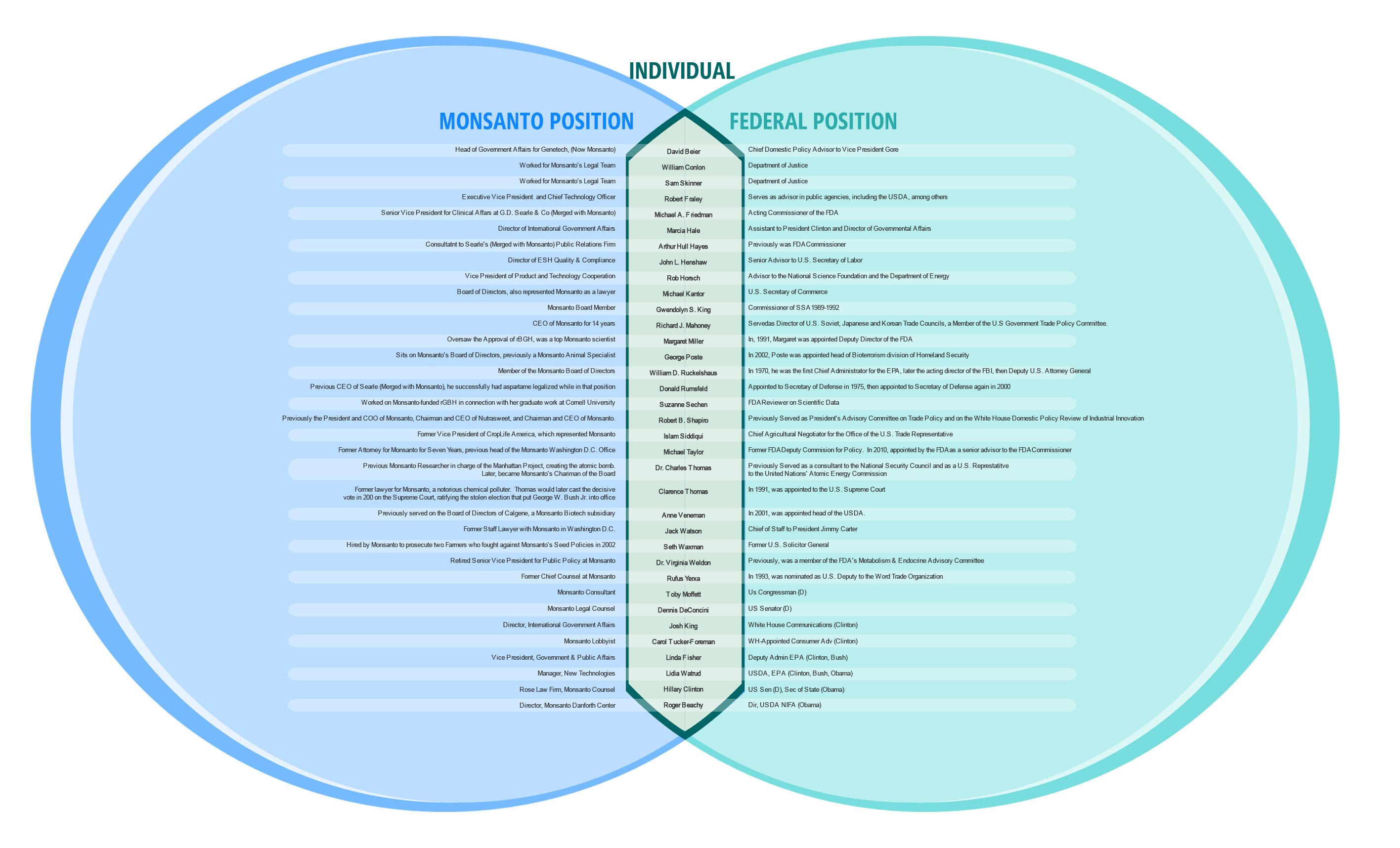
Regulators often take their power and influence and join private lobbying firms in return for big paychecks, going from regulating an industry to working FOR that industry, and then back again, like a perpetually revolving door.
Corporations love having powerful, influential people on their payroll, so they do everything they can to lure them over. In return, these regulators pass a few choice laws to benefit their future employers—and before you know it, your government has been bought.
There is little regulation that's not designed to favor one special interest or another. Laws are adopted behind a public interest veneer, but underneath they are products of negotiation between industry leaders and government officials to eliminate the competition and enhance their economic status.
The revolving door between government, industry, and academia has effectively led to a situation where it's now extremely difficult, if not impossible, to trust conventional health advice, even if it comes from supposedly reputable institutions. No longer do we have a representative form of government—it represents only a select few who possess the most money and power.
Unfortunately, this corruption is not limited to the food system. It's a much broader problem for which you can find all-too-abundant examples in the banking, media and pharmaceutical industries. As stated in "Freedom from Choice:"
"With so much collusion between the regulators and the industries they regulate, the laws governing our daily lives have become excessive, unnecessary and downright nonsensical. Keeping the public safe and free is no longer the goal of a number of our lawmakers."
Is FDA the Most Corrupt of All Government Agencies?
The US Food and Drug Administration (FDA) might be the ultimate avenue of corruption, as conflicts of interest are rampant among FDA advisors. Physicians and scientists with financial ties to the drug industry should not be permitted to participate in broad policy and public health recommendations, yet this routinely occurs. One recent study1 reviewed how financial interests affected the voting behavior of nearly 1,400 FDA advisory committee members who took part in drug approval decisions between 1997 and 2011.
Members with financial ties to the company sponsoring the drug under review voted in favor of approval 63 percent of the time. Members without financial ties had a 52 percent chance of favoring approval. Committee members who served on a sponsoring firm's advisory board had a whopping 84 percent chance of voting in favor of the drug's approval.
A significant percentage of drugs have been approved in spite of the FDA's own scientist's safety objections, and as a result, drugs known to cause heart attacks, kidney and liver failure, and numerous other major health problems remain on the market today. Others, such as Vioxx, have remained on the market for years, killing millions of people before being removed. It's important to realize that the FDA accepts the drug industry's word that their products are safe but does no independent drug testing of its own.
Corporate Crime and the Corruption of Science
Nearly 20 percent of corporate crime is being committed by companies that make products for your health. Crimes committed by some of the top pharmaceutical companies include fabricated studies and hiding damaging research. A recent study concluded that a majority of American drug commercials—60 percent of prescription drug ads, and 80 percent of ads for over-the-counter drugs—are either misleading or outright false.
Drug companies operate much like an organized crime ring, essentially a pharmaceutical cartel, as Peter Gøtzsche (head of Nordic Cochrane Centre) discusses in his book, Deadly Medicines and Organized Crime: How Big Pharma Has Corrupted Healthcare:
"Besides peddling drugs known to be more dangerous than advertised, drug companies are also in large part responsible for the decimation of the very core of medical science, since they fund a great deal of the research. The source of funding has been shown to have a tremendous impact on the results of any study."
Corruption of science is one of the most dangerous forms of corruption. Doctors rely on published studies to make treatment recommendations, and large numbers of patients can be harmed when false findings are published. At present, the average lag time between the publication of a study and the issuing of a retraction is 39 months—and that's if the misconduct is caught at all. What's worse, about 32 percent of retractions are never published, leaving the readers completely in the dark about the fallacies in those studies.
Some drug companies are so corrupt that they published results of clinical trials they never actually conducted—they completely made them up! For example, Sanofi Aventis defrauded the US Food and Drug Administration by fabricating patients in a 400-person study for their drug Ketek, right down to forging signatures on bogus consent forms.2
Even more disturbing is that the FDA approved the drug anyway! In spite of knowing the company faked their data and the drug could kill people from liver damage, FDA gave their official stamp of approval. Corporate interests are the only explanation for why these regulators would choose to look the other way and knowingly put you and your family's life at risk.
'Drug Studies' Carefully Designed for Marketing, Not Science
In 1992, Congress passed the Prescription Drug User Fee Act (PDUFA), and from that moment on, the FDA was set squarely on the path of doing more harm than good. The act authorizes FDA to collect "user fees" from drug companies in order to speed up its drug reviews. A standard drug application must now be completed within 12 months of submission, compared to as much as 30 months prior to PDUFA. Priority applications must be completed within six months.
Since the FDA began collecting user fees from the very industry it was intended to regulate, approved drugs have become increasingly dangerous—as evidenced by the sharp increase in serious adverse drug reactions. An in-depth analysis3 found that each 10-month reduction in review time resulted in an 18 percent increase in serious adverse reactions, an 11 percent increase in hospitalizations, and more than a seven percent increase in deaths.
Science is further perverted by the fact that drug companies typically don't publish studies that are unfavorable for their drugs. An analysis of 585 large, randomized clinical trials registered with ClinicalTrials.gov4 found that 29 percent have not been published in scientific journals.5 The studies that do get published tend to be the ones whose data they can successfully manipulate to their advantage, like Novartis did for its blood pressure drug Diovan. Occasionally they get caught, which is what happened to Novartis when the Japanese ministry of health analyzed its data.6
The fact is that many of the studies sponsored and funded by the drug industry are not really intended to produce genuine scientific knowledge. Documents emerging in litigation suggest that pharmaceutical companies are designing, analyzing, and publishing trials primarily as a way of positioning their drugs in the marketplace. This raises new ethical questions, such as how much risk is justified to human subjects in a study whose principal aim is to optimize the drug's marketing plan?
University Sells Unsuspecting Student to the Pharmaceutical Cartel
Many clinical studies place vulnerable people at risk—at a minimum, mild discomfort, and at worst, serious pain and death. Consider the nightmare of one young man, Dan Markingson, a mentally ill student who volunteered for a clinical trial (in the CAFÉ study) for AstraZeneca's psychiatric drug Seroquel.7 While participating in this trial, Dan stabbed himself to death in his bathtub with a box cutter.
The subsequent investigation uncovered internal documents that suggested AstraZeneca was designing clinical trials as a covert method for marketing Seroquel. The ensuing lawsuit initiated by Dan's mother revealed disturbing financial arrangements between AstraZeneca and University of Minnesota for helping to recruit subjects for the Seroquel study. Dan's participation in the study generated $15,648 for the university, as did each of the other university-generated recruits. Is there no bottom to how low Big Pharma will go to maximize their profits?
Chertoff Makes a Killing from Airport Security Scanners
The revolving door between big business and government—and the abhorrent behavior it brings—is not limited to our food and drug system. For example, consider the Transportation Security Administration (TSA). TSA has come to represent, for some, an "acceptable" invasion of privacy. Many have concluded that loss of privacy is the price they must pay for being kept safe. But what's the point of TSA—to keep you safe or to make you feel scared? The more they can strip away your rights, the more you will be under their control.
Remember the airport scanners? After the undie-bomber incident on Christmas 2009, Head of Homeland Security (2005-2009) Michael Chertoff made sure those backscatter scanners were installed in airports across the country. The scanners were built by a California company named Rapiscan. Guess who worked as a consultant for Rapiscan after leaving Homeland Security?8, 9 Yes, Chertoff.
And then there's the banking industry. In November 2007, President Bush nominated Neel Kashkari as Assistant Secretary of the Treasury for International Economics and Development. Kashkari (aka "Bailout Czar") authored and oversaw the Troubled Asset Relief Program (TARP), which choreographed the Wall Street bailout. Kashkan Kashkan was an investment banker at Goldman Sachs. Goldman Sachs received almost $13 billion in bailout funds in 200810—and they also paid out $4.8 billion in bonuses that year.
Liberty and Justice for All
With regulatory agencies so deeply entrenched with big business, it's almost impossible to know whether the rules we live by are for our safety or someone else's financial benefit. Whatever the reason, the end result is our lives are so heavily manipulated by the desires of others that our choices are becoming more and more limited. All the safety in the world means nothing without the freedom to live as you choose.
How to regain freedom is an important question today, especially as it pertains to your health, and the featured documentary exposes the root of the problem. Once the government has been given excessive authority over our lives, then there's no stopping it. To do so, power must be removed from public office.
With the preservation of health freedom in mind, I created the nonprofit coalition Health Liberty. Health Liberty is a joint mission among Mercola.com, National Vaccine Information Center (NVIC), Fluoride Action Network (FAN), Institute for Responsible Technology (IRT), Organic Consumers Association (OCA), and Consumers for Dental Choice, to help protect every American's freedom to make voluntary health choices. Each partner-organization has a rich history of advocacy and active campaigning for change and better access to truly empowering health information. By supporting these organizations, you can help protect health freedom not just for yourself, but for all Americans.
Copyright 1997- 2015 Dr. Joseph Mercola. All Rights Reserved.
http://articles.mercola.com/sites/articles/archive/2015/02/21/freedom-from-choice-documentary.aspx