Health Priorities Backwards in Government and Media

Story at-a-glance
- While no one has died from the measles in recent years, 3,000 die (and another 128,000 are hospitalized) from food each year
- Antibiotic-resistant bacteria infect 2 million Americans every year, causing at least 23,000 deaths
- Government priorities should be focused on cleaning up the US food supply, but instead research is focused on creating more profitable animals
By Dr. Mercola
Every 19 minutes, someone in the US dies from an unintentional prescription drug overdose.1 And each year, one in six Americans – that’s 48 million people, get sick from eating contaminated food.2
Turn on the news, however, and you’ll likely be inundated with reports of the latest measles victim – the result of the 2015 “multi-state outbreak” linked to Disneyland in California.
As of this writing, there have been 102 measles cases in the US this year. Last year, there were 644 – a “record number” that has government agencies and media calling for increased vaccination and inciting panic even among those who have been dutifully vaccinated.
Measles can be deadly… but in most cases it is not. There have been no deaths from measles in the current “outbreak,” nor have there been any in the US since 2005.3 Yet, levels of fear are high and rising – and are being fueled by the instigative media coverage.
Prior to measles, the media created another flurry of fear, this time prompted by Ebola. Ebola is a formidable disease – but one that is easily contained in developed countries like the US.
There were a total of four confirmed cases and one confirmed death in the US from Ebola in 20144 – with enough media coverage to fill your news feed virtually 24 hours a day! Let’s see… four Ebola cases. Just over 100 measles cases… and 48 million cases of food-borne illness. Do you sense something wrong with this picture?
Where’s All the Uproar Over the Unsafe Food Supply?
Every so often a particularly striking case of food contamination surfaces. Contaminated spinach in 2006; a massive beef recall in 2008; a salmonella-driven egg recall in 2010.
These do get a flurry of media coverage and, usually, some promises of increased oversight from the government. But the flurry dies down and most people forget. We continue on in the same pattern, purchasing food from the same industrial farms (CAFOs) using the same dangerous, disease-promoting practices.
People are dying. And they’re dying from what most would agree to be an unacceptable cause: eating a hamburger or a chicken breast. Others have succumbed to potato salad, lunchmeat and even cantaloupe. While no one has died from the measles in recent years, 3,000 die (and another 128,000 are hospitalized) from food each year.5
It’s easy to see where government priorities should lie – and much harder to comprehend why they are so far misplaced. We seem to accept that fact that dying from food happens, but make no mistake: this is preventable. As noted in The New Yorker:6
“Food-borne illness… is pervasive but mostly preventable when simple precautions are taken in the production process. In Denmark, for instance, after a surge of salmonella cases in the nineteen-eighties, poultry workers were made to wash their hands and change clothing on entering the plant and to perform extensive microbiological testing.
Sanctions—including recalls—are imposed as soon as a pathogen is found. As a result, salmonella contamination has fallen to less than two per cent. Similar results have been achieved in other European countries.”
In the US, meanwhile, the structure of the food-safety system is inherently flawed and in need of overhaul. Responsibilities are split among 15 federal agencies, and quite counter-intuitively. While the US Food and Drug Administration is responsible for the skin of a sausage link, for instance, the USDA’s Food Safety and Inspection Service (FSIS) is responsible for the meat.
US Regulations Allow Your Food to Be Contaminated
A certain level of contamination is allowed (and it’s more than you probably think). To so-called salmonella “performance standard” for ground chicken is 44.6 percent (and ground turkey is 49.9 percent). This means that nearly half of the ground chicken and ground turkey you buy can be contaminated with salmonella, and that’s fine and legal according to the US government.
If you think that’s bad, cut-up chicken parts have no performance standard at all, which means every piece of cut-up chicken you buy from a supermarket might be contaminated with salmonella (and it’s not just chicken – your lamb chops or pork ribs… also might be 100% contaminated).
Now, salmonella is usually a self-limiting illness, but it’s not always. In 2013, a nationwide salmonella outbreak occurred, courtesy of infected chicken originating from Foster Farms.
The antibiotic-resistant strain of salmonella, known as Heidelberg, sickened close to 300 people in 17 states. Of those infected, 40 percent required hospitalization—twice as many people as typically require hospitalization due to regular salmonella.7
This is frustrating on multiple levels. First, the reason why we’re seeing antibiotic-resistant superbugs showing up in our food is largely the fault of the food industry itself. They’ve created this monster.
Animals are often fed antibiotics at low doses for disease prevention and growth promotion (agricultural usage accounts for about 80 percent of all antibiotic use in the US), and those antibiotics are transferred to you via meat, and even through the animal manure that is used as crop fertilizer.
Twenty-two percent of antibiotic-resistant illness in humans is, in fact, linked to food – this is according to US Centers for Disease Control and Prevention (CDC) own data.8
Disease-Causing Food Allowed to Remain in the System
So the food industry is using practices known to promote antibiotic-resistant disease, and then they’re not taking steps to keep it out of the food you eat. Once it’s there, the system fails you even further.
The outbreak of this especially potent form of salmonella began in March. It wasn’t discovered by investigators until June, and scientists were able to tie the source of the outbreak to Foster Farms in California.
The pathogen had been detected during a routine test at Foster Farms, most of the victims said they’d recently eaten chicken and many of them specifically mentioned the Foster Farms brand.
Seems pretty cut-and-dried, right? Except that the FSIS has no authority to enact a recall. Even after sharing the findings with the CDC and Foster Farms, the company continued to produce chicken.
After all, some salmonella is allowed in chicken, and in order to request a recall, a genetic match must be confirmed between a patient’s body and the salmonella in the meat (that must still be in the victim’s possession with packaging and label intact).
Most people, when they eat chicken, throw away the packaging, so you can see how detecting this genetic match presents a challenge. And even when a genetic match is confirmed, only a voluntary recall may be requested. To make a long story short, it wasn’t until October that the CDC issued a warning to the public that Foster Farms chicken might be making people sick.And it wasn’t until a year later that a genetic match was confirmed and Foster Farms pulled chicken – for an insignificant six-day period.9 By this time 621 cases had been reported, but scientists estimated that for every reported case, 28 went unreported.
This means that up to 18,000 people may have been sickened by Foster Farms chicken.10 Where was the media to pick up on this story, to warn people against eating the meat – warnings that would have been, in this case, founded?As The New Yorker reported, even Mike Taylor, the “highest-ranking food-safety official at the FDA” said, “Everybody would agree that if you were starting on a blank piece of paper and designing the food-safety system for the future, from scratch, you wouldn’t design it the way it’s designed right now.”
So why aren’t changes happening? The media continues to deflect attention away from this gaping wound, while directing it toward mere scratches when the totality of public health is considered.
Look What Happened When a 'Zero-Tolerance' Policy Was Adopted
It’s worth noting that positive change can happen, and quite easily at that. The featured New Yorker story is important, as it pointed out what happened when FSIS announced a “zero-tolerance” policy toward E. coli in ground beef. It happened in the 1990s after, you might remember, E. coli-contaminated burgers from Jack in the Box sickened hundreds of people. The strain, O157:H7, was particularly deadly, known to kill one in 20 of those infected. In the Jack in the Box outbreak, four children died. The media attention to this story was fierce – and so was the public’s outcry.
It was this – the public’s reaction – that lead FSIS to announce there would be no acceptable level of E. coli contamination allowed in ground beef. If the bacteria was detected, the product would be pulled from the market. You might be wondering how this could occur, given the government’s lack of authority to enforce recalls. FSIS, quite simply, classified E. coli as an “adulterant,” a label typically reserved for industrial chemicals. The move worked. One prominent attorney noted that will almost all of his food-poisoning cases 15 years ago were linked to E. coli in hamburger, he now only gets two or three (now the culprit has shifted to Salmonella).
According to The New Yorker:11
“Although a consortium of meat producers and retailers sued the U.S.D.A. …[over labeling E. coli an adulterant], a federal court affirmed the change. Five years later, officials expanded the rule to banish the same strain of E. coli in other beef products. In 2011, they declared six additional strains of E. coli to be adulterants. The lesson… is that “having accountability for prevention in the government regulatory system works.” Yet, twenty years after [Mike] Taylor’s landmark E. coli decision, officials at the F.S.I.S. have failed to declare any other food-borne pathogen to be an adulterant in raw meat.”
Taxpayer-Financed Animal Research Center Works to Bolster Industrial Agriculture
Many Americans have never heard of the U.S. Meat Animal Research Center. It’s a taxpayer-financed research center whose purpose is to “re-engineer the farm animal to fit the needs of the 21st-century meat industry,” as the New York Times put it.12 You might think that a government research center such as this would be hard at work to develop safer, more humane ways to raise livestock, and produce cleaner food for Americans. This would be wishful thinking, unfortunately.
What is really happening at this remote research center? Cows are being “retooled” to give birth to triplets (cows normally bear one calf at a time). Many of these calves are born deformed and many die. Scientists have also developed “easy care” sheep. These ewes give birth without the help of farmers (and I hesitate to call them that) – but many of the newborns succumb to predators, starvation and harsh weather (those that die are tossed into an excavation called “the dead pit”).
“You don’t have to be a vegan to be repulsed by an account in The Times revealing the moral depths to which the federal government — working as a handmaiden to industrial agriculture — has sunk in pursuit of cheaper meat and fatter corporate profits,” wrote the New York Times13 in an editorial piece – and repulsed is a good description. While the federal Animal Welfare Act does provide some protections for animals used in experimentation, most farm animals are exempt. What’s happening at this research center in the name of corporate profits (and at taxpayers’ expense) is “the kind of high-risk, potentially controversial research that other institutions will not do or are no longer allowed to do.”14
There is a brief glimmer of hope to this story: the US Department of Agriculture has called for the center to create and deliver an updated Animal Welfare Strategy plan in the next 60 days.15 Hopefully the animals will no longer be made to suffer in these unspeakable ways. This coming victory was, again, prompted by media reports of the controversial animal-welfare conditions, which brought the issue to the public’s eye. So you can see the trend. The media is a powerful tool, but only as far as the public will carry it – and it can backfire too. When media attention is focused on the issues that deserve priority, we can make a real difference.
Hospital-Acquired Infections and Antibiotic-Resistant Disease Are Taking Too Many Lives: Where’s the Outrage?
There are many issues that deserve attention … nearly 100,000 people die every year as a result of hospital-acquired infections (HAIs), and 1.7 million are infected.16 When the health-care system itself is at the root cause of a disease taking this kind of death toll – attention, even outrage, is warranted. Meanwhile, antibiotic-resistant bacteria infect 2 million Americans every year, causing at least 23,000 deaths. Even more die from complications related to the infections, and the numbers are steadily growing. Nearly 25 million pounds of antibiotics are administered to livestock in the US every year for purposes other than treating disease, such as making the animals grow bigger faster.
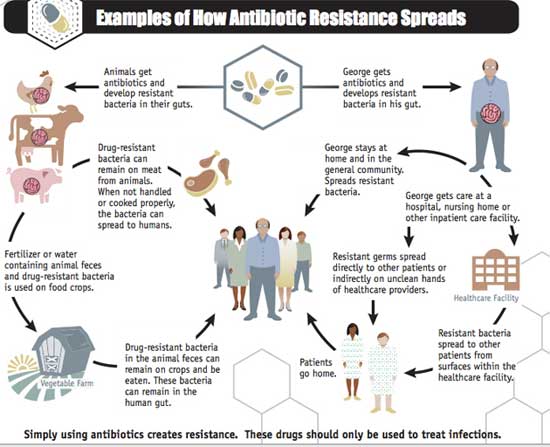
The drug-resistant bacteria that contaminate your meat may pass on their resistant genes to other bacteria in your body, making you more likely to become sick. Drug-resistant bacteria also accumulate in manure that is spread on fields and enters waterways, allowing the drug-resistant bacteria to spread far and wide and ultimately back up the food chain to us. You can see how easily antibiotic resistance spreads, via the food you eat and community contact, in the CDC's infographic below.
Source: CDC.gov, Antibiotic Resistance Threats in the United States, 2013
The frenzy that America seems to be in over measles and Ebola is what is needed for HAIs, antibiotic-resistant disease, prescription drug overdoses and food-borne illness. Many are willing to speak out on topics of vaccination, even going so far as to attack those who have made a conscious, educated decision to forgo it. Yet, we do not hear nearly the same response for the issues that are claiming thousands and even 100,000 lives a year. For these matters, often the silence is deafening.
So what can you do? Dare to speak out. You can, for starters, sign the Organic Consumer's Association's petition calling for a mandatory ban on sub-therapeutic doses of antibiotics for livestock. Then, speak to the managers at your local supermarket. Ask them to bring in food from small farmers – organic grass-fed meats and pastured dairy, for instance. Do not support those companies that engage in industrial agriculture that is damaging to human health, the environment and animal welfare. Instead, choose carefully and wisely which companies you wish to support, and spend your food dollars at family farms, farmer’s markets and, even, by investing in your own small garden at home.
Finally, if you feel that an issue is being overhyped by media, do not succumb to the fear-mongering. Speak out to your friends and family about the real issues facing Americans – antibiotic-resistant disease, food-borne illness and more. It only takes one ripple to create a wave of change. Be the ripple.
Copyright 1997- 2015 Dr. Joseph Mercola. All Rights Reserved.