With just one more day until the 114th Congress is officially sworn in, the Pew Research Center has published an in-depth look at the overarching religious affiliations of the men and women who will be representing American citizens in the nation’s capitol this year.
While Republicans will be taking the helm of both houses for the first time since the 109th Congress, there will actually be very little change in the overall religious make-up of the House and Senate.
In fact, an overwhelming proportion of both houses — 92 percent, to be exact — will be Christian, with 57 percent being counted as Protestant and 31 percent as Catholic; these are similar proportions to what has been observed in the past.
If you’re looking for the actual numbers, that’s 491 Christians overall, with 306 Protestants and 164 Catholics, more specifically. The below chart digs even deeper:
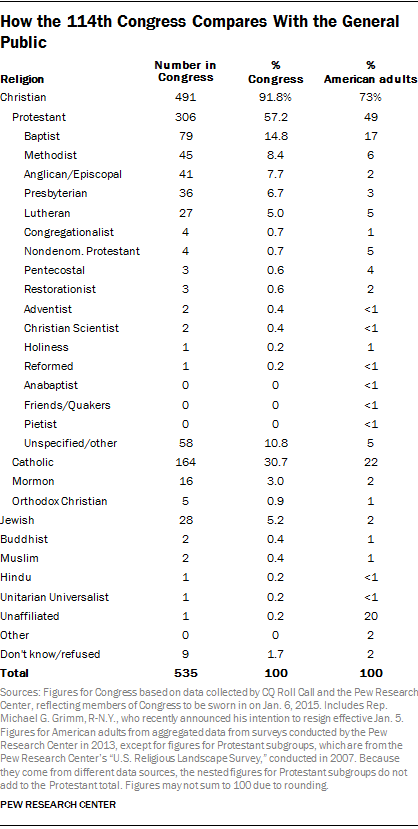
As stated, nine-in-10 congressmen and women are Christians, but only 73 percent of U.S. adults report the same affiliation. Similarly, while 5 percent of House and Senate members slated to be sworn in Tuesday are Jewish, just 2 percent of the adult population reports the same.
Religiously unaffiliated Americans, though, are actually underrepresented in Congress, as 20 percent of citizens claim they are unattached to a specific faith compared to just .2 percent of 114th congressional members.
It is important to note, though, that unaffiliated does
not necessarily mean atheist or agnostic; it simply
indicates that a person is not officially a member of a
specific denomination or category of faith, though the label
does not speak to their belief in a higher power.
Some of the less populous religious groups are closer in representation, as Buddhists, Hindus and Muslims, combined, make up around 2 percent of the population and about 1 percent of Congress.

Read more about the results here.
(H/T: Pew Research Center)