The power of prediction: A model for utilities operating wind
Bird deaths have long been a frustration among utilities that operate wind, but if you could predict where the birds are headed -- would you? A new study gives utilities the tools to figure it out.
 |
|
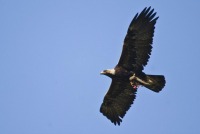
Golden eagle. Credit: FlickreviewR/Wikimedia Commons |
The report -- "A collision risk model to predict avian fatalities at wind facilities: an example using golden eagles, Aquila chrysaetos," conducted by researchers at Washington State University, the U.S. Geological Survey, and U.S. Fish and Wildlife Service -- looked at golden eagle behavior and found formulas for reducing their susceptibility to collisions with wind turbines.
"Bird fatalities due to collisions with rotating turbine blades are a leading concern for wildlife and wind facility managers," USGS said in a statement. "This new model builds upon previous approaches by directly acknowledging uncertainty inherent in predicting these fatalities. Furthermore, the computer code provided makes it possible for other researchers and managers to readily apply the model to their own data."
The research is to be used when planning for a new wind facility. Leslie New, one of the Washington State researchers on the study, told FierceEnergy, "Data on avian use of an area is collected prior to construction, and when combined with the proposed hazardous footprint (time and space of operation) of the project and a probability of collision for the species of interest, a prediction of total number of fatalities can be obtained."
The research looked at three different parameters: hazardous footprint, bird exposure to turbines and collision probability.
"This simplicity is part of what makes the model accessible to others," New explained. "It also allows wind facility developers to consider ways to reduce bird fatalities without having to collect a complicated set of data."
Although bird fatalities are a point of concern at every wind facility, there are varying rates of deaths -- due to many factors, including geographic location, local topographic features, the bird species and its life history, as well as other factors.
The research looked at publicly-available information, and combined it with biological knowledge, to created a prediction tactic for birds.
"Uncertainty in this model can be reduced once data on the actual number of fatalities are available at an operational wind facility," said New, adding that for their study, they used numbers from existing facilities. She explained that the initial probability of collision used to predict fatalities in advance of construction is different than how they created their formula, because the initial probability is based on data from many locations in order to best represent the average probability of collision for the species of interest. Their formula takes into account each individual facility.
"Once the facility is operational, or for an existing facility, data on the estimated true number of fatalities to occur at a wind facility can be used to learn about the site-specific probability of collision," New explained.
Because of this, utilities will now be able to use the data to decide whether time and location are right for them.
"Our study enables facilities to predict fatalities in advance of construction. Given comprehensive data collection, this will enable them to identify areas or times of year that are more hazardous regarding the species of interest," New explained. "Decisions can then be made about the placement of turbines on the landscape, or the time periods of operation, that will enable a utility to lessen the risk of an avian fatality."
New added that the USFWS and other government agencies have been working closely with utilities to try and lessen their potential impact birds. She told FierceEnergy, "Our model is meant to help facilitate that process, providing a relatively straight-forward, agreed upon, scientifically supported and peer-reviewed approach to predicting avian fatalities."
She added, "One of our goals when developing this approach was to make it as flexible and accessible to the utilities as possible. This apparent in different aspects of our work, such as the inclusion of code with the published manuscript to help others apply what we have done.It also plays a role in our suggested data collection and assumptions. For example, by counting all bird minutes below a specified height (e.g., 200 m) as at risk, we provide potential cost savings and greater flexibility to the utilities. This is because a change in turbine specification would not require new data to be collected, which would be the case if bird minutes were only recorded with the initially proposed rotor swept area as in many other approaches."
The American Wind Energy Association (AWEA) has partnered for extensive research into bird death prevention. AWEA's John Anderson told FierceEnergy, "No form of energy generation is free from impact and wind power is no exception. Yet, studies have shown that wind energy has the lowest life-cycle environmental impacts of any source of utility-scale electricity generation, and we proudly operate under a longstanding legacy of care for all wildlife, including eagles, and are held to a higher standard than nearly any other industry."
The scientists in the study looked specifically at Bald and Golden Eagles, because they are protected under the Golden Eagle Protection Act and the Migratory Bird Treaty Act.
USFWS requires a fatality prediction study done before approving permits for a new wind facility. The study creates a model utilities can use, as well as any impact and mitigation measures that can be taken.
"No one takes wildlife impacts more seriously than the wind industry, and while unfortunately some eagles occasionally collide with turbines at some wind farms, this is not a common occurrence, with golden eagles losses at modern wind facilities representing less than 3 percent of all reported sources of human-caused fatalities, while only a few bald eagles have been lost in collisions in the history of the industry," Anderson added. "Our modern economy requires significant amounts of energy, and deciding how to produce that energy requires a careful analysis that weighs the impacts of one generation source against its benefits and then making choices based on which sources provide the greatest benefits at the lowest cost. When all the variables are considered, wind energy is the right choice for powering our society and protecting our wildlife and their habitats."
For more:
- read the
full report
© 2015 FierceMarkets, a division of Questex, LLC. All rights reserved.
http://www.fierceenergy.com/story/power-prediction-model-utilities-operating-wind/2015-07-14