Water water everywhere, but is it too soon for wave energy?
Although wave energy development in the European Union (EU) is going full-steam ahead, the technology still has a ways to go in the United States. However, a new development is giving researchers in the U.S. a chance to look at the long-term effects of wave energy.
 |
|
Credit: Department of Energy |
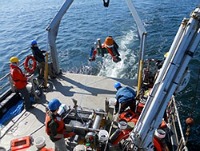
The test device, called Azura, was launched in a 30-meter test berth at the United States Navy's Wave Energy Test Site (WETS) in Kaneohe Bay, on the island of Oahu, Hawaii. It was supported by the Department of Energy (DOE) and the U.S. Navy.
Azura is a grid-connected wave energy converter (WEC), and is being independently tested by the University of Hawaii in open ocean.
"The project supports the Energy Department's mission to research, test, and develop innovative technologies capable of generating renewable, environmentally responsible, and cost-effective electricity from clean energy resources, including water," DOE said in a statement. "Marine and hydrokinetic (MHK) technologies, which generate power from waves, tides, or currents, are at an early but promising stage of development."
The researchers first tested a smaller prototype of Azura in a wave tank, before launching the full prototype, which was done in open sea off the cost of Oregon in 2014. Azura's developer, Northwest Energy Innovations (NWEI) of Portland, Oregon, tested the functionality of the device, while also testing other aspects and collecting data during the experiment.
According to DOE, more than 50 percent of the population of the United States lives within 50 miles of a coastline, and many coastlines in the country have strong wave and tidal resources.
"The technically recoverable resource for electric generation from waves is approximately 1,170 terawatt-hours per year (TWh/year), which is almost one third of the 4,000 TWh of electricity uses in the United States each year," Katie Arberg, spokesperson for the U.S. Department of Energy's Office of Energy Efficiency and Renewable Energy, told FierceEnergy. "Developing just a small fraction of the available wave energy resource could allow for millions of American homes to be powered with this clean, reliable form of energy. For context, approximately 85,000 homes can be powered by 1 TWh/year."
Because of this, transmission from wave energy could become economically viable. But there have been numerous investments in wave energy across the world, and very few in the United States. Arberg explained that the US has been an active member of International Energy Agency's Ocean Energy Systems (OES) Technology Initiative since 2005 -- an intergovernmental collaboration of 22 countries to advance MHK.
"The current state of the wave energy industry is much like the early stages of the wind energy industry in the 1980s," she explained. "Many concepts for MHK devices have been proposed with a wide variety of methods for energy capture and conversion, but there has been little technology convergence to date."
Arberg told FierceEnergy that short-term growth will be seen in the form of technology advancement -- in both prototypes and early-production models. However, wave energy devices are not yet cost-competitive with other forms of energy.
"Thus, DOE sees an important opportunity in reducing the cost of wave energy so it can contribute to the nation's clean energy supply," she explained. "Over the past six years, DOE has awarded over $110 million in funding in technology research and development (R&D) projects related to marine and hydrokinetic (MHK) energy systems, infrastructure, and instrumentation, many of which have directly benefited wave energy development. In 2014 alone, DOE supported $29.5 million in competitive awards to industry and university R&D efforts."
NWEI has also launched a 20-kilowatt (kW) demonstration project connected to the grid at WETS.
"The current phase of in-water testing at the WETS's 30-meter test berth has already proven valuable in gathering performance and reliability data from the device in deepwater, open-ocean conditions," DOE said. "The data will be used to further optimize Azura's performance and refine existing wave energy computer simulations, ultimately supporting commercialization of this technology."
NWEI received $5 million from DOE for the project, and is helping with the current deployment. The researchers are looking to learn from the first test, and improve the efficiency and reliability of the technology. They plan to launch a full-scale device, from 500 kW and 1 megawatt (MW) at WETS in water between 60 meters and 80 meteres deep.
The projects are supported by the Energy Department's Office of Energy Efficiency and Renewable Energy (EERE), whose goal is to develop renewable energy technologies, while also creating energy security, environmental quality, and economic vitality.
In April 2015 DOE also launched the Wave Energy Prize competition, the first opportunity for wave energy conversion devices to test their innovative designs at the nation's most advanced wave-making facility in the Naval Surface Warfare Center Carderock's Maneuvering and Seakeeping (MASK) Basin in Maryland.
"With further progress towards commercialization, MHK technologies could make substantial contributions to our nation's electricity needs," DOE said. "To accelerate commercialization of wave energy devices, the Energy Department funds research and development -- from laboratory and field-testing of individual components, up to demonstration and deployment of complete utility-scale systems."
For more:
- visit this
website
- watch this
video
© 2015 FierceMarkets, a division of Questex, LLC. All rights reserved.
http://www.fierceenergy.com/story/water-water-everywhere-it-too-soon-wave-energy/2015-07-08